
A commentary by our author Klaus Bastian:
In the Lower Saxon municipality of Bothel, the local council voted unanimously in October 2026 to coordinate future revenue from wind power in collaboration with neighboring municipalities. Furthermore, the municipality intends to explore the possibility of taking an equity stake in wind energy projects. The motivation behind this is the prospect of additional income for strained municipal budgets. Other municipalities also anticipate receiving hundreds of thousands of euros from wind farms located on their own land. In some cases, this even includes forest areas—even though the construction of the turbines necessitates clearing trees and building new access roads. Consequently, the potential revenue must be weighed against the resulting impact on nature and the landscape.
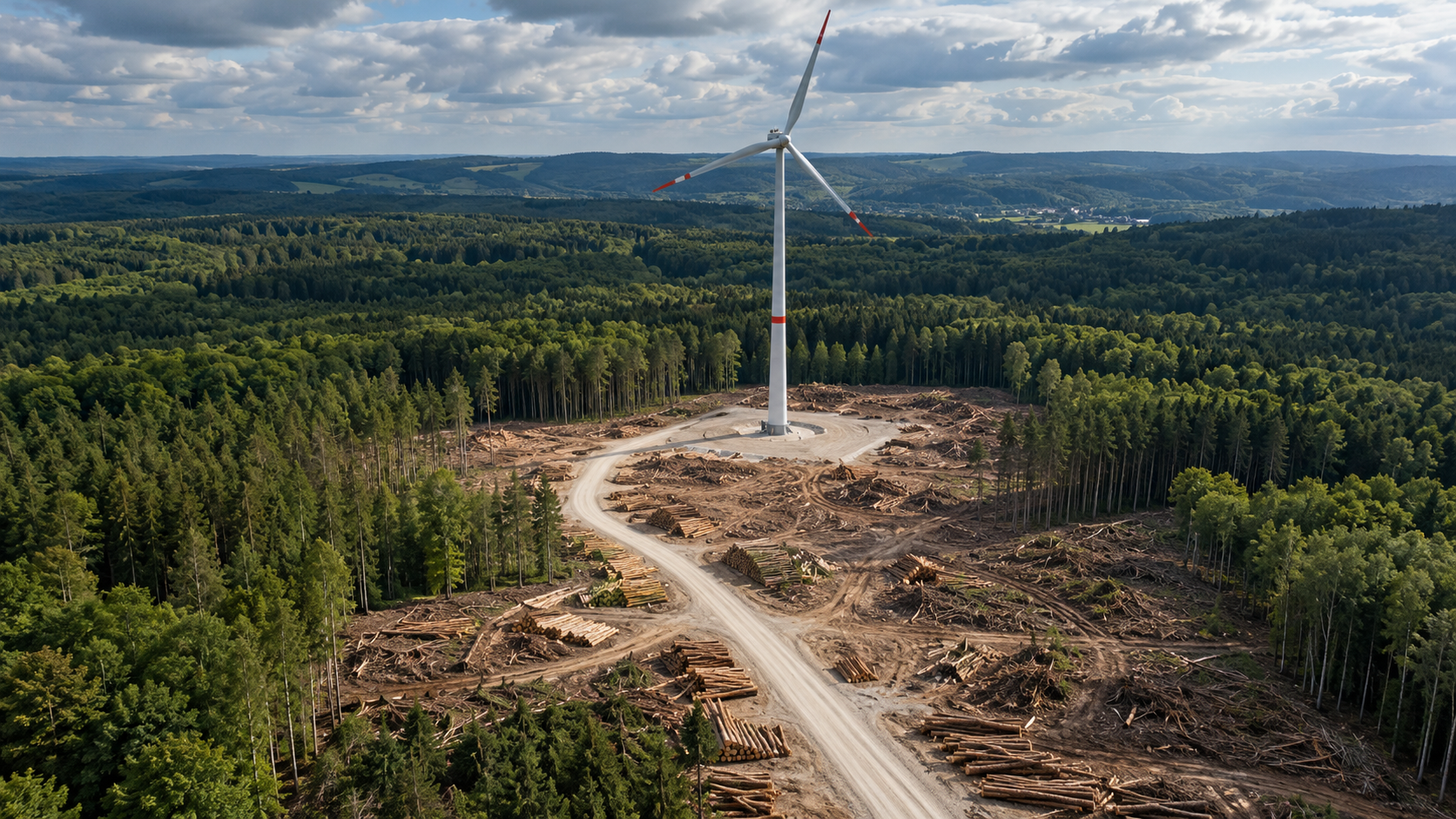
Image: AI-generated
When the municipal treasury becomes more important than the landscape
A decision made in Bothel illustrates the weight now placed on financial expectations. The municipal council discussed the distribution of future revenue and potential investments. Deputy Mayor Sascha Murso stated, “If we all want to survive, we should join forces.” While the council did not make any specific decisions regarding the clearing of forests, the financial outlook has clearly become the primary focus of the municipality’s deliberations.
This development warrants critical examination. Municipalities can generate substantial, long-term revenue from wind turbines—most lucratively by leasing out land they own. As the operator constructs the turbines, the landowner receives regular payments, creating a financial incentive to make more land available. In this way, a piece of municipal forest can be transformed into a source of income, potentially yielding six-figure sums every year.
Wind Power Turns Municipal Forests into a Lucrative Business
The town of Bruchsal in Baden-Württemberg illustrates just how strongly financial interests can influence decisions regarding municipal forest land. The town anticipated annual revenues of around one million euros from a planned wind farm, which would have seen four wind turbines erected on municipal forest land. Although a citizens’ initiative succeeded in triggering a local referendum on the matter, a majority of the municipal council continued to support the project. The CDU faction explicitly stated: “We cannot afford to forgo approximately 1 million euros per year.” In doing so, financial gain became an openly cited argument for utilizing the municipal forest. However, the original project developer withdrew shortly before the referendum, leaving the projected revenue uncertain once again.
Birkenfeld, located in the Enz district, is also counting on significant sums. Six wind turbines there could generate between 300,000 and 600,000 euros in annual lease payments—with the designated municipal sites also located within a forest. Furthermore, the municipality has explicitly noted that these funds could be used to cover ongoing expenditures. The economic benefit is thus clearly quantified, whereas the value of existing habitats cannot be recorded as a comparable form of revenue in the municipal budget.
Existing Forests Cleared for New Wind Farms
The wind farm in Holzheim—situated in the Weisinger Forst in Bavaria—demonstrates the kind of interventions such projects can entail. Preparatory work for four wind turbines began there in October 2026. This process involves the initial removal of trees and shrubs, followed by the construction of access roads, ground stabilization, and the preparation of foundations. At the same time, the project includes a 25 percent stake for municipal stakeholders. Thus, economic benefits and interventions in the forest coexist within the same project.
However, the consequences are not limited to the immediate sites of the installations. The transport of heavy components, assembly work, and the creation of permanent access infrastructure also require land. While areas used temporarily can be partially restored later, the original forest structure cannot be replaced in the short term. This highlights the inherent contradiction: on one hand, the energy transition is intended to serve environmental and climate protection; on the other, its implementation involves the industrial development of existing natural areas.
Municipalities are even taking out loans in anticipation of future wind farm profits
In Üchtelhausen, near Schweinfurt, this economic involvement goes even further. The municipality has entered into an equal partnership in a wind farm company, taking out a loan of 3.5 million euros to do so. The necessary supplementary budget received regulatory approval in October. Mayor Johannes Grebner expects this to generate solid, long-term revenue for the municipality—a welcome prospect, given the town’s currently below-average income. This illustrates the significant financial scale that such investments can reach.
In the district of Gießen, the potential level of lease income has also sparked political debate. Local mayors fear substantial losses resulting from a proposed cap on wind farm lease payments—a measure that could render some projects economically unviable. This underscores a crucial point: the economic value of new installations is not determined solely by electricity generation; the payments made to landowners and municipalities also play a central role.
When Municipalities Profit from Encroachment on Nature
Ground-mounted solar parks present a similar financial incentive. Municipalities can receive land lease payments, profit-sharing contributions, and, in some cases, trade tax revenue. However, the ecological impact varies significantly depending on the specific site; a facility built on a former landfill must be evaluated differently than one developed on previously undeveloped natural land. Nevertheless, a fundamental conflict of interest remains: a municipality may stand to gain economically while simultaneously being tasked with representing the public interest regarding land use.
This creates a particularly problematic dual role for municipalities. They are responsible for managing natural areas in the public interest, yet they can also generate substantial revenue from the commercial exploitation of those same lands. Consequently, every new wind farm project also becomes a matter of potential budgetary gain. While it cannot be proven that financial motives are the deciding factor in every instance, the documented lease payments make the incentive undeniable. Climate protection does not automatically justify every intrusion into the natural environment. When municipalities profit from such interventions, their financial interests must be scrutinized just as critically as the ecological consequences. Otherwise, there is a risk that nature conservation will lose its significance precisely where restricting it offers the greatest potential for financial gain.
Author: Klaus Bastian – Blackout News
Sources: Wetterauer Zeitung (24.10.26) – Kreiszeitung (19.10.26) – Gemeinde Üchtelhausen (16.10.26) – Presseportal (15.10.26) – Gemeinde Birkenfeld (Stand: 29.10.26) – SWR (14.12.25)