
In the realm of European automotive policy, a proposal emerging in late October 2026 to mandate smaller fuel tanks in new cars has sparked debate. While manufacturers are investing significant technical effort into extending the range of their electric vehicles, the range advantage currently enjoyed by internal combustion engine vehicles could soon be deliberately curtailed. The environmental organization Transport & Environment is therefore calling for a 15-liter limit on the fuel tank capacity of plug-in hybrids. The goal is to encourage drivers to charge their vehicles more frequently rather than covering long distances using liquid fuel. However, such a proposal would eliminate a key benefit of this powertrain technology: the ability to travel long distances without relying on charging infrastructure. Consequently, those who frequently drive long distances would face more frequent stops for both refueling and recharging. No such EU regulation has been adopted to date.
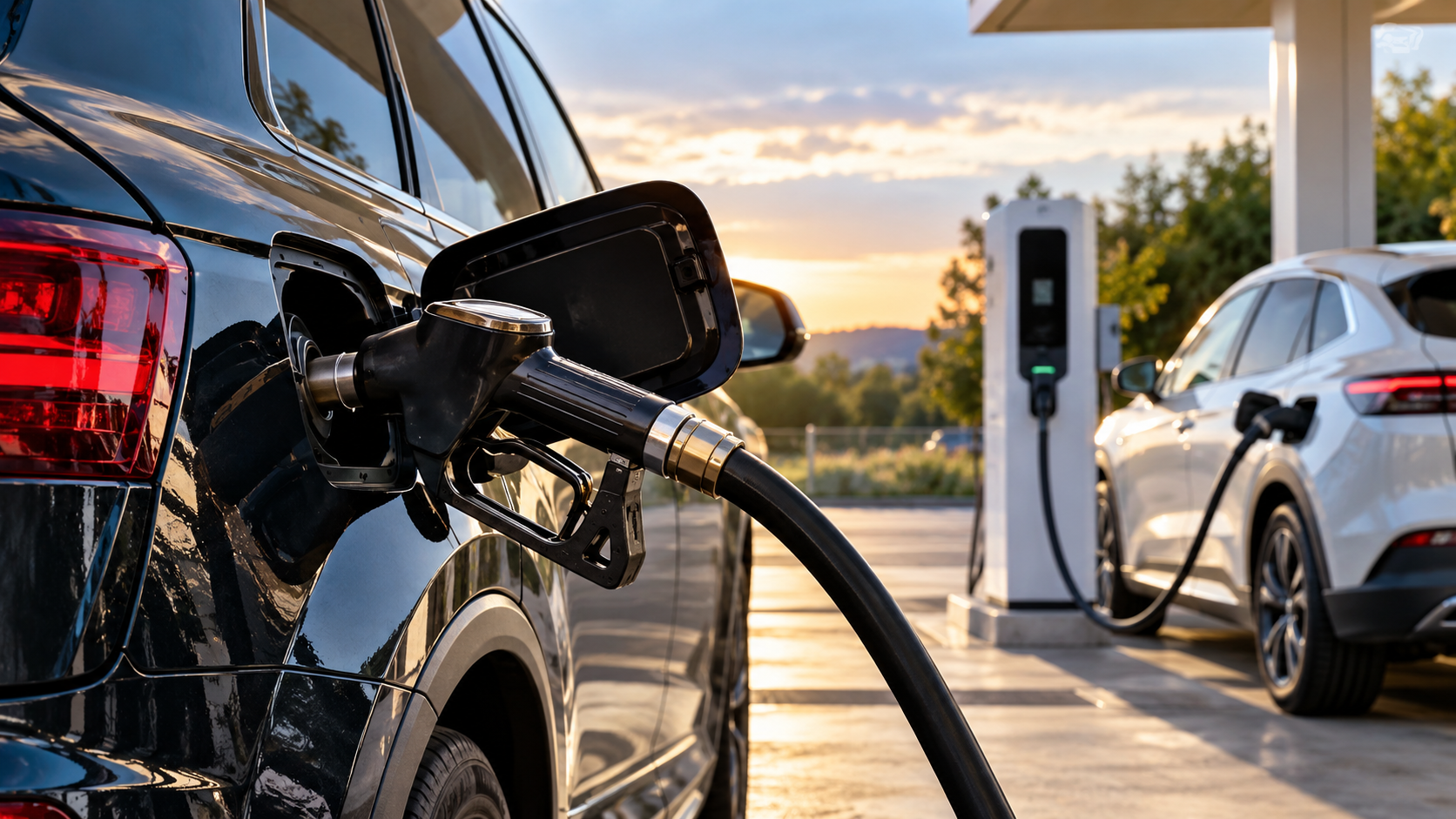
Image: AI-generated
Smaller fuel tanks intended to eliminate the range advantage over electric vehicles
This proposal highlights a fundamental contradiction in European transport policy. While the range of electric vehicles is expected to increase through technological progress, the range of plug-in hybrids could be restricted by regulation. Rather than focusing solely on improving the performance of electric powertrains, the policy aims to strip competing powertrain concepts of some of their existing advantages. In doing so, policymakers would not merely set emission targets; they would directly intervene in the practical utility of the vehicles.
The organization Transport & Environment is calling for a maximum fuel tank capacity of 15 liters for plug-in hybrids. At the same time, it proposes that, from 2030 onwards, these vehicles should be capable of traveling at least 200 kilometers in all-electric mode. This would be complemented by fast-charging capabilities exceeding 100 kilowatts and significantly more powerful electric motors. The organization’s objective is clear: to compel drivers to charge their vehicles regularly by drastically reducing the range available from fuel alone. This would deliberately curtail the independence from the charging infrastructure that these vehicles have previously offered.
From 760 kilometers down to just 224 kilometers
A simple calculation illustrates just how drastic the impact could be. With a fuel consumption rate of 6.7 liters per 100 kilometers, a 51-liter tank provides a range of approximately 760 kilometers. With only 15 liters, however, that range would drop to about 224 kilometers—a reduction of more than 70 percent in the distance that can be covered on a single tank. While electric-only range would also be a factor, it depends on variables such as battery capacity, temperature, and driving conditions.
For drivers, this limitation would have immediate consequences. Those who primarily drive on highways or regularly cover long distances would need to refuel much more frequently. This would be particularly problematic for drivers who lack reliable access to charging stations. After all, smaller fuel tanks neither improve engine efficiency nor automatically lower fuel consumption per kilometer; they simply force more frequent stops. Consequently, what might be framed as a technical advantage effectively becomes a vehicle characteristic that is politically undesirable.
Addressing consumption issues through technical constraints
Transport & Environment justifies this proposal by pointing to the actual emissions of plug-in hybrids. According to their analysis, these vehicles produce, on average, nearly six times more CO₂ in real-world driving conditions than their official figures suggest. Many owners rely on the internal combustion engine more frequently than the standard consumption calculations assume. For this reason, the organization is calling not only for more realistic test figures but also for changes to vehicle design—specifically, smaller fuel tanks intended to influence how owners use their vehicles.
However, the root cause also lies in how these vehicles have been evaluated to date. When official testing procedures overestimate the proportion of driving done in electric mode, the resulting fuel consumption figures become unrealistic. For this reason, the EU is already adjusting the so-called “utility factor,” which determines the calculated proportion of electric-powered travel. Such an adjustment makes consumption figures more transparent without artificially limiting the vehicle’s range. Imposing an additional limit on fuel tank capacity would go much further; it would effectively dictate to drivers how often they must concern themselves with replenishing their vehicle’s energy supply.
Diesel vehicles could also be affected by an expansion of such measures
To date, automobile manufacturers have competed on the basis of range, fuel consumption, comfort, and purchase price. For instance, the Audi A8 50 TDI is equipped with an 82-liter diesel tank; the plug-in hybrid Audi A8 60 TFSI e features a 65-liter tank, while the Chinese-made Yangwang U8 has a 75-liter capacity. Large fuel reserves allow for longer journeys without the need for a stop. If policymakers were to restrict such features, the competition to offer the greatest possible everyday utility would lose some of its significance.
However, the specific proposal to limit tank capacity to 15 liters currently applies exclusively to plug-in hybrids. There is no EU-wide regulation in place to limit tank sizes for all gasoline and diesel vehicles. Nevertheless, this approach warrants fundamental criticism: rather than evaluating vehicles based on their actual fuel consumption and emissions, the intention is to deliberately constrain their utility. This does nothing to foster better batteries or more robust charging infrastructure for electric vehicles. For affected drivers, the result could simply be a vehicle that requires much more frequent visits to the gas station, despite having the same fuel consumption. In effect, technological competition would be partially replaced by regulatory constraints.
Author: Blackout News
Sources: Autopista (27.10.26) – PHEVs (25.10.26) – AutoPlus (19.10.26) – Telemetry (20.10.26)