
A commentary by our author Klaus Bastian:
In Namibia, the German start-up Carbonsate buries shredded wood to sequester carbon over the long term, selling CO2 certificates in the process. At the same time, Germany promotes the burning of wood as a contribution to climate protection. A single new thermal power plant in Chemnitz, for instance, is set to burn 100,000 tonnes of wood annually starting in late 2027—amounting to two million tonnes over 20 years. While the start-up earns money by preventing the release of CO2, German power plants release the carbon stored in wood by burning it. Both business models are considered climate-friendly, even though they pursue opposing objectives. This contradiction highlights just how questionable the climate-policy assessment and subsidization of biomass have become.
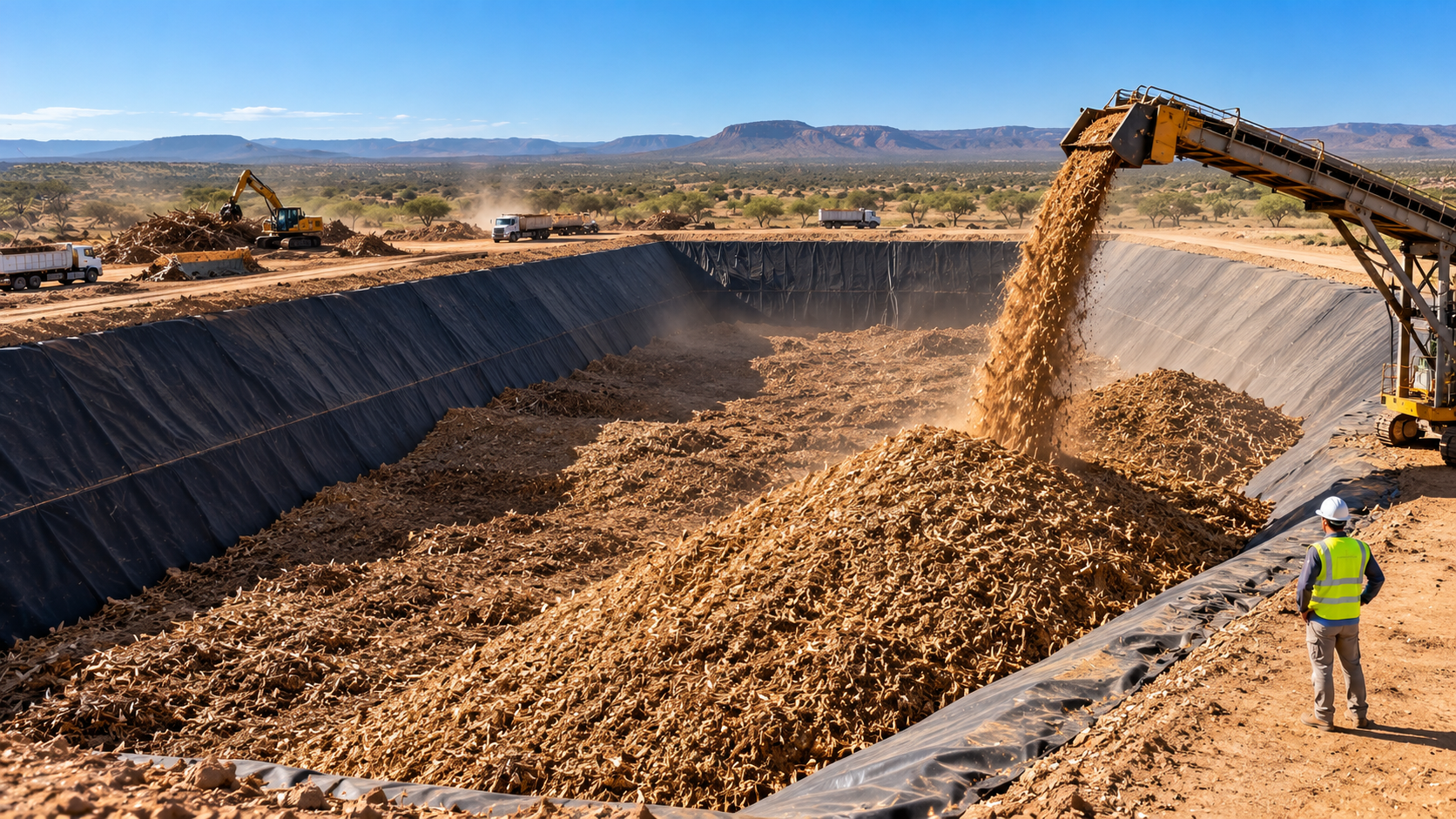
Image: AI-generated
In Africa, what Germany burns in massive quantities is being buried instead
Carbonsate, a company founded by two individuals from Saxony, has developed an unusual business model in Namibia. Woody biomass—cleared from encroaching bush—is chipped and then stored in large, sealed earthen pits. The goal is to keep the material protected from decomposition for at least 100 years, ensuring that the carbon it contains remains sequestered rather than being released back into the atmosphere as CO2. In October 2026, the company opened its third storage facility. Furthermore, it has reached an agreement with the carbon-credit marketplace Senken to supply a total of 50,000 tonnes of CO2 removal by 2028.
Meanwhile, in the German city of Chemnitz, a new wood-fired combined heat and power plant is under construction. The operators intend to use 100,000 tonnes of wood annually to generate electricity and district heating, with approximately 90 percent of the fuel sourced from within a 250-kilometer radius. Over the plant’s planned operational lifespan, this will require an estimated two million tonnes of wood. However, it remains unproven whether such large quantities can be sourced sustainably and without causing ecological damage. This massive demand for raw material stands in stark contrast to the approach of the German start-up, which—counterintuitively—generates revenue precisely by not burning wood.
Burning wood is considered a form of climate protection—even though it releases CO2 immediately
The climate-policy assessment of burning wood appears particularly contradictory. When wood is burned, the carbon it previously stored is released directly into the atmosphere as CO2. Nevertheless, in the energy sector, biogenic CO2 is accounted for as zero. Instead, the corresponding changes in carbon stocks are meant to be recorded under the land-use sector. While this rule prevents double counting, it does not negate the actual emissions; after all, a chimney emits the same CO2 molecule, regardless of whether the carbon originally came from wood or coal.
Even more significant is the temporal discrepancy. Wood that has grown over decades is consumed by fire in a very short time. It then takes many years for new trees to absorb an equivalent amount of carbon. Furthermore, there is no guarantee that every tree removed will be fully replaced. Forest damage, drought, and declining rates of tree growth make such compensation even more difficult. Yet, government subsidy mechanisms create economic incentives for using wood for energy. Public discussions about such projects often overlook the fact that the overall climate impact depends on which energy source is being replaced.
One party profits from storage, the other from combustion
The economic contrast is striking. Carbonsate markets the long-term sequestration of carbon as a certified climate-protection service, with the company quoting prices between 120 and 150 euros per ton for the corresponding CO2 certificates. By purchasing these, buyers acquire a claim to CO2 removal that has been verified according to specific standards. However, the long-term benefit hinges on whether these storage sites remain reliable over the course of decades. Defective seals could once again expose the wood to biological decomposition processes. Consequently, this business model also relies on technical assumptions that have yet to be proven sustainable in the long term.
In Chemnitz, by contrast, the combustion of wood is intended to generate economic returns. The power plant will sell district heating while also producing electricity. The project developer points to remuneration provided under the Renewable Energy Sources Act. This creates revenue streams from two sources: carbon storage on the one hand, and the energetic use of wood on the other. Both approaches entail different performance levels, costs, and alternatives. Nevertheless, a fundamental climate policy question remains: why does the system simultaneously provide economic incentives to store carbon for as long as possible and to release it for energy production?
German forests are losing carbon—yet new power plants require ever-increasing amounts of wood
This trend is particularly concerning given the current state of Germany’s forests. According to the fourth National Forest Inventory, annual wood growth has declined by 16 percent compared to the previous survey. Furthermore, between 2017 and 2022, these forests lost significant quantities of stored carbon. Drought, pest infestations, and forest damage have weakened their capacity to act as carbon sinks. Despite this, new biomass power plants are creating additional demand for fuel. Every new consumer potentially intensifies the competition for a finite raw material.
The operators of the Chemnitz power plant state that they rely on forest residues, landscape maintenance debris, and trimmings from roadside trees. However, even these materials are not available in unlimited quantities. Some are already being put to other uses or serve vital ecological functions. Deadwood, for instance, provides habitats and contributes to the nutrient supply of forest soils. Removing large quantities of such material can impair the regeneration of forests. A climate-friendly energy supply should therefore not be judged solely on the basis of the fuel’s origin.
Climate Action Based on Business Models Rather Than Actual Carbon Footprint
The real scandal is not that a start-up is developing new methods for carbon sequestration; nor is the use of residual wood for heat supply necessarily problematic under the right conditions. The core issue lies in the lack of comparability among climate protection claims. While some companies sell certificates for long-term carbon sequestration, power plant operators are permitted to market the energetic use of the very same type of raw material as “renewable energy.” In both cases, the full scope of emissions—as well as the impact on natural carbon sinks—must be taken into account. A “green” label is no substitute for a robust, comprehensive assessment.
Germany requires a reliable heat supply and effective climate action. Neither can be guaranteed through contradictory evaluation standards. Those who promote the burning of wood must disclose the additional demand for raw materials and the actual CO2 savings achieved. Those who sell carbon sequestration services must prove their permanence. These two German-linked projects illustrate just how wide the gap can be between climate promises and physical reality. When burying wood in Africa is marketed as climate action, while Germany simultaneously burns millions of tons of wood as a “climate-friendly” fuel, the logic behind such subsidies and accounting practices demands a fundamental review.
Author: Klaus Bastian – Blackout News
Sources: Futuremedianews (20.10.26) – Futuremedianews (19.10.26) – MDR (04.09.26) – MDR (19.10.26)