
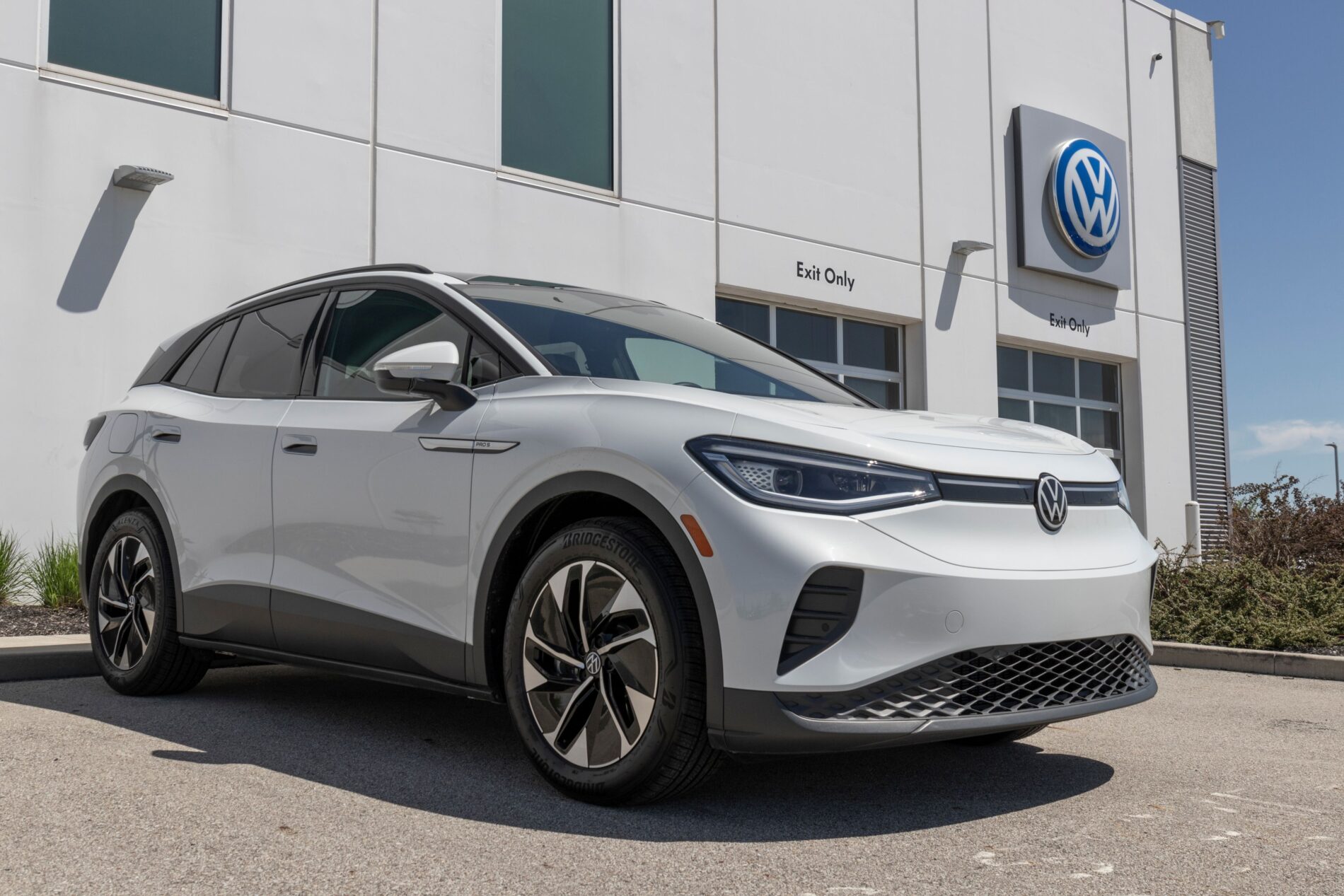
Volkswagen will end production of its ID.4 electric SUV at its Chattanooga plant in Tennessee this month, reacting to the weak US market for electric vehicles. According to the company, the move is due to a challenging environment, further exacerbated by the elimination of a $7,500 tax credit for electric vehicles. At the same time, ID.4 sales plummeted by 62 percent year-over-year in the fourth quarter of 2024. Volkswagen is therefore shifting production to its Atlas and Atlas Cross Sport gasoline models, which are in higher demand in the US. This step is particularly critical for the company because Volkswagen is currently facing a deep crisis, with profits falling by 44 percent in 2025 and plans to cut around 50,000 jobs in Germany by 2030. (wsj: 09.04.26)
Sales slump forces VW to change course
The decision affects one of the brand’s most important electric models. The ID.4 was considered Volkswagen’s key vehicle in the North American market. Nevertheless, the model has recently lost significant ground. The sharp drop in sales has therefore increased the pressure to realign production in Chattanooga.
Added to this was a political setback with direct consequences for demand. In the fall, the US government eliminated the $7,500 tax credit for the purchase of electric vehicles. This significantly worsened the sales prospects of many electric cars. Such a loss has a rapid impact, especially in the price-sensitive mass market. Volkswagen is therefore reacting not with expansion, but with a withdrawal from local ID.4 production.
Chattanooga refocuses on Atlas and Atlas Cross Sport
Instead of the electric SUV, the focus in Tennessee will once again be on high-selling combustion engine vehicles. Volkswagen plans to convert the plant to produce the Atlas and the Atlas Cross Sport. Both models sell better in the US and are thus a better fit for the current market situation. The company is therefore focusing on vehicles that promise higher returns in the short term.
At the same time, Volkswagen is not completely closing the door on the ID.4 in North America. A future version of the model for the North American market is still planned. However, the manufacturer did not specify a launch date. This illustrates how uncertain the outlook remains at present. The current stock of ID.4 vehicles is also expected to last until 2027.
Electric vehicle strategy remains uncertain as the company faces cost-cutting measures
The withdrawal from US production of the ID.4 does not mean the end of all Volkswagen’s electric vehicle plans in the United States. The ID. Buzz electric van will continue to be offered. Furthermore, the company plans to begin production of a revised version of the Atlas this summer. This variant is slated to go on sale in 2027. Volkswagen is thus primarily strengthening its traditional SUV business.
However, this change in strategy in the US comes at a time of significant challenges for the company. Volkswagen is struggling with weak results and facing tough cutbacks. In 2025, profits plummeted by 44 percent compared to the previous year. As a result, the company is pushing ahead with its cost-cutting program. Around 50,000 jobs are to be eliminated in Germany by 2030. The decision in Chattanooga is therefore not an isolated case, but rather fits into a broader picture of declining demand for electric vehicles, increased cost pressures, and a return to models that currently generate more reliable revenue.