
Over the past decade, China has massively expanded its natural gas reserves in Yancheng and other coastal locations, creating the world’s largest above-ground LNG storage facilities. The current backdrop is the crisis in the Middle East, as the Strait of Hormuz was effectively blocked for five and a half weeks following the initial US-Israeli attacks on Iran. Although the US and Iran agreed to a ceasefire, Qatar anticipates years of repairs to damaged gas infrastructure. This is precisely where the greatest risk lies, as both transport routes and production capacity could be disrupted. China is mitigating this risk, however, with enormous storage tanks, increased domestic production, pipelines from Russia and Central Asia, and contingency plans for parts of its industry, while other Asian countries are already suffering more from gas shortages. (nytimes: 08.04.26)
Yancheng Demonstrates the Scale of China’s LNG Storage Expansion
At the Yancheng industrial port stand six enormous tanks, each capable of storing enough gas to meet the household needs of Beijing’s 22 million residents for more than two months. Right next to them are four additional, slightly smaller tanks. This facility clearly illustrates the extent to which China has already advanced its LNG storage capacity. The site is not an isolated case, but rather part of a nationwide program.
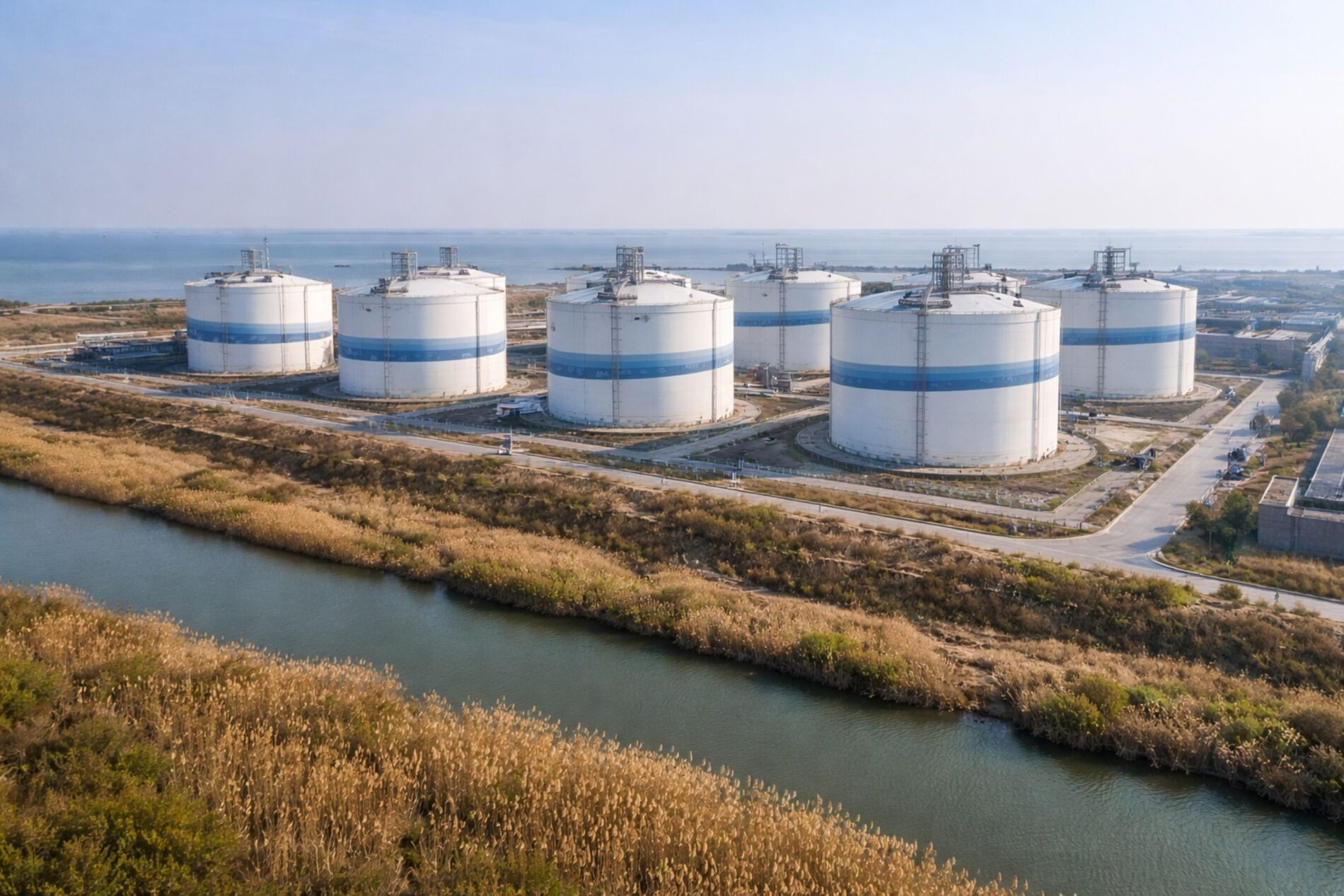
The state-owned China National Offshore Oil Corporation announced in December that it had already constructed 18 of its largest-scale storage tanks. That’s more than twice as many as the rest of the world combined. Each of these tanks holds 9.5 million cubic feet, while even large halls like Madison Square Garden are significantly smaller. China has thus not only created individual reserves but also established a new order of magnitude for liquefied natural gas (LNG) storage.
China Chooses a Risky but Effective Storage Method
Natural gas is difficult to store, and this is precisely what long complicated the development of such reserves. Many countries use salt caverns or depleted underground gas fields, but China has too few suitable locations relative to its size. Therefore, Beijing opted for enormous aboveground tanks for cryogenically cooled LNG. This decision was technically risky but strategically effective.
In Yancheng, the gas is stored at minus 162 degrees Celsius to drastically reduce its volume. When it is later heated in a controlled manner, it expands to 600 times its original size. This is precisely why the construction and operation of these LNG storage facilities are considered critical, as improperly handled liquefied gas can explode. Concrete stabilizes the tanks on the outside, while special steel reinforced with manganese and nickel is used on the inside. Robots also handle the welding work to ensure the enormous containers remain permanently leak-proof.
The Expansion of LNG Storage Follows a Clear Crisis Strategy in Beijing
The expansion of gas storage facilities is part of a much broader contingency plan. In recent years, China has also built up reserves of coal, rice, pork, and rare earth elements. However, the strategy is particularly significant with regard to natural gas, because China is the world’s largest importer and requires enormous quantities for chemicals, fertilizers, and industry. This is precisely why Beijing is making such extensive preparations for this commodity.
Storage facilities alone, however, are not enough as a protective shield. China has simultaneously built pipelines to gas fields in Central Asia and Russia and significantly increased its own production using fracking and other methods. According to official data, only 6.9 percent of China’s total gas consumption last year was transported via the Strait of Hormuz. Xi Jinping openly outlined the direction for 2022. He demanded that China “improve its storage capacity for coal, oil, and gas” and strengthen its energy independence. The country is also creating additional fertilizer reserves, as analysts say China has halted a large portion of its exports since the start of the war in Iran.
For private households, the situation therefore remains manageable for the time being. Less than 15 percent of gas consumption is attributable to households, and the heating season ended last month after another mild winter. China generates only about 4 percent of its electricity from gas, while coal and renewable energies can fill supply gaps more quickly. In villages near Yancheng, traders also report well-stocked fertilizer stores. One vendor said, “I stocked up on quite a lot of fertilizer in advance—after all, there’s a war going on in the Middle East.” China’s strategy is thus clearly aimed at one thing: expanding the world’s largest gas storage facilities as a robust reserve for the next supply crisis.