
Globally, the dispute regarding retrospectively altered temperature data from NASA, NOAA, and other climate agencies is currently flaring up once again. One catalyst for this is the debate surrounding the former “worst-case scenario,” RCP8.5—a pathway that is no longer to be considered a plausible standard trajectory for the next IPCC assessment cycle. Experts increasingly view it as an extreme scenario rather than a probable development. Critics repeatedly compare older and newer climate datasets, noting that some historical data series depict different trends than the current ones. The institutions in question attribute these changes to factors such as relocated monitoring stations, new instrumentation, altered measurement times, and data gaps. Critics, however, raise suspicions of manipulation, pointing out that algorithms are used to process the raw data. These corrections influence global temperature curves; consequently, they also have implications for energy policy, CO2 regulations, investment strategies, and industrial compliance requirements. (nius: 27.05.26)
Raw Data Is Open, But the Post-Processing Chain Is What Counts
A great deal of measurement data is publicly available—this applies particularly to international station data. NASA-GISTEMP, for instance, cites key sources for both land and ocean data. Nevertheless, scrutiny does not end with the raw value; a single measurement alone does not constitute a temperature curve, as many steps lie between the raw reading and the final graphic.
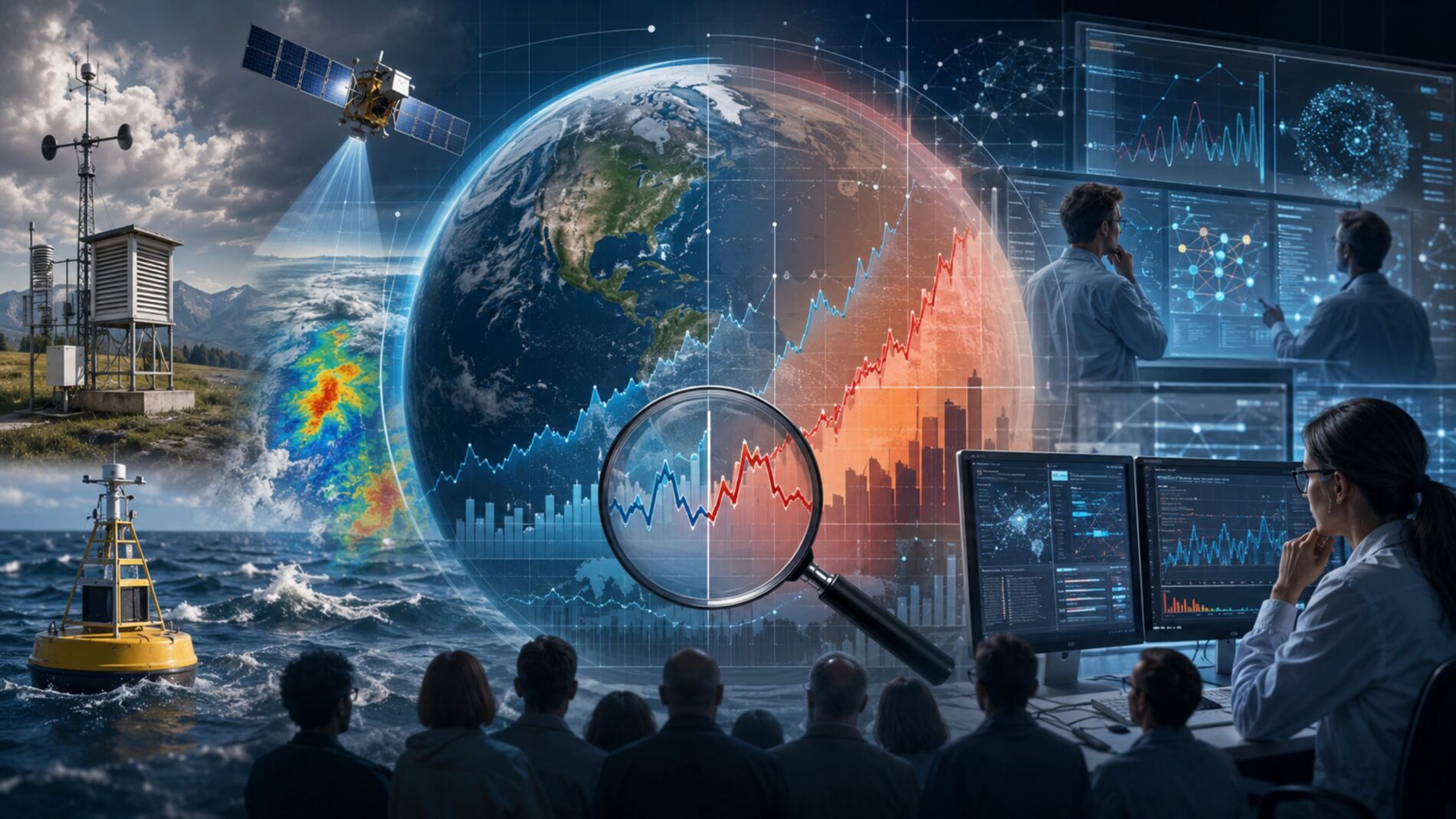
Institutes scrutinize outliers, fill gaps, and apply regional weighting. Furthermore, they smooth out sudden spikes in measurement data—anomalies that may arise, for instance, from a change in station location or the installation of a new measuring instrument. A weather station might be relocated; a measuring device might be replaced. Such changes can obscure genuine climate signals. Consequently, applying appropriate corrections may be technically necessary.
Suspicions of Manipulation Arise During Data Post-Processing
The critical point, however, lies in the processing stage. An algorithm determines which stations appear anomalous; it selects comparator stations and calculates the magnitude of any necessary adjustment to a given data point. In doing so, the relative weight of individual, actual measured values shifts in favor of the statistical model.
It is precisely at this juncture that suspicions of manipulation arise. If older data values are adjusted downward while more recent values are adjusted upward, the apparent warming trend appears more pronounced. While such adjustments may be objectively justified, they can also introduce a systemic bias. Therefore, parameters, software versions, and intermediate processing steps ought to be fully disclosed to ensure that the rationale behind such corrections can be independently verified. A mere generalized description of the methodology is insufficient for this purpose.
Political Consequences Demand Stricter Oversight
Climate data does not remain confined to the laboratory. It serves as the basis for laws, subsidy programs, and bans. Furthermore, it influences electricity prices, industrial planning, and heating regulations. Therefore, the standard of oversight applied to it must be higher than that for purely academic datasets. Citizens and businesses are the ones who bear the consequences.
Potential manipulation need not occur overtly. Even one-sided assumptions could alter trends. Moreover, older versions—which are often difficult to locate—complicate comparative analysis. Consequently, robust archives are essential. Every correction must remain individually traceable. Only then can suspicions be subjected to a rigorous and reliable examination.
Disclosure Must Be Practically Usable
What matters is not merely whether data is available somewhere; rather, the crucial factor is whether independent experts can precisely replicate the calculated trends. To do so, they require raw data, metadata, algorithms, parameters, and change logs. Furthermore, previous versions must remain permanently accessible. Otherwise, oversight remains incomplete.
Retrospective corrections do not necessarily constitute proof of deception. They can serve to rectify measurement errors and ensure the comparability of data series. However, they must not appear to be an opaque or inscrutable intervention. As long as the entire chain of calculation remains difficult to verify, room for doubt persists. Open access to raw data is, therefore, merely the beginning; what is truly decisive is complete transparency extending all the way to the final calculated value.