
At the end of March 2026, an act of sabotage targeted the power supply of a pumping station on the Transalpine Pipeline (TAL) near Terzo di Tolmezzo in northern Italy, disrupting the flow of crude oil to southern Germany for approximately three days. Refineries in Bavaria and Baden-Württemberg were particularly affected, as they were only able to maintain production using reserves, while the risk of shortages of gasoline, diesel, and kerosene immediately increased. At the same time, the attack went largely unnoticed in Germany by public broadcasters and much of the mainstream media, even though a critical energy link with direct implications for supply in the south of the country had been hit. (politico: 10.04.26)
The TAL pipeline is a critical hub for southern Germany
The pipeline connects the port of Trieste with Austria and Germany and supplies several refineries with crude oil. Therefore, a disruption would not only affect individual facilities but would quickly impact large parts of the fuel market in southern Germany. Bavaria and Baden-Württemberg, in particular, depend on a few key supply routes, while reliable alternative routes remain scarce.
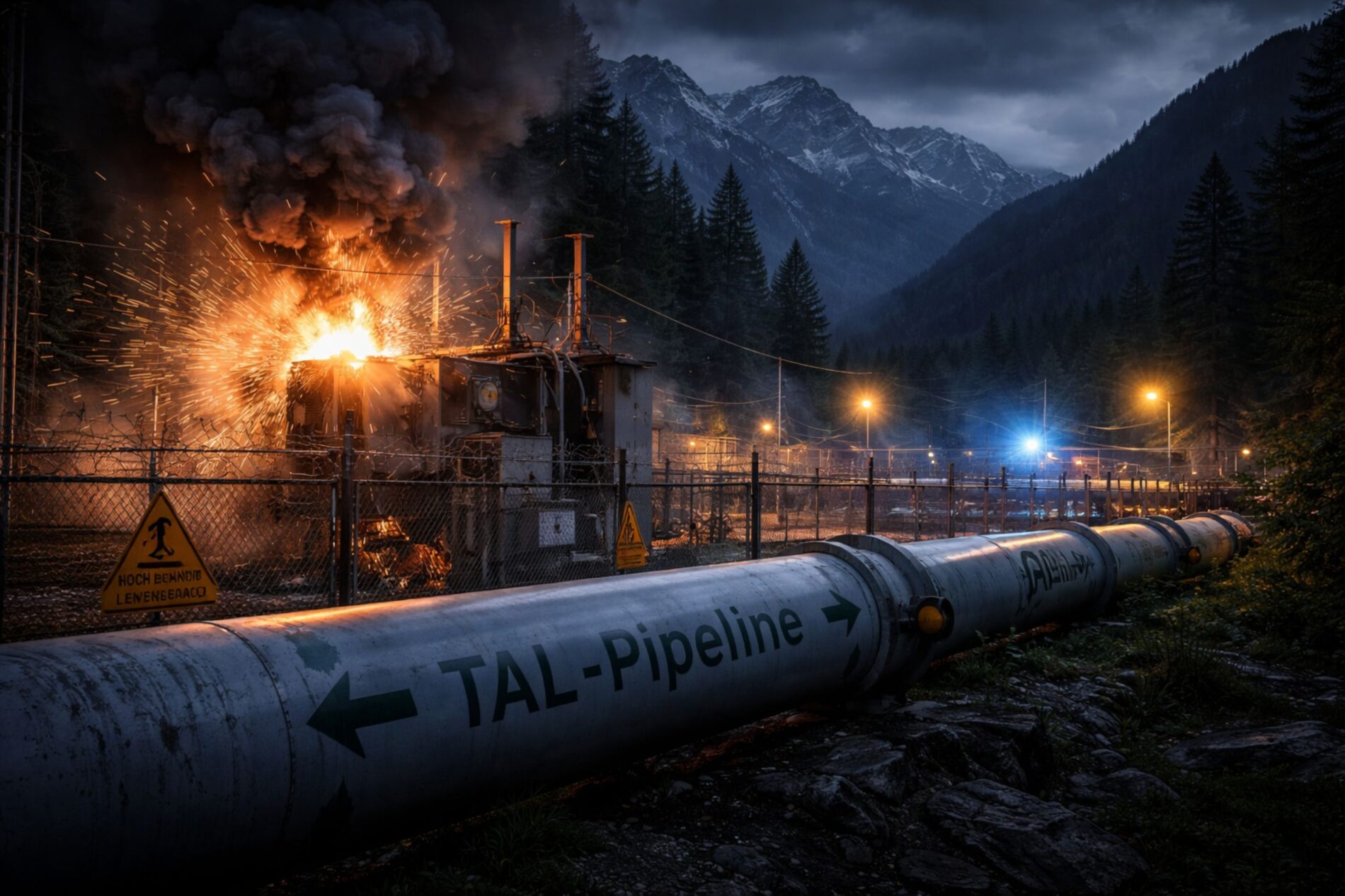
The attack appeared to be localized at first glance, but its consequences extended far beyond the immediate area. Just a few days of disruption forced the affected sites to draw on their reserves. This demonstrates how quickly even a limited intervention can deplete the safety margins in a tightly scheduled supply system.
Three days of downtime reveal the system’s weakness
For motorists, the immediate impact was initially limited because reserves kicked in and supplies didn’t cease instantly. Nevertheless, the situation was critical, as a longer shutdown would have severely impacted fuel production. Furthermore, supply chains, logistics, and prices would have been under significantly greater pressure had the interruption lasted only slightly longer.
The pipeline itself is not the only particularly vulnerable point. Anyone who damages the power supply to a pumping station can paralyze transport via the TAL pipeline with relatively little effort. This is precisely why not only the pipeline but also its surrounding infrastructure is increasingly becoming a central focus of security concerns.
Attack on Energy Infrastructure with Consequences Far Beyond Italy
The investigation continues as a possible political motive is examined and German authorities are in contact with Italian officials. However, it is already clear that this was not a local incident. The attack targeted an energy corridor whose failure directly impacts Germany’s energy supply and therefore has implications far beyond northern Italy.
This presents a clear mandate for policymakers, operators, and refineries. They must expand their security measures, create redundancies, and plan more realistically for the failure of critical infrastructure. As long as large portions of the energy supply depend on just a few routes, any attack on the TAL pipeline remains a risk with potentially severe consequences for southern Germany.