
Im Sandbergtunnel bei Traßdorf im Ilm-Kreis missglückte am 8. August 2026 eine Großübung zum ICE-Brand teilweise. Mehr als 250 Einsatzkräfte trainierten dort auf der ICE-Strecke Nürnberg–Erfurt den Ernstfall. Im Zug saßen 100 Komparsen, rund 30 von ihnen spielten Verletzte. Bei der Alarmierung verhinderte ein Serverausfall in der Leitstelle Arnstadt jedoch den automatischen Versand der Alarmfaxe an benachbarte Leitstellen. Hinzu kamen Funkprobleme, Abstimmungsschwierigkeiten und Umwege wegen der Vollsperrung der Autobahn 71. Die ersten Retter erreichten den ICE-Tunnel deshalb erst nach rund zwei Stunden statt nach 10 bis 25 Minuten. Gut drei Monate danach zieht das Thüringer Innenministerium Konsequenzen. Es plant schnellere Abläufe, mehr Automatisierung, zusätzliche Schulungen und einen Funkcheck an einem Tunnelportal.
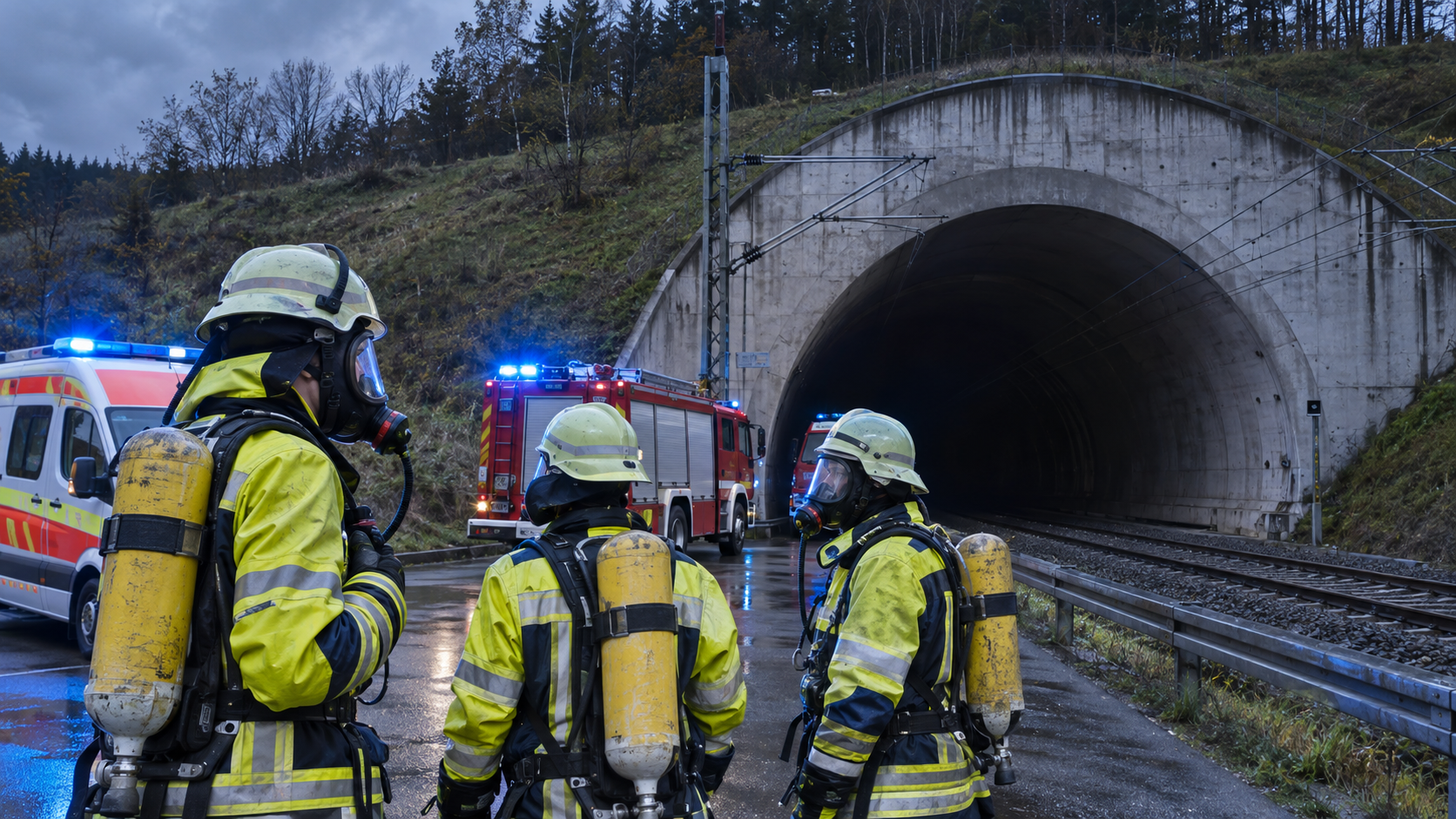
Image: AI-generated
Rescue operation in ICE tunnel takes five times longer than planned
The figures reveal the extent of the issue. While the plan allowed for a maximum of 25 minutes, it actually took 127 minutes for the first rescuers to reach the north portal of the Sandberg Tunnel. In this scenario, the train driver reported a fire to the railway operator in Leipzig at 10:15 a.m. However, the emergency dispatch center was not notified until around 10:45 a.m., and the fire departments were alerted about half an hour after that. Consequently, roughly 60 minutes elapsed before the fire departments were even notified—well before they could begin their journey to the site.
The alert process involved several handovers, each of which consumed time. The report passed from the railway operator to the dispatch center in Arnstadt, and from there to neighboring dispatch centers. When a server in the Arnstadt center failed, the system did not automatically transmit the alarm faxes. The Ministry of the Interior attributes the delay precisely to these points of transfer. Before the exercise, Fire Chief Marc Stielow had issued a warning: “The ultimate adversary in a tunnel is time.”
Radio communications, doors, and the motorway: Additional critical factors in an emergency
Beyond the alert chain, other links in the response process also failed. Radio communications proved problematic, and coordination among emergency responders was not seamless. Furthermore, the complete closure of the A71 motorway forced responders to take detours. Interior Minister Georg Maier (SPD) described the situation as a “chain of unfortunate circumstances,” also noting that actual accidents had occurred on the motorway. A similar issue arose on October 10 in the district of Grafschaft Bentheim, where the radio network failed intermittently during an exercise involving approximately 1,000 personnel. Both exercises underscore a fundamental reality: without reliable communication, the coordination of emergency assistance is impossible.
There were also complications involving the train itself. District Administrator Petra Enders reported that, inside the Sandberg Tunnel, it was not possible to open the ICE train’s doors from the outside. While a standard square-drive key—provided by the railway operator—is typically used for this purpose, it only functions when the train has been completely powered down; apparently, that was not the case here. In a real-world emergency, rescuers could break the windows, though they opted not to do so during the exercise. Only 100 passengers were on board for the drill, whereas an ICE train typically carries more than 500 people. Consequently, an actual evacuation inside an ICE tunnel would have presented rescuers with a significantly greater challenge.
Faxes and Jurisdiction: Dispute Between the State and Ilm-Kreis
The dispute centers on the use of faxes. District Administrator Enders considers them obsolete, stating, “I don’t believe faxes are appropriate for the modern age.” The ministry rejects her criticisms regarding emergency alert procedures. State Secretary Andreas Bausewein points out that the district is responsible for emergency medical services and the fire department, adding that the digital “alarm fax” system is reliable. Enders counters that the state mandates this procedure—even though it identified problems with it three years ago. Responsibility is thus split across two levels: local authorities operate the dispatch centers, while the state sets the guidelines. The ministry acknowledges that implementing a unified software system requires the voluntary cooperation of the districts.
The ministry now intends to address weaknesses in the alert system. The goal is for dispatch centers to exchange information more quickly and with a higher degree of automation. Additional training is planned, and radio coverage at a tunnel portal is being reviewed. In the long term, a specialized digital solution is intended to replace the alarm fax. Whether this will suffice remains unclear, as the evaluation of the exercise conducted in the Sandberg Tunnel has not yet been completed. The Ilm-Kreis district council removed the topic from its November 11 agenda because the expected report had not been submitted. Structurally, the state is pushing for a reduction in the number of dispatch centers; currently, there are more than ten centers for the 112 emergency number, compared to only one for the 110 police emergency number. An initial attempt to consolidate them failed due to resistance from local authorities, so the state is now offering subsidies to encourage the creation of voluntary regional dispatch centers. The ministry itself admits that larger dispatch centers would not necessarily have prevented the glitches that occurred in the ICE tunnel. Furthermore, Enders is calling for a revised safety concept, citing the increasing volume of regional, freight, and hazardous-materials transport.
Author: Blackout News
Sources: inSüdthüringen (18.11.26) – Schiene (19.11.26) – Volksstimme (18.11.26)