
In a YouTube video, former forester Josef Erhard warns of the consequences of planned wind turbines in the Bavarian Forest. The catalyst for his warning is a designated wind priority area located within his former forestry district. According to his account, turbines are slated for construction there—within a habitat home to lynx, wildcats, bats, and birds of prey. However, this encroachment affects more than just individual sites; Erhard identifies forest clearing, soil compaction, new access roads, cable routes, and concrete foundations as the primary consequences. Furthermore, he warns of the potential harm to wildlife, drinking water, forest soils, the landscape, and recreational areas.
Why the Forester Views the Construction Phase as the Main Problem
Many citizens later see only the finished wind turbine. However, construction begins with massive interventions in the forest. Operators require wide access roads for rotor blades, cranes, and heavy transport vehicles. Furthermore, existing forest roads must be widened. Curve radii, staging areas, and construction sites alter entire sections of the forest.
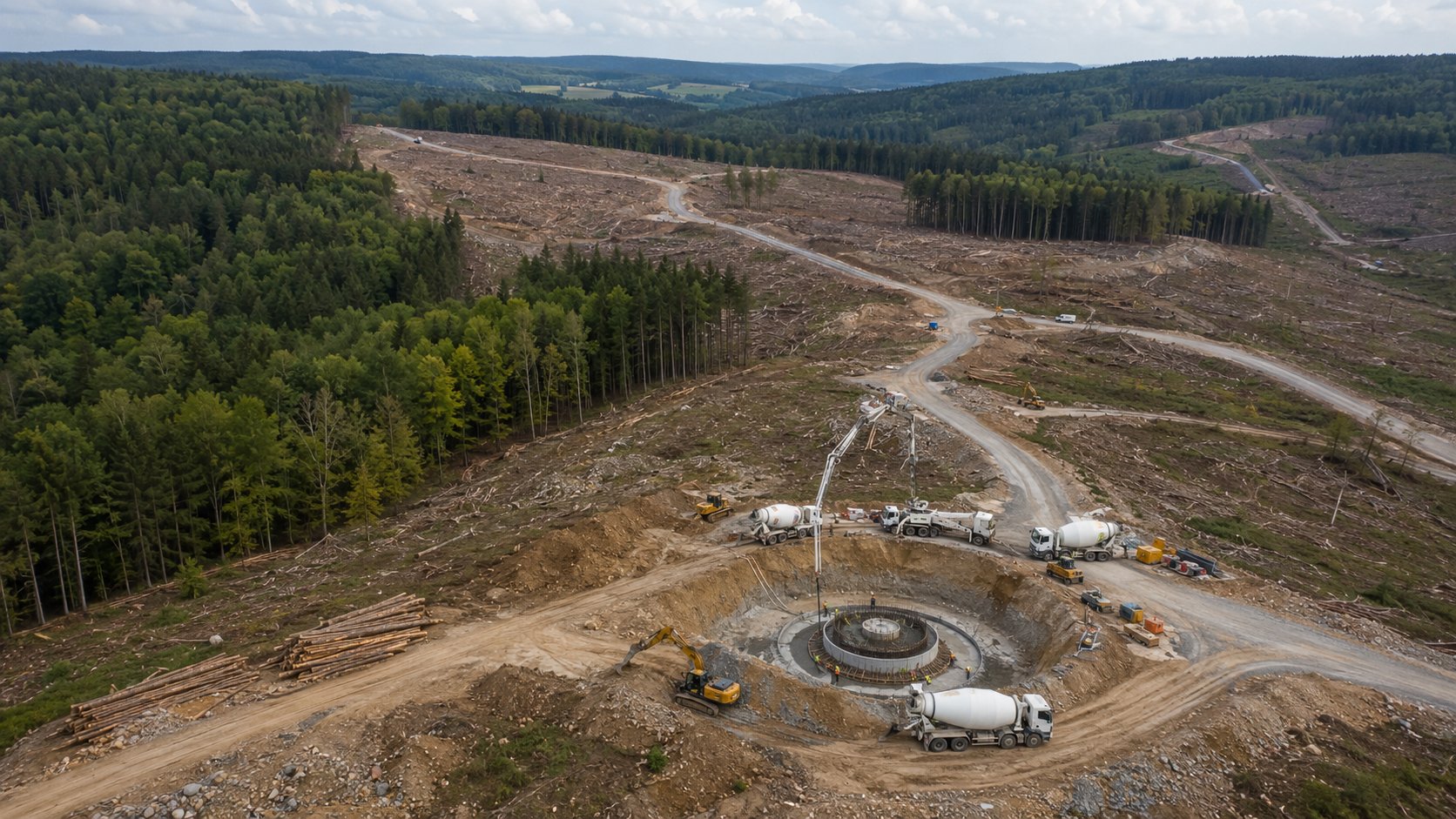
Erhard draws particular attention to the forest floor. Heavy machinery compacts the soil—the very medium that stores water and supports root systems. Cable routes and drainage systems also disrupt the site’s natural conditions. Furthermore, the foundations remain buried deep within the ground. Composed of massive quantities of reinforced concrete, they do not disappear completely even after the facility has been dismantled.
Deforestation Impacts Habitats and Water Balance
The former forester views the removal of the forest itself as the most severe intrusion. While storms or bark beetles can certainly damage stands of trees, the forest is subsequently able to regenerate naturally. The systematic clearing of land to make way for industrial facilities, however, permanently alters the site. Erhard summarizes his criticism succinctly: “Wind power in the forest means deforestation.”
In his assessment, the issue extends far beyond individual trees. Forests serve simultaneously as habitats, water reservoirs, and protective buffers. Protected species inhabit the affected areas; moreover, bats, birds of prey, and insects frequently stray into the operational zone of the turbines. For this reason, Erhard refers to wind turbines as “shredding machines.”
Drinking Water, Raw Materials, and Power Supply Remain Points of Contention
Forests play a crucial role in groundwater and drinking water supplies. The forester therefore draws attention to the potential consequences of creating new access roads, digging drainage ditches, and causing soil compaction. Such interventions can alter water flow patterns. This is of particular concern in high-altitude areas and sensitive forest ecosystems. Consequently, the benefits of electricity generation must be carefully weighed against the potential environmental damage.
His critique also extends to the materials involved. Rotor blades, metals, resins, and technical components are sourced from global supply chains. Furthermore, Erhard identifies rotor blade abrasion as a potential environmental hazard. He also views the use of hydraulic fluids and lubricants with skepticism. In his view, this overall picture does not align with the concept of “clean energy.”
Erhard also takes issue with the political narrative surrounding wind power. In his assessment, Bavaria is a relatively poor location for wind energy generation. From an economic standpoint, he argues that wind turbines are viable there only through the aid of subsidies. At the same time, the forester points to periods when neither wind nor sun is available; during such times, an industrialized nation still requires a reliable supply of power from other sources.