
Construction work at the Brombeerkopf wind farm near Stegen, in the Breisgau-Hochschwarzwald district, has already visibly altered the character of the forest site. Images from July 26, 2026, show cleared areas, exposed soil, removed stumps, and newly constructed gravel access roads. Approval has been granted for the permanent conversion of 1.345 hectares of forest and the temporary conversion of an additional 0.443 hectares. Plans call for two Enercon E-160 wind turbines, each with a total height of 246.5 meters and a capacity of 5.56 megawatts. Four private springs in the Hintereschbach district are of particular importance in this context; consequently, the permit mandates extensive protective and monitoring measures. The project remains politically controversial, as the municipal council refused to grant its consent; however, the district authority overrode the lack of municipal approval during the permitting process.
Brombeerkopf Wind Farm Makes Significant Impact on Forest Site
The work is not limited to felling individual trees; stable surfaces must be created for access roads, crane pads, and assembly areas. Consequently, construction machinery removes root systems and organic soil layers before crushed stone is laid and the ground is compacted. From a technical standpoint, this procedure is necessary to accommodate heavy-load transport and large cranes. Ecologically, however, it alters a site where the soil previously stored water, bound nutrients, and supported the tree population.
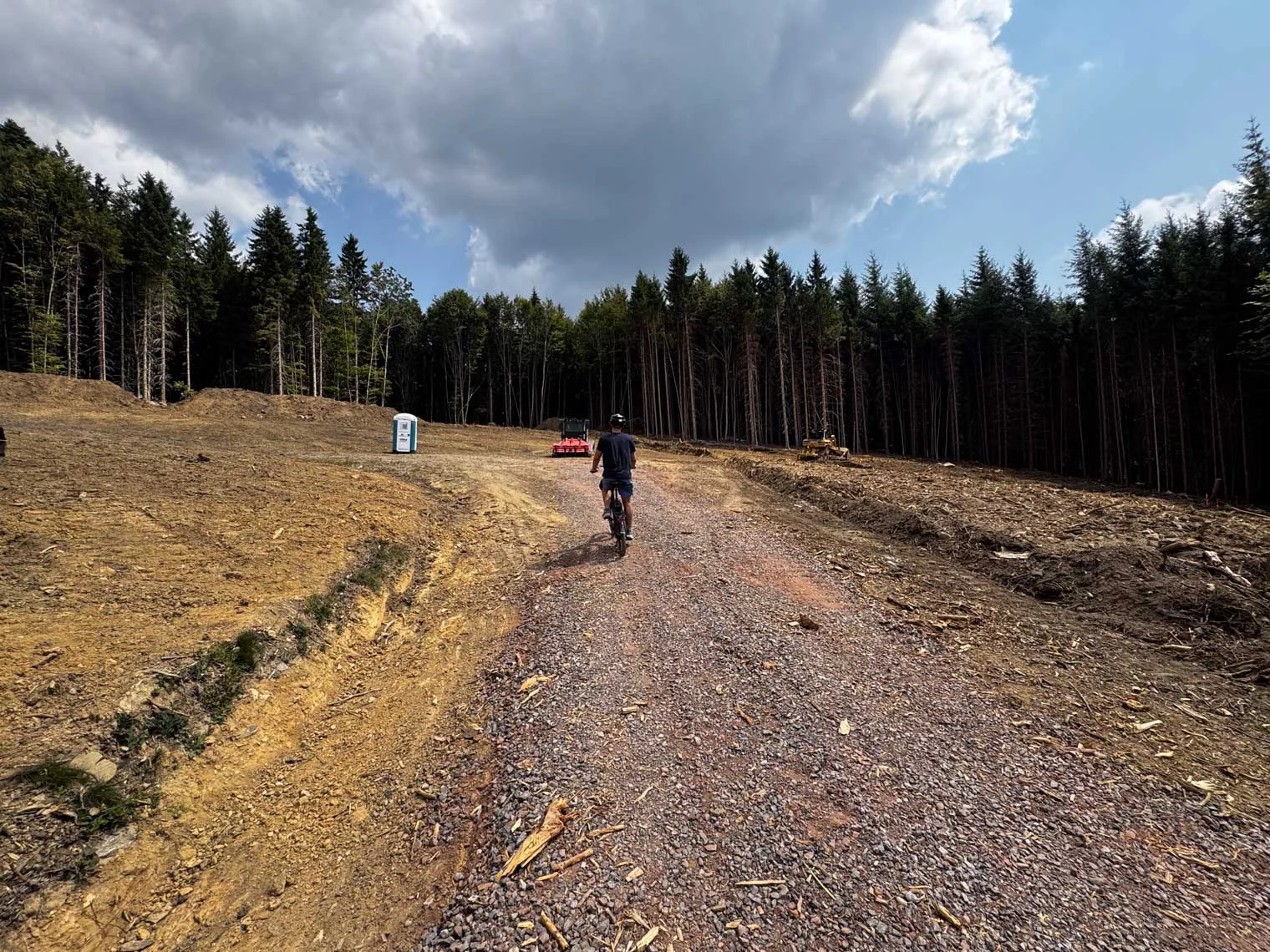
Image: ©Adrian Kempf, Kirchzarten
A total of 17,885 square meters of forest land may be converted for the Brombeerkopf wind farm. Of this area, 13,454 square meters will be permanently occupied by turbines, access roads, and ancillary areas. Another 4,431 square meters are slated to return to forestry use following the construction phase. The permit requires reforestation with a deciduous tree component of at least 40 percent. However, such reclamation cannot immediately replace established forest soil. Particularly in areas where soil has been compacted or removed, restoring original soil functions takes significantly longer than the construction phase itself.
Private Water Supply Requires Special Protective Measures
The project also directly affects several properties in Hintereschbach. Four private water supply systems lie within the potential zone of influence of the turbine sites or the upgraded access road. Regarding the properties at Hintereschbach 23 and 24, the authorities consider impacts highly unlikely due to the local terrain. In the case of Hintereschbach 25, however, changes during the construction period cannot be entirely ruled out. The situation is even more critical for Hintereschbach 26, as road construction there encroaches upon the water supply infrastructure; relocating the well chamber may therefore become necessary.
For this reason, the District Office requires water monitoring, regular sampling, and a coordinated groundwater protection plan. It is an explicit condition that the water supply for the affected property must not be impaired. The permit thus acknowledges the site’s particular sensitivity. At the same time, the authorities assess the potential consequences as manageable, provided all conditions are met. Success will therefore depend on whether the protective measures remain effective throughout the earthworks, road construction, and heavy-load transport operations.
Municipality Rejects Project – Authority Overrides Refusal of Consent
The project met with resistance in local political circles at an early stage. On June 25, 2024, the Stegen municipal council rejected the project by a vote of nine against, four in favor, and one abstention. The Eschbach local council also voted against it by a majority. The bodies cited reasons including the protection of water sources, the loss of forest area, fire safety concerns, and difficult access conditions. However, the district administration deemed the refusal of consent legally untenable and overrode the municipality’s decision.
Furthermore, the scale of the planned turbines increased following the initial approval. Originally, two wind turbines were envisaged, each with a total height of 229.5 meters and a capacity of 4.26 megawatts. In February 2026, the district administration approved a switch to Enercon E-160 models, each standing 246.5 meters tall with a capacity of 5.56 megawatts. This results in a significant increase in both turbine height and rated power output. According to project documentation, the Brombeerkopf wind farm is expected to generate a combined total of approximately 21 million kilowatt-hours of electricity annually. Additionally, the Conventwald protected forest begins about 290 meters west of one of the turbines; long-term scientific measurements regarding water and nutrient cycles have been conducted there for decades. While the authority does not anticipate any direct adverse impact, it does not entirely rule out potential effects on specific series of measurements.
Author: Blackout News
Sources: Adrian Kempf (26.07.26) – Gemeinde Stegen (28.04.26) – Landratsamt Breisgau Hochschwarzwald (11.02.26)