
Since Wednesday, misleading claims regarding the charging of electric cars in Germany have once again been circulating on social media. Several posts allege that private charging for long-distance travel will soon no longer be possible or will be restricted to “three hours for 50 kilometers.” However, no such limit on mileage or energy volume exists. It is true, however, that grid operators are permitted to throttle wallboxes if there is an imminent risk of overloading the local low-voltage grid; in doing so, they temporarily ration the available charging power. For directly controllable wallboxes, a minimum grid power intake of 4.2 kilowatts must generally be maintained. This rule has applied to new controllable systems since 2024 and affects not only wallboxes but also heat pumps, air conditioning units, and certain electricity storage systems.
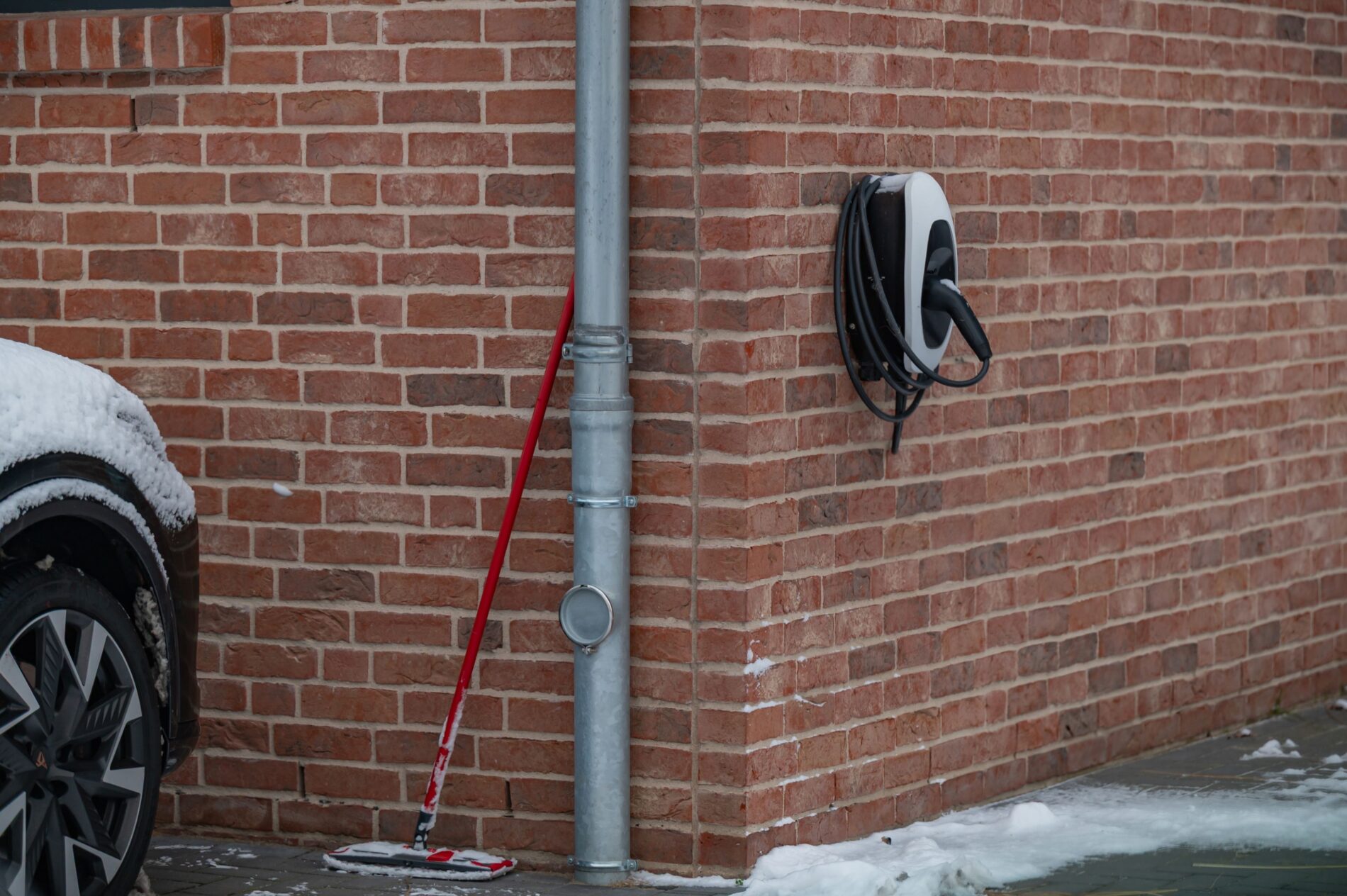
Image: Shutterstock
When grid operators are permitted to throttle wallboxes
A post circulated on September 23 explicitly claims that private charging for long-distance travel will become impossible in the future. This statement is factually incorrect. Section 14a of the Energy Industry Act (EnWG) specifies neither a maximum number of charging hours nor a permissible driving distance. Nor is there a daily quota for kilowatt-hours. Furthermore, the “three-hour” figure circulating online stems from an earlier debate involving different power output values.
What is real, however, is the intervention regarding currently available power output. Since January 1, 2024, new private wallboxes with a capacity exceeding 4.2 kilowatts must, in principle, be controllable. Consequently, grid operators are permitted to throttle wallboxes in the event of a local grid bottleneck. A typical 11 kW wallbox can be limited to a grid draw of 4.2 kW through direct control. Mathematically, this leaves only around 38 percent of the regular power output available. The electric car continues to charge, albeit significantly more slowly.
It is power output that is rationed, not the total amount of electricity
The term “rationing” is therefore not fundamentally incorrect. However, the crucial factor is what is actually being rationed. In the event of a grid bottleneck, the grid operator limits the available connection power rather than the total usable volume of electricity. Once the throttling ends, the vehicle can resume charging at the standard available power level. Furthermore, publicly accessible charging stations are exempt from this regulation. Standard household electricity supplies also remain unaffected.
A recent analysis by Finanztip, dated September 22, illustrates the scale of this regulation. It estimates that around 1.7 million households possess wallboxes, heat pumps, or battery storage systems that could qualify for reduced grid charges. By law, this reduction is linked to the controllability of the respective systems. The Federal Network Agency has established several grid charge models for this purpose. Consequently, Section 14a does not create a voluntary “convenience tariff,” but rather a mandatory framework for newly connected controllable loads.
Heat pumps and storage systems can also be throttled
In addition to private charging points, the regulation covers heat pumps, including auxiliary and emergency electric heating elements. It also encompasses room cooling systems and grid-charging electricity storage units. However, heat pumps generate high loads primarily during the heating season. Wallboxes, by contrast, can draw high levels of power at any time of year. Consequently, the simultaneous charging of many electric vehicles can place a heavy strain on local low-voltage grids.
In the event of an actual grid overload, the power limitation may remain in effect for as long as the critical condition persists. The grid operator is required to lift the throttling only once that condition has ended. Different limits—specifically, a maximum of two hours per day—apply to a preventive transitional rule. Section 14a of the Energy Industry Act (EnWG) was last amended in late 2025 and remains in force in its current version. Therefore, claims that Germany has introduced a new mileage-based rationing system for electric vehicles misrepresent the legal situation. Conversely, the fact that grid operators are permitted to throttle wallboxes—and thus ration available charging power—during actual grid bottlenecks has long been established law.
Author: Blackout News
Sources: Integration von steuerbaren Verbrauchseinrichtungen: Betroffene Anlagen und Dimm-Regelungen – § 14a Netzorientierte Steuerung von steuerbaren Verbrauchseinrichtungen