
The offshore supplier EEW plans to cut more than 100 permanent jobs by the end of the year. At the same time, the use of temporary agency workers is to be almost entirely phased out. These measures are driven by a lack of new offshore orders, competition from China, and expected underutilization of capacity through the end of 2028. Furthermore, site auctions originally scheduled for 2026 have been postponed to 2027, while major North Sea projects that had already been awarded face uncertainty. As a result, one of Mecklenburg-Western Pomerania’s largest industrial employers is losing around ten percent of its permanent workforce. Nevertheless, Germany aims to expand its offshore capacity to at least 70 gigawatts by 2045.
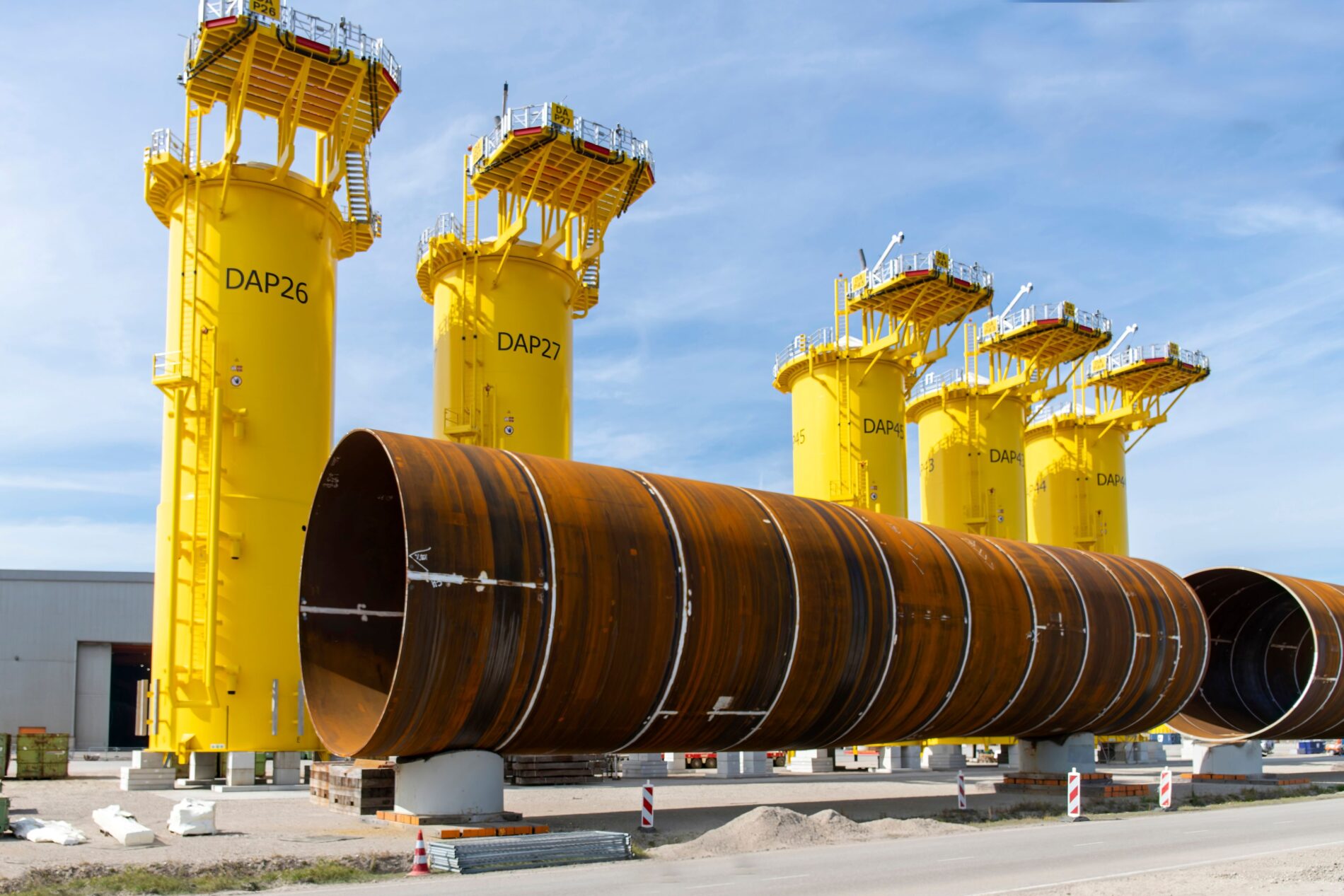
Image: Shutterstock
EEW Cuts Core Jobs and Reduces Use of Temporary Workers
EEW has been manufacturing monopiles for offshore wind turbines at the Rostock overseas port since 2008. The company is one of the world’s leading manufacturers in this sector. Currently, around 1,000 people work at the site. According to the Ostsee-Zeitung newspaper, the job cuts affect more than 100 members of the core workforce. In addition, the use of temporary agency workers is set to be virtually eliminated starting at the end of this week. The workforce reduction is initially intended to be voluntary, though management has not ruled out compulsory redundancies.
As early as the beginning of September, Managing Director Robert Dreves had warned of a weaker order book for the coming two years. Now, according to information from NDR, EEW anticipates low capacity utilization through 2028. The company also cites competition from Chinese suppliers as a burden. According to NDR, pre-formed steel components from China can enter the EU duty-free. This increases price pressure on European manufacturers at a time when new orders from Germany are lacking.
Auction hiatus creates gap in offshore project pipeline
The gap in orders is closely linked to German offshore planning. No bids were submitted during the tender for two sites in August 2025; consequently, the auctions originally scheduled for 2026 were postponed to 2027. In late September, the federal government also proposed a reform of the Offshore Wind Energy Act, citing the challenging market environment as the reason. Starting in 2027, a new tender corridor of 2,000 to 4,800 megawatts per year is set to apply.
At the same time, major projects that have already been awarded are faltering. Investigations by NDR, WDR, and the Süddeutsche Zeitung reveal that BP has effectively halted work on two North Sea projects. Uncertainties also surround other projects that have already been awarded. The offshore industry association is therefore warning of gaps in the industrial project pipeline. Furthermore, new orders reach manufacturers like EEW only after significant delays. Long-term expansion targets are thus failing to prevent short-term job losses.
Plant expansion meets short-term lack of orders
In parallel, EEW is pressing ahead with plans to expand its Rostock site. The plant requires additional space because future monopiles will be larger. The city had already initiated planning procedures for this, discussing expansion areas of up to 40 hectares. Parts of the protected Swienskuhlen forest area were also under consideration. Meanwhile, the company remains committed to Rostock as a production site while simultaneously evaluating alternatives.
The job cuts thus highlight a discrepancy between expansion targets and industrial reality. Germany plans to achieve at least 70 gigawatts of offshore capacity by 2045. However, the industry requires a continuous pipeline of projects that are actually realized to meet this goal. Recent tenders have attracted no bidders or were postponed, while projects that had already been awarded stalled. For suppliers, therefore, the political goal for 2045 is not the only factor that matters; concrete orders for the coming years are crucial. EEW is now taking action in response to this situation, affecting more than 100 jobs.
Author: Blackout News
Sources: Ostsee-Zeitung (07.10.26) – NDR (06.10.26)