
Germany is facing a growing challenge regarding the volume and cost of recycling wind turbine rotor blades. In 2025, the decommissioning of 554 wind turbines generated approximately 6,400 tons of rotor blade material. However, an industrial recycling chain—as analyzed in a recent study—would require a significantly larger volume to achieve profitable, high-value recovery. Meanwhile, Fraunhofer IWES forecasts that annual volumes will peak at around 83,000 tons by 2037. Because the glass fibers and synthetic resins in older rotor blades are firmly bonded together, operators continue to face the prospect of high disposal costs and the generation of large quantities of low-value secondary products.
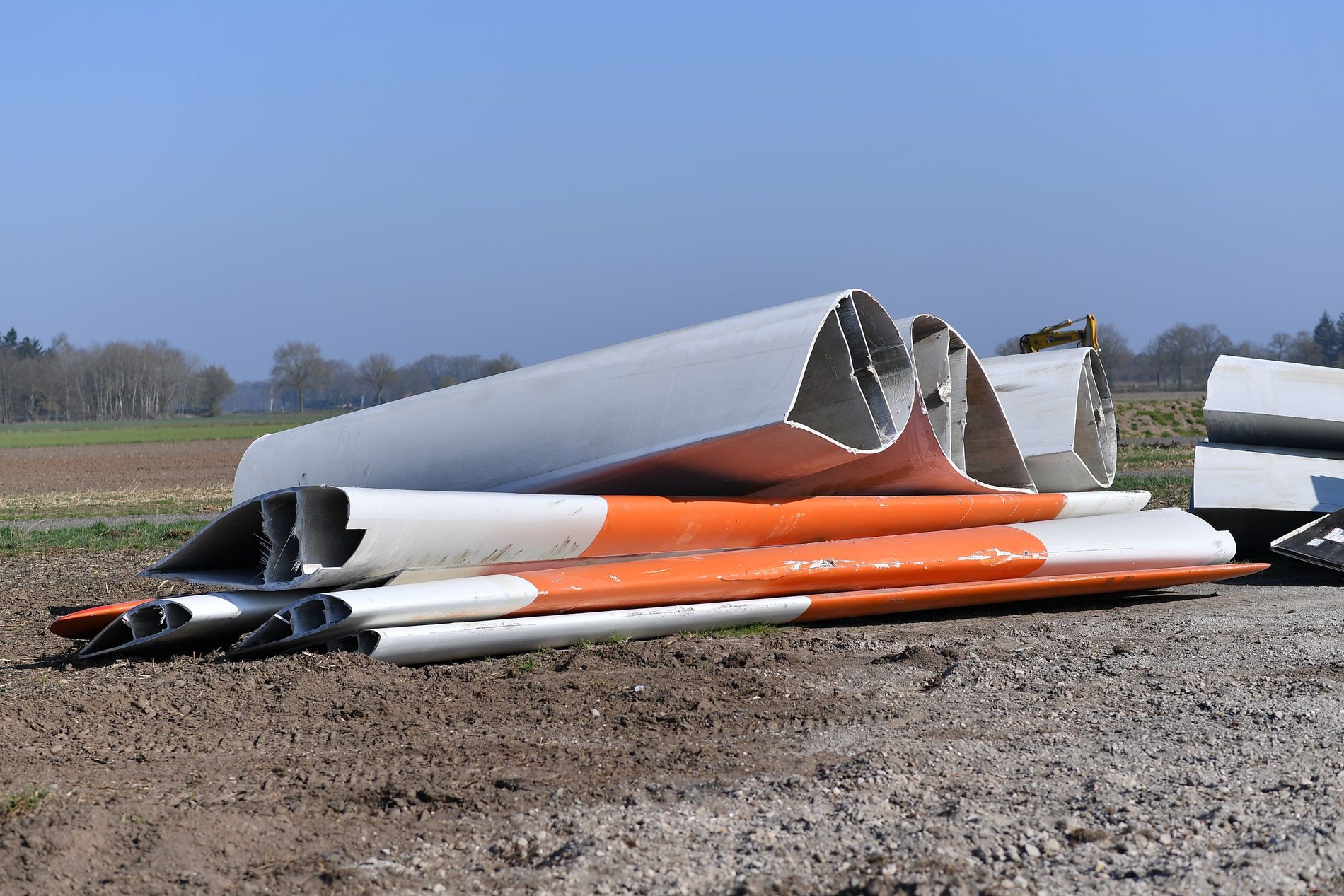
Image: Shutterstock
Rotor Blade Recycling: Insufficient Waste for Profitable Large-Scale Facilities
The Dutch research organization TNO estimates that the recycling chain it studied requires an annual throughput of 40,000 to 50,000 tons of composite material to be economically viable. Germany’s projected volume of rotor blade waste for 2025 would amount to only 13 to 16 percent of this figure. While this does not represent a universal threshold for all recycling methods, it highlights the challenge of achieving sufficient capacity utilization. Even if the number of decommissioned rotor blades increases significantly in the future, the quantities will likely fluctuate by region and from year to year. Consequently, recycling facilities would need to process waste from other industries as well and consolidate transport logistics.
The low value of the recovered raw materials further complicates the situation. According to the Fraunhofer Society, new glass fiber costs approximately one euro per kilogram, while new carbon fiber costs between 16 and 18 euros. As rotor blades are primarily composed of glass fiber, recovering these materials is particularly difficult to finance. A British modeling study estimates the gross cost of a small-scale thermal recycling process at 4.54 pounds per kilogram of recovered glass fiber. The economics only improve with a significantly higher throughput—a condition that requires both reliable buyers and a consistent supply of waste.
Shredding and Cement Plants: Recovery Without a True Circular Economy
Mechanical recycling processes are the most widespread. Companies saw or shred old rotor blades and then process the resulting granulate into fillers or panels. In the Netherlands, this material is already being used to create components for infrastructure projects. While this form of recycling is practical, the original glass fibers and epoxy resin are not recovered as high-quality, individual raw materials. Consequently, this often results in a degradation of material quality—a process known as “downcycling.”
The cement industry also processes significant quantities of rotor blade waste. In this context, the epoxy resin serves as a fuel substitute, while the mineral components are incorporated into cement production as raw materials. This approach leverages existing industrial infrastructure, making it relatively easy to scale. However, it does not result in the creation of new glass fibers or new rotor blades. While this method of disposal may make economic sense, it does not constitute a closed material loop.
Pyrolysis: Technically Feasible, Economically Uncertain
In pyrolysis, heat is used to break down the plastic matrix, thereby liberating the fibers. Depending on the temperatures applied and subsequent treatment, glass fibers may lose some of their structural strength, which limits their potential for reuse. High-quality carbon fibers, by contrast, offer the prospect of better economic returns. TNO is currently testing a two-stage thermal treatment process and has reported the recovery of approximately 60 kilograms of glass fiber so far; a facility with an annual capacity of 10,000 tons is currently in the planning stages.
In Germany, too, the recycling of rotor blades remains largely in the development phase. As part of the “ReWert” project, the Fraunhofer Society has been working since 2026 on a pilot plant designed to separate the materials found in decommissioned wind turbine blades prior to further processing. The objective is to specifically recover glass fibers, plastics, and core materials. The researchers are also examining disposal costs and potential future industrial utilization. Consequently, a formal economic assessment has yet to be conducted, even though the demand for such recycling processes is already growing.
Chemical Recycling: Great Promises, Slow Scaling
As early as 2023, Vestas and its research partners presented a method for the chemical separation of aged epoxy resins. This allows for the recovery of glass fibers and specific resin components, eliminating the need to completely reconstruct rotor blades. In May 2026, Stena Recycling reported progress at a test facility in Halmstad, Sweden, where several trials involving larger quantities of material have already taken place. However, there is no documentation yet of a full-scale, continuously operating facility with publicly verified total costs.
Other manufacturers are developing rotor blades that use epoxy resin designed to be dissolvable. Such components are already in use, and another field test has been arranged in India. While these innovations improve the outlook for new wind turbines, they do not address the disposal of the existing stock of decommissioned blades. Furthermore, chemical recycling processes require solvents, energy, and complex material separation techniques. It remains unclear whether the costs involved can be offset by the value of the recovered raw materials in a large-scale industrial operation.
New laboratory breakthroughs do not yet change the economic equation
The latest development comes from China. Researchers are using an electrical pulse to transform ground-up rotor blade material—at temperatures of around 2,000 degrees—into silicon carbide and graphene. The heating pulse lasts only half a second, but, to date, it can process a maximum of just ten grams at a time. A model-based calculation suggests a potential profit of around 80 US dollars per ton. However, this figure does not account for the costs of shredding, plant infrastructure, or other processing steps; consequently, it does not represent a reliable industrial return on investment.
The conclusion, therefore, is sobering. While several technically viable methods for processing rotor blades exist, large-scale, economically sound facilities for high-quality rotor blade recycling remain the exception. In particular, it has proven difficult to recover low-cost glass fibers in a way that creates a closed-loop system without incurring additional expenses. As the volume of waste grows, operators require reliable off-takers, long-term contracts, and sufficient capacity utilization. For this reason, it is currently impossible to foresee when a comprehensive, economically viable circular economy for decommissioned wind turbines might be achieved.
Author: Blackout News
Sources: Fraunhofer IWES (Stand: 21.11.26) – Sustainable Materials and Technologies (30.10.26) – TNO (02.07.26) – University of Strathclyde (08.06.26) – Stena Recycling (12.05.26)