
On June 19, 2026, in Madison, Wisconsin, Realta Fusion achieved a significant milestone in nuclear fusion. Conventional fusion power plant designs primarily generate electricity using heat, steam, and turbines. In contrast, Realta directly converted the kinetic energy of charged particles within the plasma into electric current. According to the company, this marked the first time a commercial fusion firm had achieved such a feat at a fusion facility. The electrostatic converter delivered several amperes at approximately 100 volts, yielding an output of several hundred watts. Realta must now scale the technology from this experimental level to power outputs relevant for future power plants.
Nuclear fusion could supply electricity without a thermal intermediate step
Conventional power plants typically generate electrical energy through a series of conversion steps: a heat source heats water, and the resulting steam drives a turbine and a generator. Many planned fusion power plants also rely on this principle. Realta, however, is attempting to harness a portion of the energy present in the plasma directly as electricity.
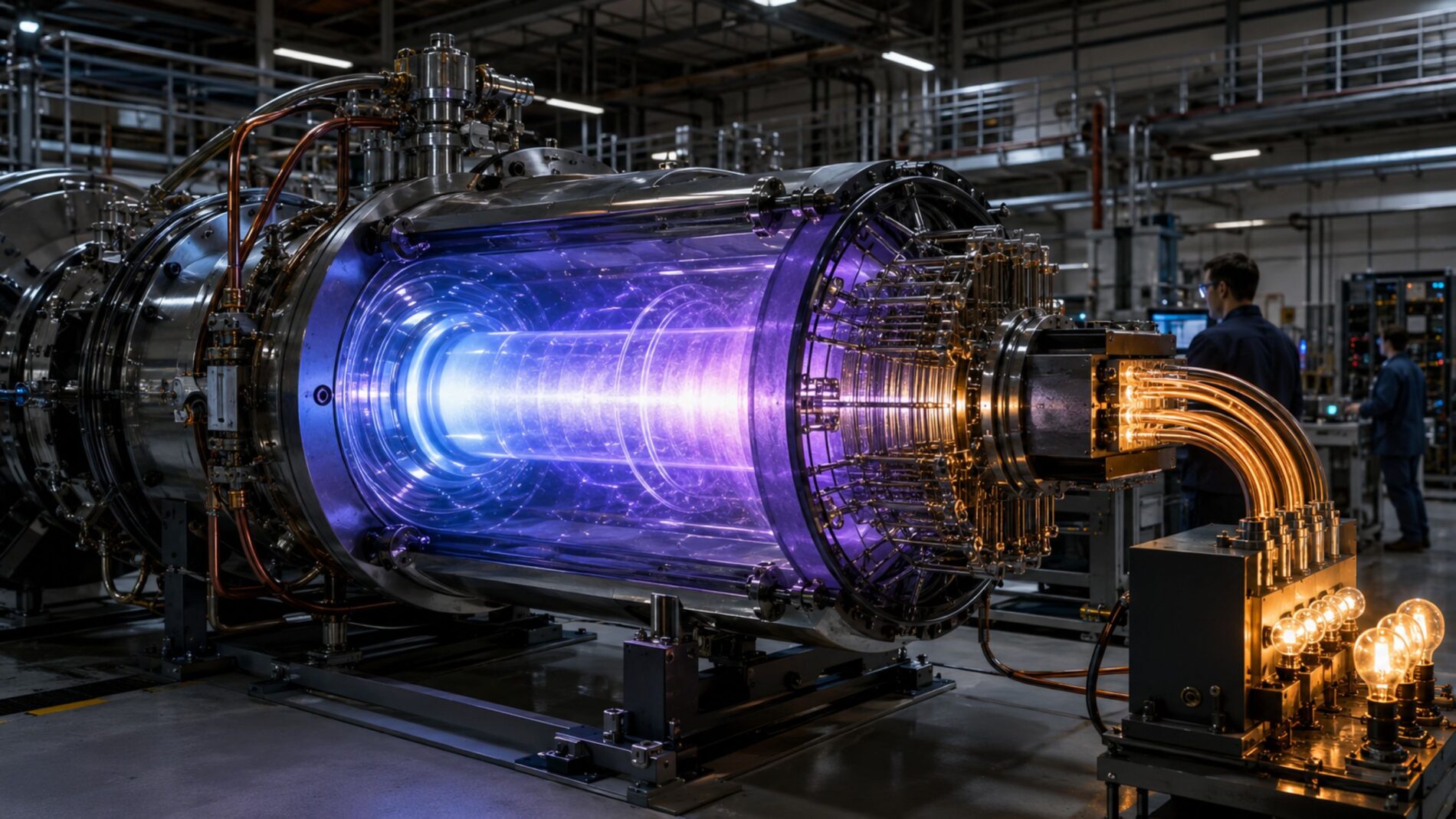
Representative image: AI-generated
To achieve this, the company leverages the unique design of its WHAM magnetic mirror reactor. Charged particles within the confined plasma tend to escape primarily at the ends of the magnetic field. There, an electrostatic system selectively decelerates the fast-moving particles, transferring a portion of their kinetic energy directly to the electrical system. Three fine-meshed grids perform distinct roles in separating and collecting the charge carriers.
Extracting energy directly from plasma could boost efficiency
The physical principle of direct energy conversion is not entirely new; research facilities investigated similar methods using magnetic mirror concepts decades ago. However, Realta has now integrated this technology into a modern commercial nuclear fusion program. This brings a previously overlooked question into sharper focus: how can the energy of a hot plasma be converted into usable electricity with maximum efficiency?
The potential advantage lies primarily in reduced conversion losses. Realta believes that future direct energy converters could technically achieve efficiencies exceeding 90 percent—a figure significantly higher than that of conventional thermal power plant cycles. However, the current experiment does not yet demonstrate this high level of efficiency; the company has not yet published a measured efficiency rating for the prototype used.
From hundreds of watts to megawatt-scale power
In the current experiment, the converter generated several amperes at a voltage of approximately 100 volts, resulting in an electrical output of a few hundred watts. Realta demonstrated the generated energy by, among other things, powering several connected incandescent light bulbs. However, this scale is far from sufficient for power plant applications, so the company is already planning significantly larger systems.
The next step involves developing converters in the kilowatt range, after which Realta aims to scale the technology up to several megawatts. The company also believes that achieving substantially higher power outputs with the existing WHAM facility is possible in the long term. However, it is not just higher electric currents that are crucial. The components must also withstand sustained high temperatures, particle fluxes, and electromagnetic stresses.
This provides a second pathway for electricity generation via nuclear fusion
Direct energy conversion could offer an additional method for generating electricity in future facilities. A fusion power plant would not necessarily have to convert all usable energy into heat first; instead, a portion of the charged plasma particles could directly supply electrical power. This could reduce energy losses while simultaneously lowering the power plant’s own internal energy consumption.
Consequently, the field of nuclear fusion faces not only the challenge of controlling fusion reactions in a sustained and economical manner, but also the equally important question of how to convert the generated energy into electricity as efficiently as possible. Realta has now demonstrated that electrical energy can be extracted directly from the charged particles of a fusion plasma. Whether this leads to a commercially viable power plant technology depends primarily on the planned scaling and reliable, continuous operation.