
How does electricity reach the wall outlet? A technically complex, interconnected European system lies between the power plant, wind turbine, or solar panel and the consumer. Generators and converters produce grid-compatible three-phase current, while transformers adjust the voltage for transmission and distribution. Grid operators also maintain frequency and voltage within strict limits. This overview describes the journey to the household outlet for interested laypeople, without oversimplifying the underlying physics.
Electricity is generated in various ways
Coal, biomass, and nuclear power plants typically generate heat first; this heat drives a turbine via a steam cycle. In contrast, with gas turbines, hot combustion gases act directly on the turbine. Hydroelectric power plants utilize flowing water, while the generator converts mechanical rotational energy into three-phase alternating current. Large turbogenerators produce voltages ranging from several thousand to tens of thousands of volts.
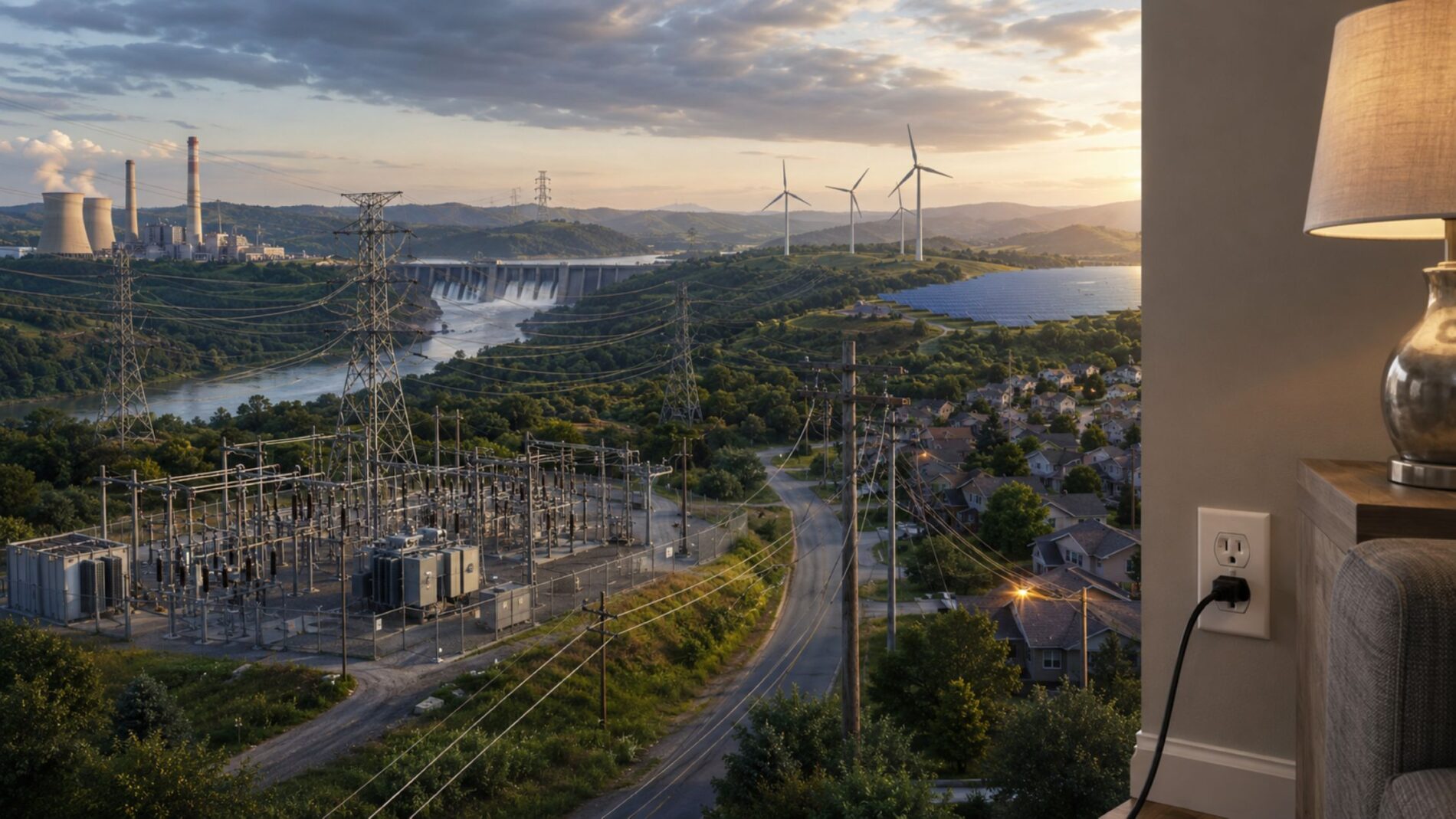
Image: AI-generated
The generator of a wind turbine also typically produces three-phase alternating current. However, in variable-speed turbines, its frequency varies with the rotor speed. In a turbine equipped with a full-scale converter, a power converter first rectifies the entire electrical output into direct current. Subsequently, the grid-side inverter converts this back into three-phase AC with the appropriate frequency, voltage, and phase. In contrast, with doubly fed asynchronous generators, the stator is connected directly to the grid; only the rotor current—and thus a portion of the power—passes through the converter. Photovoltaic modules generate direct current directly, which is why they also require an inverter to convert it into the appropriate alternating current.
How does electricity reach the wall outlet? Four levels lead to the home
The German electricity grid is divided into extra-high, high, medium, and low voltage levels. The extra-high-voltage grid operates predominantly at 220,000 or 380,000 volts and handles long-distance transmission. The high-voltage grid subsequently distributes power—usually at 110,000 volts—within larger regions. Medium-voltage grids often deliver power at 10,000, 20,000, or 30,000 volts to industrial facilities and local distribution substations. There, a transformer steps the voltage down to the low-voltage level.
The nominal voltage between two phase conductors in the low-voltage grid is 400 volts. Conversely, 230 volts is available between a phase conductor and the neutral conductor for standard household circuits. High transmission voltages reduce the required current for a given active power and power factor. This results in lower ohmic line losses, as these losses increase with the square of the current.
Frequency and voltage require different control methods
In a meshed AC grid, electrical power does not follow a single, geographically shortest path; instead, it distributes itself simultaneously across all electrically connected lines. A key factor in this regard is impedance. This term describes the total resistance a line presents to alternating current. Impedance encompasses the ohmic resistance of the conductor material as well as the effects of magnetic and electric fields; these additional components are known as inductive and capacitive reactance. In the case of high-voltage overhead lines, the inductive component typically has a particularly strong influence on power flow.
Given comparable voltage conditions, low impedance facilitates higher power flow. However, it is not the sole determinant; the magnitude and phase angle of voltages at various grid nodes also play a role. Consequently, grid operators adjust power flows through switching operations, phase-shifting transformers, controllable direct-current links, and redispatch measures. Thus, a power supply contract specifies the quantity of energy delivered, but not the physical path it takes through the grid.
Frequency, voltage, and protection systems keep the power grid stable
The Continental European synchronous grid operates at a nominal frequency of 50 hertz. If consumption rises more sharply than generation input, the frequency initially drops slightly; conversely, it rises if there is a surplus of power. Rotating synchronous generators dampen rapid fluctuations by utilizing their stored kinetic energy. Subsequently, balancing reserves restore the equilibrium between generation input and consumption. Voltage, on the other hand, depends more heavily on local loads, reactive power, and line impedances. Consequently, generators, inverters, compensation systems, and controllable transformers handle voltage regulation.
How does electricity reach the wall outlet even though generation and consumption are constantly changing? Control centers monitor currents, voltages, and power flows, while protection relays selectively disconnect faulty sections in the event of short circuits. Even switching on a single appliance increases the local current and slightly alters the total system’s power demand. While this individual effect is minuscule, millions of such events collectively shape the load profile. Every wall outlet is thus directly part of a European system that responds to every change in generation and consumption.
Author: Blackout News
Sources: 50Herz (Stand:16.07.26) – Bundesnetzagentur (Stand: 16.07.26) – VDE (15.06.25) – entso-e (20.03.26) – eon (Stand 16.07.26) – westenergie (15.06.26)