
In November 2026, physicist and former Greenpeace campaign strategist Peter Metzinger criticised Europe’s one-sided transport policy favouring electric cars. While policymakers primarily emphasise the high efficiency of electric motors, Metzinger advocates a more comprehensive energy assessment. Electricity generation, transmission and charging losses significantly influence actual primary energy consumption. Under certain conditions, a modern diesel vehicle can therefore achieve greater overall energy efficiency. Metzinger also advocates alternative fuels and points to China’s technology-neutral approach. For Europe’s automotive industry, the debate also concerns investment, competitiveness and the preservation of existing infrastructure.
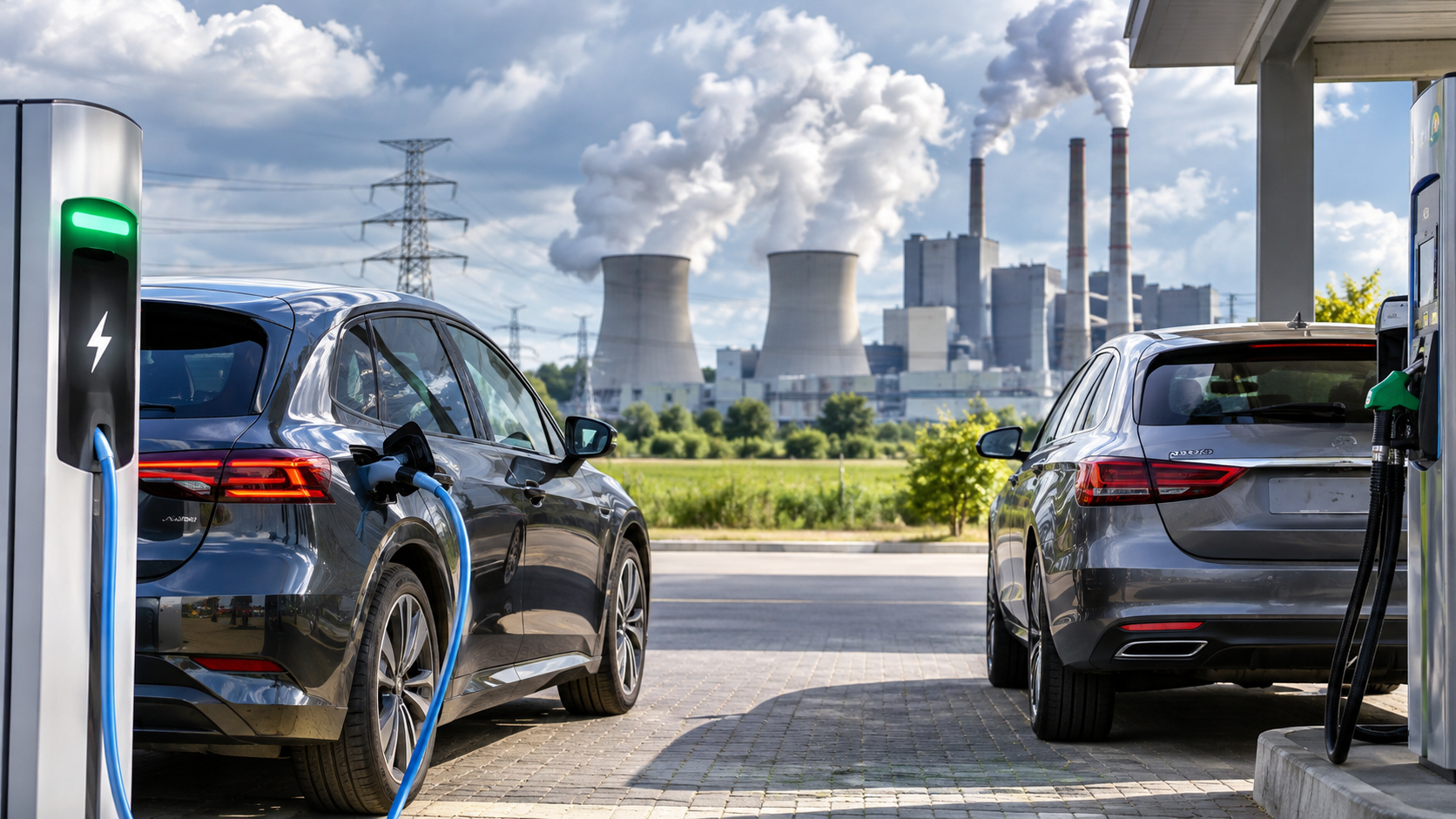
Image: AI-generated illustration
Electric cars – motor efficiency alone tells only part of the story
Electric motors achieve efficiencies exceeding 90 percent under favourable operating conditions. Modern diesel engines, by contrast, achieve efficiencies above 40 percent at their optimum operating point. However, this comparison accounts for only part of the energy losses. While diesel engines draw energy directly from fuel, electric cars first require electricity generation.
Fossil-fuel power generation involves considerable energy conversion losses. Additional losses occur during electricity transmission, battery charging and within the electric drivetrain. Therefore, the entire energy supply chain determines overall efficiency. However, any assessment of diesel vehicles must also include energy consumption during oil extraction, refining and fuel transportation.
Coal-fired power can eliminate the efficiency advantage
A simplified calculation illustrates these relationships. A coal-fired power plant operating at 38 percent efficiency converts 100 kilowatt-hours of primary energy into just 38 kilowatt-hours of electricity. Assuming five percent transmission losses and ten percent charging losses, approximately 32.5 kilowatt-hours remain. With an electric drivetrain efficiency of 90 percent, roughly 29 kilowatt-hours reach the wheels.
Assuming fuel supply efficiency of 85 percent and drivetrain efficiency of 38 percent, the diesel achieves approximately 32 percent overall efficiency. Under these specific assumptions, the diesel therefore marginally outperforms the electric car. However, a modern combined-cycle gas power plant operating at 60 percent efficiency fundamentally changes the result. Under otherwise identical conditions, the electric drivetrain achieves an overall efficiency of approximately 46 percent.
Electricity generation determines additional energy demand
For Germany’s energy transition, the timing of electricity consumption also plays a crucial role. The annual average electricity mix does not reveal which power plant meets additional demand during a particular hour. Electric cars perform particularly well when surplus wind and solar power is available. However, additional fossil-fuel generation changes the energy balance. Charging losses also vary depending on temperature and charging power.
Recent consumption measurements by Germany’s automobile association ADAC demonstrate considerable differences between individual vehicle models. The Tesla Model 3 Premium consumes approximately 15.9 kilowatt-hours per 100 kilometres, including charging losses. By comparison, the electric Mercedes GLC 400 consumes around 20.4 kilowatt-hours. Energy consumption therefore depends not only on drivetrain technology but also on vehicle weight, aerodynamics and driving conditions.
High energy efficiency does not guarantee lower operating costs
Greater energy efficiency does not necessarily translate into lower operating costs. Assuming electricity consumption of 20 kilowatt-hours and a charging price of €0.60 per kilowatt-hour, driving 100 kilometres costs €12. A diesel vehicle consuming five litres at an assumed price of €1.80 per litre costs €9. However, at a residential electricity price of €0.30 per kilowatt-hour, the electric car becomes considerably cheaper.
Metzinger therefore also advocates alternative fuels compatible with the existing vehicle fleet. However, the physicist himself has commercial interests in synthetic fuels. Producing these fuels requires considerably more electricity than using it directly in electric cars. Nevertheless, liquid fuels can offer advantages in storage, transportation and compatibility with existing infrastructure.
Technology neutrality instead of blanket efficiency claims
A transport policy based solely on motor efficiency falls short of addressing the challenges facing German industry. Beyond electricity generation, raw material requirements, vehicle manufacturing, infrastructure and energy security determine the wider economic consequences. Moreover, widespread electrification requires additional investment in electricity grids.
Electric cars offer a substantial energy efficiency advantage under favourable conditions. However, this does not establish universal superiority across all operating conditions. A sound transport policy must therefore consider complete energy supply chains, real-world consumption data and the economic consequences of different drivetrain technologies. Political targets cannot change the laws of physics.
Author: Blackout News
Sources: Focus (23 Nov 2026) – eFuels Forum – ReclaimTheFacts – ADAC – Energy consumption tests – ADAC – Vehicle cost comparison
Read also:
- The Charging Station Cost Trap: High Electricity Prices Threaten the Economic Viability of Electric Cars
- North Rhine-Westphalia’s finance minister switches from electric car to diesel, confirming the skepticism of electric car critics
- Court draws a clear line: Return of electric car possible if range is insufficient
- Electric cars: Car manufacturers suffer €60 billion in losses due to ideological mismanagement