
At the end of July 2026, China achieved a decisive development step in gas-cooled nuclear technology. A helium turbine in the megawatt class generated electricity with pure helium in hot test operation for the first time in China. The system works with a closed Brayton circuit. In the future, the hot helium could therefore directly drive a turbine without first generating water vapor. German engineers investigated exactly this approach decades ago for the high-temperature reactor in Jülich. China is now moving the principle from theoretical concepts toward technical demonstration. However, the new turbine is currently running in a test facility and not on a commercial reactor.
High-temperature reactor could eliminate the need for the entire steam cycle
The commercial Chinese HTR-PM in Shidaowan currently still operates using conventional steam technology. Two helium-cooled reactor modules heat water via steam generators. The resulting steam then drives a shared turbine with an electrical output of 210 megawatts. Thus, the helium merely transfers the reactor heat, while a second circuit handles the actual electricity generation.
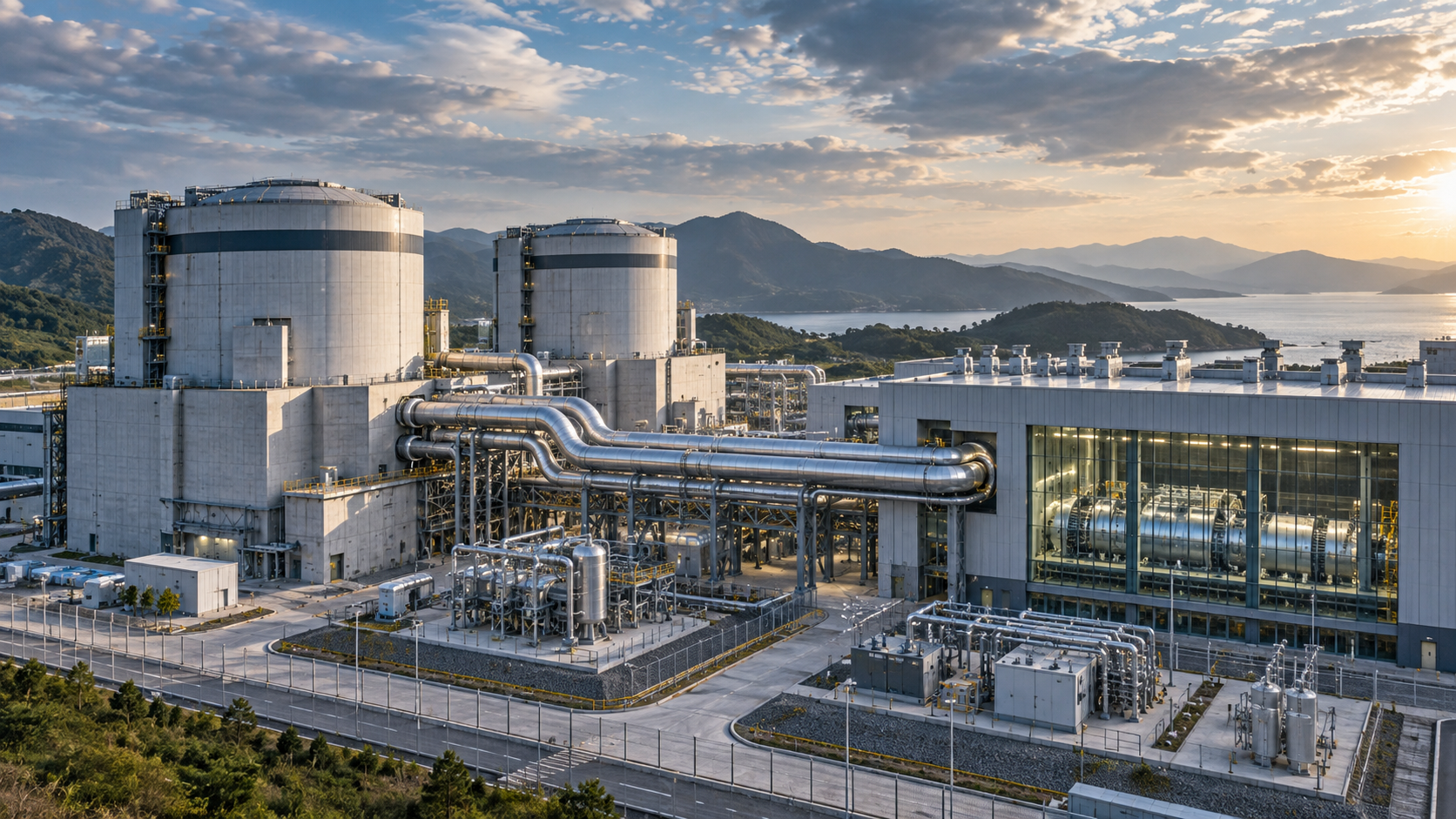
Representative image: AI-generated
In the new concept, however, helium also assumes the role of the working fluid within the turbine. The gas transports the heat and subsequently expands directly inside the turbine assembly. Heat exchangers then cool the helium down, while compressors restore the necessary pressure. A closed Brayton cycle can therefore eliminate the need for steam generators and large sections of the water-steam system. Furthermore, directly utilizing high gas temperatures can improve electrical efficiency.
German engineers began developing the direct helium cycle as early as 1968
The foundations of this technology were largely established in Germany. The AVR—a helium-cooled pebble-bed reactor operating at temperatures of up to approximately 950 degrees Celsius—began operation in Jülich in 1967. However, this high-temperature reactor still utilized a steam generator and a conventional steam turbine. In parallel, Germany launched the HHT program in 1968 to develop a direct helium gas turbine cycle. The goal was a power plant in which the reactor coolant—helium—would drive the turbine directly.
To this end, German researchers built facilities such as the HHV (High-Temperature Helium Test Facility) in Jülich. There, they investigated turbomachinery, heat exchangers, hot-gas piping, materials, and seals under high-temperature helium conditions. Additionally, a test facility featuring a helium turbine operated for many thousands of hours in Oberhausen. The IAEA generally regards those early experiments as having demonstrated the technical feasibility of the direct helium cycle. However, Germany did not carry the HHT project through to the construction of a nuclear power plant featuring a direct helium turbine.
China Scaling Up German HTR Technology to Industrial Levels
China subsequently adopted key concepts from modular pebble-bed reactors and used them to develop the HTR-10 and HTR-PM. The HTR-PM has been in commercial operation since December 2023. At the same time, China is significantly expanding the program; Unit 3—a high-temperature reactor with an electrical output of approximately 660 megawatts—is currently under construction in Xuwei. China’s nuclear safety authority approved the safety design criteria for this unit in late August 2026. Contracts for key components and the installation of the nuclear island are also currently being awarded.
However, the new helium turbine is not part of the 660-megawatt reactor in Xuwei. CNNC is initially developing it as a core component for gas-cooled micro-reactors. Nevertheless, the trial demonstrates a technology that Germany investigated intensively more than five decades ago. Today, China combines these fundamentals with its own reactor development, manufacturing capabilities, and growing experience in series production. Ultimately, however, factors such as continuous operation, maintenance requirements, helium losses, and actual efficiency levels will determine whether this leads to a commercial nuclear power plant that operates without a steam cycle.
Author: Blackout News
Sources: Seetao (05.09.26) – Cinie (02.09.26)