
Berlin – Several German climate and environmental policymakers will no longer be driving purely electric cars in 2026. This is revealed by the new company car assessment published by Environmental Action Germany (DUH) on September 1. Hamburg’s Senator for the Environment, Katharina Fegebank, and Saxony’s State Minister for the Environment, Georg-Ludwig von Breitenbuch, have switched to plug-in hybrids. Saxony-Anhalt’s Minister for Climate Protection, Armin Willingmann, also drives a plug-in hybrid; according to DUH calculations, his Audi emits 192 grams of CO2 per kilometer. In total, 160 of the 249 vehicles examined received a “red card.” However, the figures for the hybrids are based on model-based assumptions rather than measurements taken during actual driving.
Company car with combustion engine instead of pure electric drive
Katharina Fegebank’s switch is particularly notable. Hamburg’s Green Party Senator for the Environment previously drove an electric vehicle but now uses a Mercedes-Benz E 300 e. The DUH calculates emissions of 153 grams of CO2 per kilometer for this model, placing the vehicle firmly in the “red” rating zone. Hamburg’s Senator for Finance, Andreas Dressel, also switched from an electric car to a plug-in hybrid.
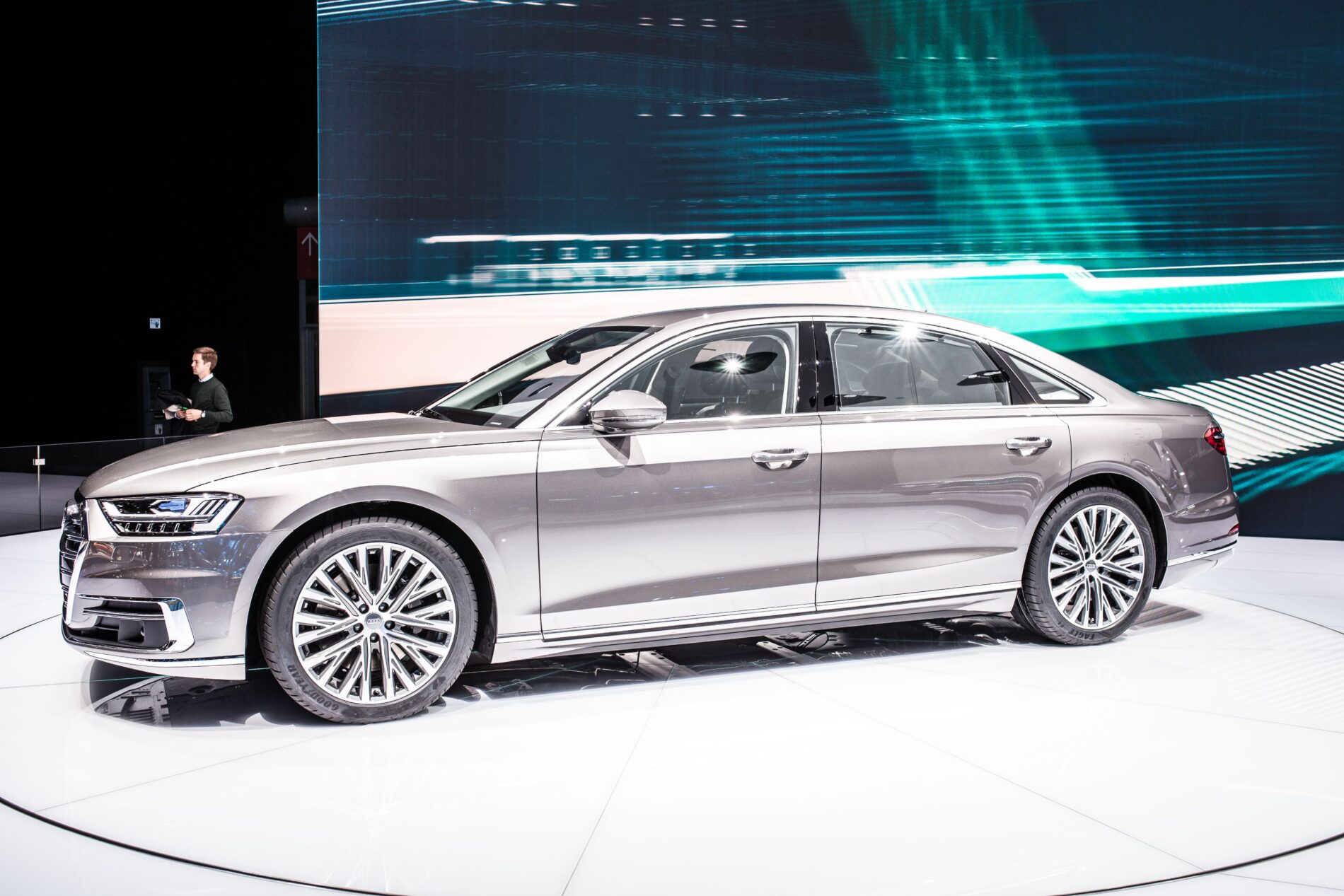
Image: Shutterstock
This switch is particularly notable because Fegebank’s own agency actively promotes electromobility. In July, she explicitly praised Hamburg-based companies for switching to zero-emission vehicles. Notably, the city’s “UmweltFlotte” (Environmental Fleet) program does not classify plug-in hybrids as zero-emission vehicles. Yet, the responsible senator now uses a vehicle with an internal combustion engine herself. This decision stands in stark contrast to the policy direction of her agency.
Plug-in hybrids now dominate government fleets
Vehicles in other environmental departments also show high emission figures. Willingmann’s Audi A8 L 60 TFSI e has a calculated output of 192 grams of CO2. Von Breitenbuch’s Mercedes S 580 e comes in at 182 grams. Brandenburg’s Environment Minister Hanka Mittelstädt records 176 grams with her hybrid. In contrast, Mecklenburg-Western Pomerania’s Climate Protection Minister Till Backhaus drives a diesel model emitting 148 grams.
However, the trend extends beyond environment ministers. Plug-in hybrids now account for 42 percent of all official vehicles surveyed, making them the largest category by powertrain type. Pure electric cars account for only 36 percent, or 90 vehicles. Their share has declined at both the federal and state levels. According to the DUH (Environmental Action Germany), vehicles with internal combustion engines average 193 grams of CO2 per kilometer. At 179 grams, plug-in hybrids are only slightly below that figure.
Review of official vehicles reveals shift within the federal government
Three Ministers of State at the Federal Foreign Office also switched from all-electric cars to plug-in hybrids. Serap Güler, Gunther Krichbaum, and Florian Hahn now each use an Audi A8 L 60 TFSI e. The DUH (Environmental Action Germany) calculates emissions of 196 grams of CO2 per kilometer for these vehicles. Justice Minister Stefanie Hubig and Education Minister Karin Prien also record the same figure with comparable models. In contrast, Development Minister Reem Alabali-Radovan’s vehicle emits 64 grams of CO2.
Figures for state leaders are in some cases even higher. Hendrik Wüst, Manuela Schwesig, and Kai Wegner each record a calculated 262 grams of CO2 with their armored Audi models. However, direct emissions data for the armored variants is unavailable, so the DUH uses comparably powered base models for its calculations. Conversely, Baden-Württemberg Minister-President Cem Özdemir drives an electric vehicle, resulting in 66 grams of CO2 emissions.
Calculation of hybrid figures based on a generalized assumption
The high CO2 figures for plug-in hybrids require important context. The DUH does not measure how often a specific official vehicle actually runs on electric power. Instead, it assumes an electric driving share of around eleven percent for plug-in hybrids. The remaining 89 percent is attributed to the internal combustion engine for calculation purposes. Consequently, the calculated figures are significantly higher than the official WLTP ratings provided by many manufacturers.
Despite this methodology, the fundamental conclusion remains clear: politicians have replaced several all-electric cars with vehicles that also feature an internal combustion engine. Meanwhile, the DUH advocates for the procurement of exclusively efficient electric vehicles. Among the political parties, the Greens still perform the best, with an average of 89 grams. Therefore, this shift back to hybrids does not apply to all climate and environmental policymakers; however, it is particularly noticeable among the relevant department heads.
Author: Blackout News
Sources: Deutsche Umwelthilfe (01.09.26) – Tagesschau (01.09.26)