
Germany, August 2026 – Starting in 2030, the EU is halving the permissible annual limit for nitrogen dioxide from 40 to 20 micrograms per cubic meter. Engine expert Thomas Koch from KIT warns that this could lead to driving bans for millions of diesel vehicles, including those meeting Euro 6 standards. The timing is notable, given that Germany’s air quality has been improving for years; in 2025, every monitoring station complied with the NO₂ limit currently in force. Nevertheless, the EU is establishing a significantly stricter legal standard that could turn previously unproblematic roads into trouble spots once again.
Driving bans are based on a political decision regarding limit values
The health impacts of nitrogen dioxide have been scientifically studied and are fundamentally established. However, this does not imply a scientifically mandatory threshold set precisely at 20 micrograms. Rather, the specific limit value is the result of political considerations, in which factors such as preventive health protection, technical feasibility, costs, and societal consequences play a role.
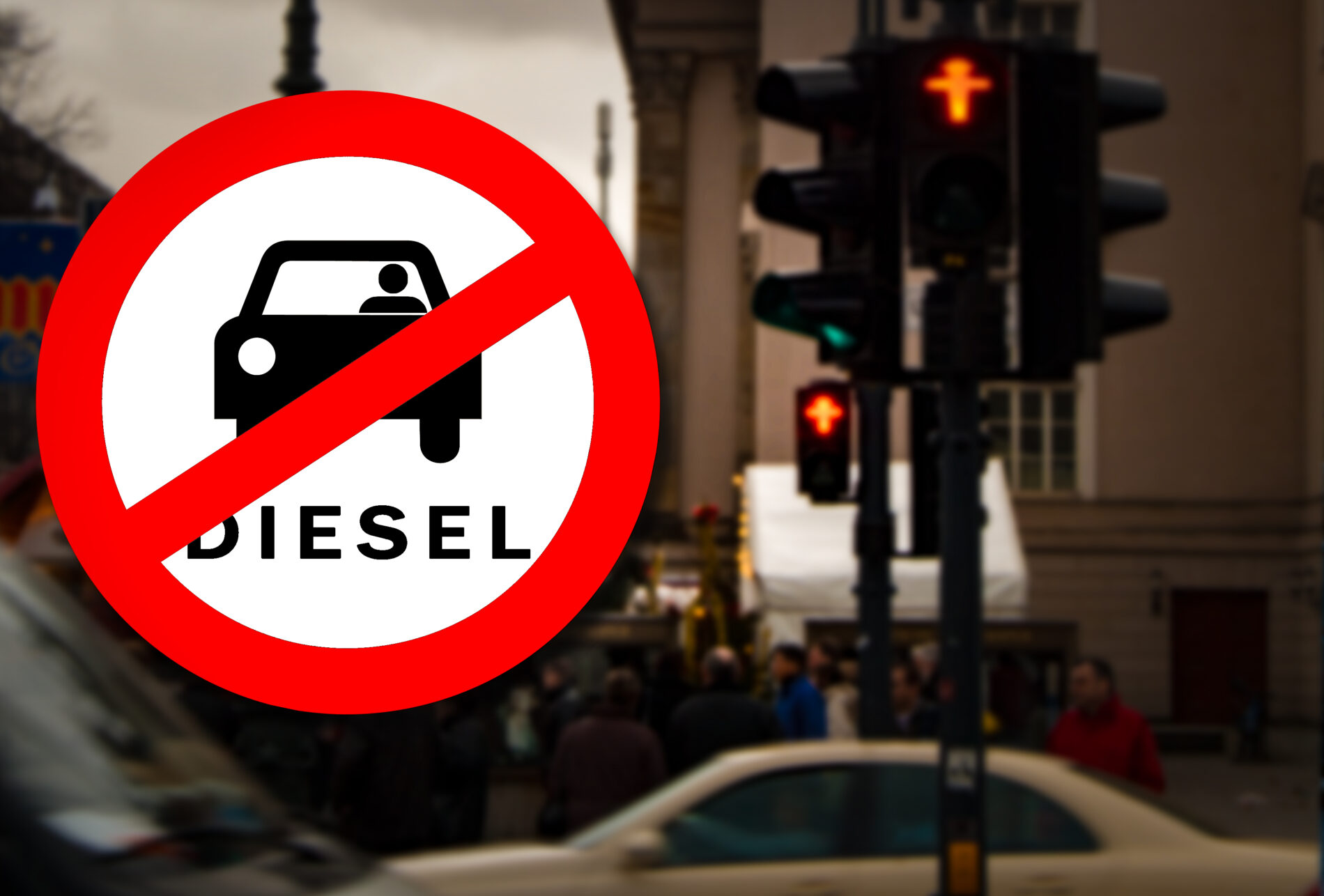
Image: Shutterstock
This is precisely why the rationale for the new limit value should not be based solely on scientific findings. Research provides data on potential exposure and risks, but it does not dictate that lawmakers must exactly halve the current limit. Ultimately, the decision to set the limit at 20 micrograms rather than 40 is a political one—and that includes the decision regarding the potential consequences for motorists.
Germany meets current standards—yet the EU is drastically tightening them
It is precisely the actual trends that make this tightening of regulations a matter requiring explanation. In 2025, Germany complied with all currently valid European air quality limits. For NO₂, this marked the second consecutive year of compliance; for fine particulate matter, it was the eighth. Nevertheless, 39 percent of monitoring stations still recorded levels above the future NO₂ limit of 20 micrograms. However, the German Environment Agency (UBA) expects only isolated exceedances by 2030.
This means that what changes is not the air itself, but rather its legal assessment. A street with NO₂ levels of 25 micrograms currently complies with regulations without issue. From 2030 onwards, however, that same level of pollution will be well above the new limit. This is precisely what could lead to new driving bans, even though actual pollutant levels have not increased.
No evidence of a covert ban on combustion engines—yet the transport sector bears the consequences
There is no evidence that Brussels decided to tighten limit values solely to phase out the internal combustion engine; after all, the regulations also affect industry, heating systems, and other sources of emissions. Nevertheless, the EU explicitly cites traffic restrictions as a potential instrument. Furthermore, authorities are required to develop air quality plans at an early stage if limit values are at risk of being exceeded.
This turns an abstract decision on limit values into very concrete consequences. Cities can tighten access restrictions if other measures prove insufficient. The DIHK (Association of German Chambers of Commerce and Industry) therefore explicitly calls for driving bans and operational restrictions to be ruled out during the German implementation process. After all, it is not EU institutions that bear the immediate costs, but rather vehicle owners and businesses.
The political direction cannot, therefore, be reduced to a purely technical adjustment. The EU is setting a significantly stricter standard, even though pollution levels are declining in the long term. As a result, roads that currently meet all requirements could become legally problematic from 2030 onwards. This creates a new economic risk for millions of diesel vehicle owners. Precisely for this reason, policymakers must openly explain what additional benefits they expect from halving the limits and which restrictions they consider proportionate to achieve this.
Author: Blackout News
Sources: Focus (22.08.26) – IHK Karlsruhe (23.06.26) – Bundesumweltministerium (02.06.26) – Umweltbundesamt (11.02.26)