
A commentary by our author Klaus Bastian:
On November 4, 2026, former State Secretary Patrick Graichen confirmed the cost advantage of existing nuclear power plants during an R21 conference. As early as 2022, the Ministry for Economic Affairs had received indications pointing to lower electricity prices, reduced gas consumption, and more stable grid operations. Nevertheless, the ministries led by Robert Habeck and Steffi Lemke persisted with the final nuclear phase-out. The last three reactors were taken off the grid on April 15, 2023. As a result, Germany lost approximately four gigawatts of reliable power capacity, while costs for fossil-fuel-based replacement capacity and grid stability continue to be incurred.
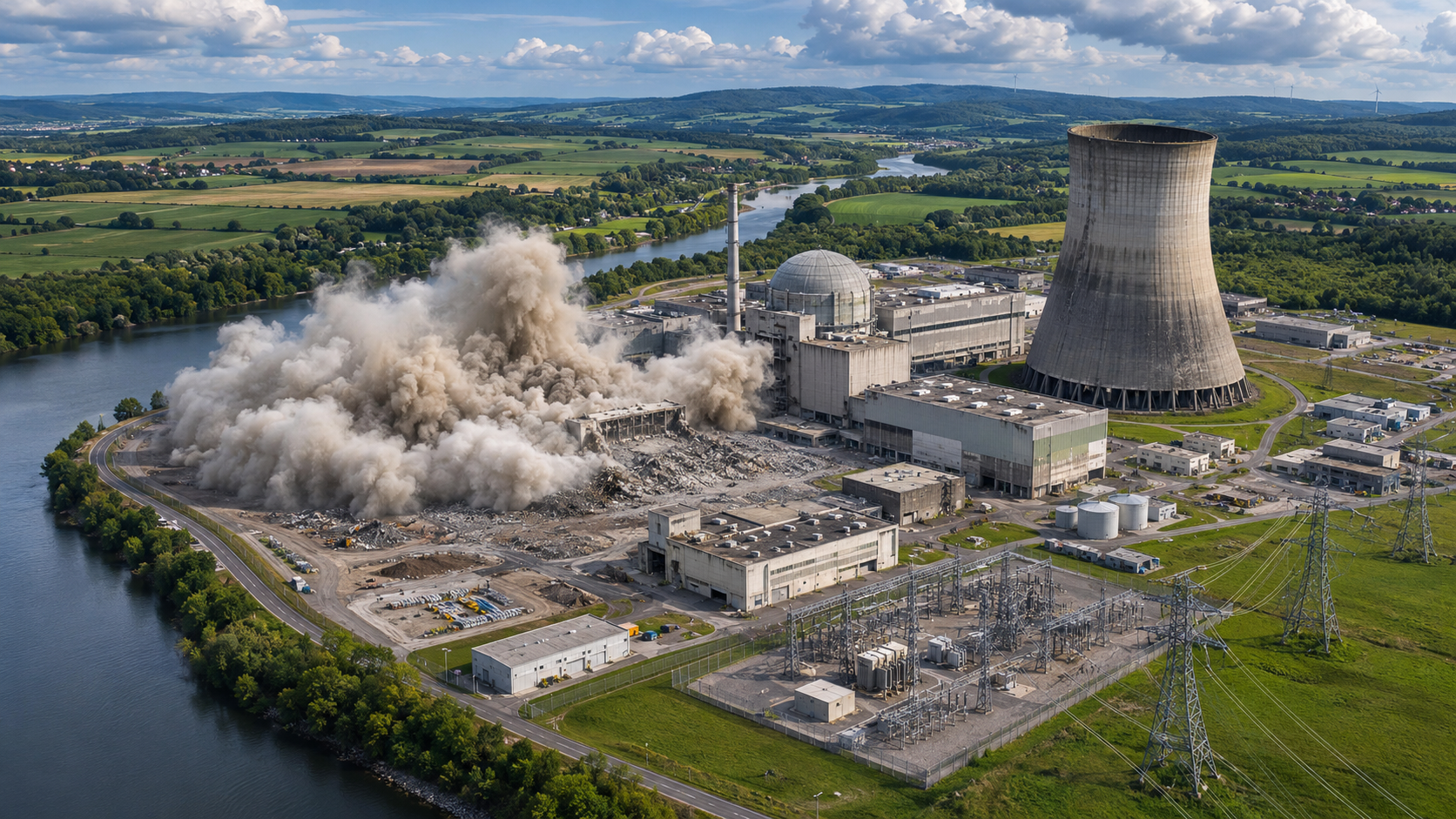
Image: AI-generated
The economic benefits were already known in 2022
An internal email exchange from 2022 between the Ministry for Economic Affairs and the Ministry for the Environment is particularly striking. According to a recent report by BILD, the department responsible for electricity outlined three advantages of continuing nuclear plant operations: electricity prices would fall, grid stability would improve, and natural gas consumption would decrease. This department fell under Graichen’s purview. Consequently, the economic arguments were documented within his own sphere of responsibility long before the federal government shut down the final reactors.
The disagreements that existed at the time are further highlighted by the findings of a parliamentary investigative committee. A ministry official testified that Graichen had initially rejected his proposal to extend the operation of nuclear power plants. The official’s objective was to conserve natural gas—especially during the winter—by having nuclear plants take over some of the electricity generation otherwise provided by gas-fired power plants. Although Graichen did allow these considerations to be recorded in writing, the official was already aware of his opposition from a prior personal conversation.
Gas was in short supply—yet the government opted against using existing nuclear power plants
The contradiction with the crisis policy of that time is significant. On June 19, 2022, Robert Habeck announced the deployment of additional coal-fired power plants to save natural gas. For political reasons, the federal government sought to make Germany independent of Russian natural gas as quickly as possible—at a time when Russia was drastically reducing its gas supplies. While the government was willing to accept increased coal-fired power generation—and the resulting higher CO₂ emissions—it continued to reject extending the operational lifespan of existing nuclear power plants. In doing so, it passed up an additional opportunity to conserve gas and lower electricity prices, precisely during an energy crisis.
The federal government was also aware of the link between gas prices and electricity costs. As early as 2022, it explained to the Bundestag that gas-fired power plants frequently determine the electricity price on the exchange. Consequently, expensive natural gas did not merely increase the cost of generation for individual plants; it influenced the entire wholesale market. Additional nuclear-generated electricity could have displaced more expensive forms of production. In such a situation, every instance of avoidable gas consumption should have been subjected to particularly rigorous economic scrutiny.
Graichen now acknowledges the price advantage—but denies it was a mistake
“Of course, if we had kept those units running in 2023, we would have had even more electricity available at relatively low marginal costs,” Graichen stated. Nevertheless, he refused to concede that the nuclear phase-out was a mistake. Instead, he reiterated his position by citing the risk of a major reactor accident. The price advantage has since been quantified scientifically: the IWH (Leibniz Institute for Economic Research) in Halle estimated that continued operation between April and December 2023 could have led to a decline in wholesale electricity prices of between one and eight percent.
The crucial point, however, concerns the timing of these insights. Today, Graichen points to economic benefits that his department had already documented during the energy crisis. Nevertheless, the government at the time insisted on the final shutdown. While the fact that they placed greater weight on safety concerns explains their position, it does not substitute for a coherent, comprehensive assessment of the economic drawbacks that were knowingly accepted. It is precisely this accounting that those responsible at the time owe to the public.
Nuclear power shut down – multi-billion-euro subsidies for gas-fired power plants
The consequences extend beyond electricity prices themselves. The shutdown removed approximately four gigawatts of weather-independent generation capacity. Consequently, during periods of low wind and solar output—known as “dunkelflaute”—the power supply must still be secured by coal and gas-fired plants, energy storage, or imports. In early November 2026, the Federal Network Agency awarded contracts for 5,160 megawatts of new gas-fired power plant capacity. Over a 15-year period, the operators will receive a total of approximately twelve billion euros for this—costs that will ultimately be borne by electricity consumers.
Additional financial burdens arise from grid operations. The Federal Network Agency confirms that the phase-out of nuclear energy has altered electricity flows, necessitating further “redispatch” measures (adjustments to power plant output to manage grid congestion). Furthermore, the German Environment Agency has identified the shutdown of the final reactors in 2023 and 2024 as a factor that increases emissions. While overall emissions did decline due to other developments, the loss of nuclear power plants meant the disappearance of an existing, low-carbon source of electricity. Therefore, both the economic and climate-policy consequences must be subjected to a comprehensive review.
What responsibility do Habeck, Lemke, and Graichen bear?
The initial decision to phase out nuclear power dates back to previous administrations. However, during the energy crisis, Habeck, Lemke, and the federal government at the time made the final determination regarding the continued operation (or lack thereof) of these plants. Graichen was one of the key figures responsible for energy policy. Meanwhile, the legally mandated dismantling process began following the shutdowns. With every component removed, any potential future restart becomes increasingly complex—and the possibility of reversing the original decision steadily diminishes.
Those who made these decisions must therefore explain how they evaluated the well-known price advantages and potential savings in natural gas consumption. This requires an independent assessment covering replacement power plants, grid operations, and the resulting additional emissions. Not all of these expenditures can be attributed solely to the nuclear phase-out. Yet, without such a calculation, it also remains unclear what costs might have been avoided through continued operation for a longer period. Graichen’s confirmation today of the price advantage makes this political accounting particularly urgent.
Author: Klaus Bastian – Blackout News
Sources: Bild (07.11.26) – Denkfabrik 21 (06.11.26) – Welt (07.11.26) – Reuters (03.11.26)