
In Lower Austria, plans for a wind farm between Harmannsdorf and Leobendorf—slated for early November 2026—have sparked debate. At the heart of the discussion is a previously overlooked phenomenon: infrasound from wind turbines can cause structural components of residential buildings to resonate, potentially amplifying specific frequencies. Scientific studies describe this mechanism, which, under certain conditions, can trigger perceptible vibrations. Consequently, local residents fear sleep disturbances and a decline in their quality of life. However, no such impact has yet been demonstrated at the proposed site. The wind farm has not yet received approval.
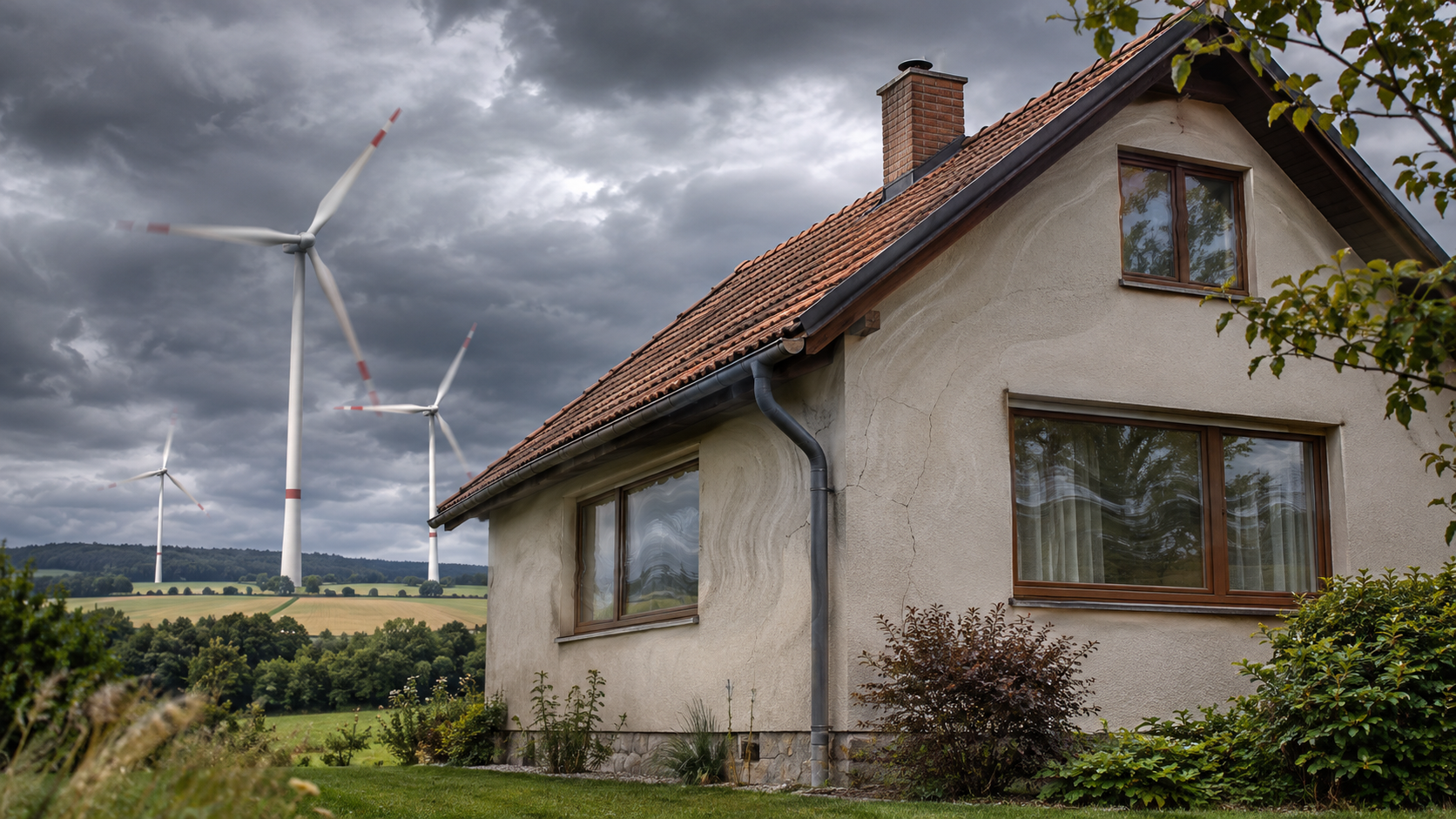
Image: AI-generated
When Infrasound Causes Walls and Ceilings to Vibrate
As their rotor blades turn, wind turbines generate low-frequency sound waves. Frequencies below 20 hertz are classified as infrasound. While these vibrations generally fall outside the range of human hearing, they can still excite building structures—even though the occupants cannot hear the original sound waves. The outcome depends on the specific frequencies involved and the physical properties of the building components.
A scientific review by Claire and Rory Flemmer describes this physical mechanism. It explains that, under certain conditions, wind turbines can trigger vibrations and audible secondary noises in nearby buildings. When specific frequencies align with the natural frequencies of building elements, resonance can occur, causing walls, ceilings, or other structural components to transmit vibrations. However, the study—published in 2023—does not suggest that all residential buildings located near wind farms are affected in this way.
Why sound measurements taken outside a house may not be sufficient
The extent to which low-frequency sound affects indoor spaces depends significantly on the building’s construction. Solid masonry, timber-frame structures, and varying room geometries can each exhibit different resonance characteristics. Consequently, sound levels inside a building cannot always be reliably inferred from measurements taken outdoors. Furthermore, closed windows do not necessarily prevent the transmission of low-frequency sound. However, the mere physical possibility of resonance does not automatically imply a health-relevant impact.
Assessing sound exposure also involves a specific technical nuance. The German Environment Agency (Umweltbundesamt) refers to the DIN 45680 standard for low-frequency noise, which covers indoor frequencies between 8 and 100 Hertz. Extremely low frequencies—those below 8 Hertz—therefore fall outside this measurement range. If complaints suggest the presence of even lower frequencies, a separate investigation may be necessary. Nevertheless, the absence of a specific assessment standard does not constitute proof of a health risk.
Scientific debate surrounding sleep disturbances caused by wind turbines
Residents living near wind farms frequently report sleep disturbances, headaches, and persistent noise-related distress—issues that can significantly impair their quality of life. However, this does not automatically establish a causal link to infrasound. A large-scale, long-term study, which included researchers from the University of Augsburg, found no statistically significant adverse health effects at typical residential distances from wind turbines. The researchers reached this conclusion by analyzing data from more than 120,000 U.S. households.
The study does, however, have methodological limitations. For instance, the researchers were unable to determine the precise distances between individual homes and the wind turbines; instead, they relied on geographical approximations based on postal code areas. Consequently, minor health effects cannot be entirely ruled out. Furthermore, the study does not address whether certain buildings might experience unusually high indoor sound levels due to resonance effects.
EU identifies need for further research into infrasound from wind turbines
At the European level, too, policymakers are examining potential health consequences. In October 2026, the European Commission stated that it takes the potential health impacts of wind turbines—including infrasound—seriously. However, it noted that there is currently an insufficient scientific basis for establishing specific WHO limit values. While Brussels thus acknowledges the need for further research, it does not confirm that wind turbines cause proven health damage.
In Germany, the issue has also reached the Bundestag. A parliamentary inquiry dated October 22 addresses potential effects on the nervous system, sleep, and cardiovascular health. It should be noted, however, that the health conditions mentioned in the inquiry are the subject of the questioning rather than confirmed research findings. The long-term impact of recurring sound events, in particular, therefore remains an important area for further research.
Planned Wind Farm Makes Noise Protection a Key Point of Contention
In the municipalities of Harmannsdorf and Leobendorf, local authorities are set to provide information regarding a proposed wind farm area on November 5. The sessions will feature input from experts in the energy sector, spatial planning, and environmental medicine. Each event is scheduled to begin at 7:00 p.m. However, reliable operational data for the designated site is currently unavailable, as no authorized turbines have yet been installed there. Consequently, it is not currently possible to quantify the specific noise impact on individual homes.
For local residents, a critical issue is how the future permitting process will account for noise exposure. This assessment should transparently evaluate factors such as the proximity of residential properties, the operational conditions of the turbines, and the potential for low-frequency sound components. Should complaints arise later, indoor noise measurements might also become necessary; compliance with outdoor noise limits does not necessarily address all concerns regarding potential resonance effects within a building.
Author: Blackout News
Sources: tkp (04.11.26) – Parlamentarische Anfrage (19.10.26)