
A commentary by our author Klaus Bastian:
Friedrich Merz set out with exceptionally ambitious promises. The AfD was to shrink, the Union to grow stronger, and Germany to return to economic growth. At the same time, the Union pledged sound finances, less bureaucracy, and lower energy costs. By early October 2026, however, several outcomes hardly align with these aspirations. Employment is falling while unemployment rises. The Union has slipped to 17.5 percent in an INSA poll, and only ten percent are satisfied with Merz’s performance as Chancellor. Added to this are high levels of new borrowing and relief promises that have not been fully kept. It is precisely this widening gap between mission and outcome that lends a tragic dimension to the comparison with Don Quixote.
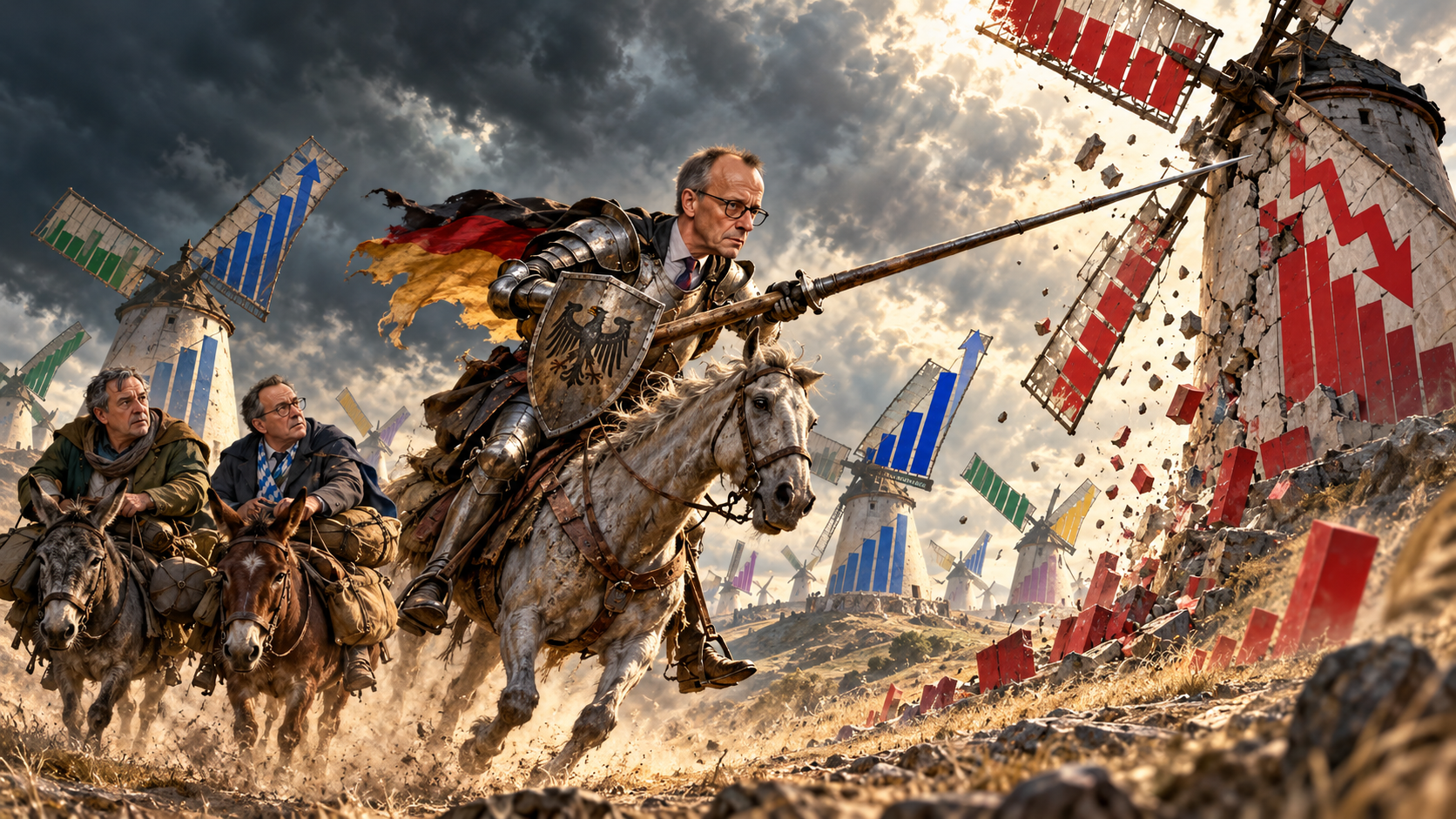
Image: AI-generated
Friedrich Merz wanted to cut the AfD’s support in half, yet he has nearly halved the Union’s.
In 2018, Merz declared that the Union could once again reach 40 percent and cut the AfD’s support in half. Today, INSA polls place the AfD at 30.5 percent and the CDU/CSU at 17.5 percent. Compared to the 32.9 percent the Union secured in the 2017 federal election, this represents a decline of nearly 47 percent. Merz is not solely responsible for this development. Nevertheless, the goal he once set has been turned almost completely on its head.
The “firewall” strategy has also failed to prevent the AfD’s rise so far. However, one cannot directly attribute the Union’s losses to this policy. Moreover, the strategy of distancing the party remains controversial even among Union supporters. A sober assessment therefore suffices for this commentary: the strategic goal was a weaker AfD, yet in reality, the party has become significantly stronger.
Friedrich Merz promises growth – yet employment is falling
A similar contrast is evident in economic policy. Merz repeatedly calls for more growth, investment, and employment. In fact, gross domestic product grew by 0.3 percent in the second quarter compared to the previous one. The federal government now even projects growth of 1.3 percent for 2026. Yet, this upturn has not yet reached the labor market.
In August, 45.41 million people were employed—235,000 fewer than a year earlier. At the same time, the number of unemployed persons rose by 120,000 to 1.86 million. The unemployment rate increased from 3.9 to 4.3 percent. While economic growth and declining employment are not mutually exclusive in economic terms, politically there remains a stark contrast to the promised upturn accompanied by higher employment.
Strict debt brake gives way to billions in new borrowing
The about-face regarding public finances is even more pronounced. For years, Merz defended the debt brake against any loosening. As recently as February 25, 2025, he initially ruled out rapid reform. Yet, just a few days later, the Union and the SPD agreed on a fundamental change. This was accompanied by a special credit-financed infrastructure fund worth 500 billion euros. The altered security situation and a backlog of investment provided understandable reasons for this move. Nevertheless, the shift in course remains exceptionally significant.
A similar pattern is evident regarding energy costs. In its election manifesto, the Union explicitly promised a reduction in the electricity tax “for everyone.” In reality, the lower electricity tax was initially limited to the manufacturing sector as well as agriculture and forestry. Instead, private households benefit through grid fees and the abolition of the gas storage levy. Merz himself later acknowledged that the electricity tax had not been lowered for households. Here, too, the original promise has thus been implemented only in part.
The political Sancho Panzas keep the knight in the saddle
Meanwhile, the state premiers from the Union parties continue to stand behind Merz. Markus Söder explicitly declared: “Friedrich Merz is the chancellor candidate and will remain the chancellor candidate.” Hendrik Wüst likewise dismisses any ambitions to succeed him. At the same time, the media has been citing both men as possible alternatives for months. Reuters also reports on internal dissatisfaction regarding a lack of economic reforms and poor communication. The parallel to Sancho Panza thus works primarily as an image of power dynamics: the companions see the difficulties but keep the joint enterprise on track.
In this way, the Don Quixote metaphor extends far beyond the AfD. Friedrich Merz sought growth, yet employment is falling. He championed sound public finances, yet he is responsible for a historic investment strategy funded by debt. The Union promised lower electricity taxes for everyone but only partially delivered on that pledge. At the same time, 67 percent of respondents in the ZDF Politbarometer poll doubt that Merz can successfully pursue his reform agenda. Don Quixote’s tragedy was not that he lacked goals; it stemmed from the ever-widening gap between his vision and reality. That is precisely where the political resonance of the comparison lies.
Author: Klaus Bastian
Sources: Berliner Zeitung (05.10.26) – ZDF (05.10.26) – Reuters (01.10.26) – Destatis (30.09.26) – Politbarometer (28.09.26)