
A commentary by our author Klaus Bastian:
German energy policy is exacerbating the competitive disadvantage faced by the domestic basic materials industry vis-à-vis the United States. Natural gas in Europe now costs more than ten times as much as it does in the U.S. Further price hikes in October are hitting chemical companies, fertilizer manufacturers, and other energy-intensive businesses particularly hard. At the same time, disruptions to liquefied natural gas (LNG) shipments from the Middle East are driving up the cost of Europe’s energy supply. Germany has shut down its nuclear power plants and is pinning its hopes on the continued expansion of weather-dependent power generation. However, billions in subsidies cannot compensate for the raw material requirements of the industrial sector. Consequently, there is a growing risk of production being relocated abroad, a decline in investment, and the gradual erosion of industrial value creation.
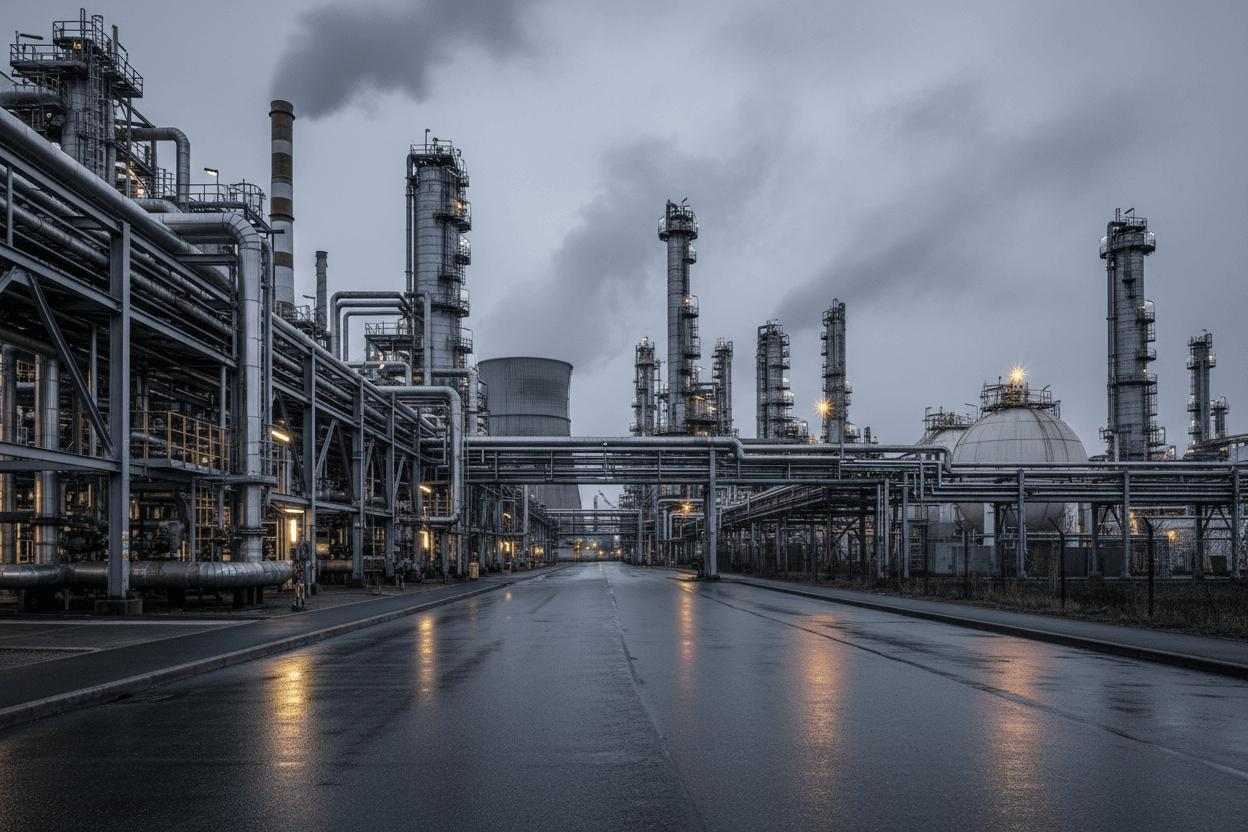
Image: AI-generated
Basic Materials Industry Loses Competitiveness Relative to the U.S.
On October 23, the price of natural gas at the European TTF trading hub reached approximately 93 euros per megawatt-hour. In contrast, the U.S. contract for November delivery was priced at just 2.64 dollars per million British thermal units. When converted, this reveals a price differential of more than tenfold. While this comparison concerns wholesale prices rather than individual supply contracts, it nonetheless highlights a severe cost gap between the two economic regions. For products such as ammonia, methanol, and fertilizers, the price of natural gas is a critical factor in production costs.
The German basic materials industry, however, does not use natural gas solely to heat industrial facilities; it also employs it as a feedstock for numerous chemical products. Consequently, wind turbines and solar panels cannot directly substitute for this requirement. If basic materials production migrates elsewhere, downstream industrial sectors will also face difficulties. Plastics processors, automotive suppliers, and pharmaceutical companies risk losing vital domestic suppliers. Meanwhile, new production facilities and jobs are increasingly being established in regions where companies anticipate lower energy costs over the long term.
Billions in Subsidies for Renewable Energy Fail to Solve the Cost Problem
Over the course of several decades, Germany has spent hundreds of billions of euros on the expansion and promotion of renewable energy. Nevertheless, energy costs for energy-intensive companies remain high by international standards. While wind and solar installations generate electricity without fuel costs, their output is dependent on weather conditions and the time of day. Consequently, the power system still requires reliable, dispatchable generation capacity, grid expansion, and additional flexibility. Furthermore, surplus solar power cannot replace natural gas when the latter is used as a chemical feedstock. In effect, policymakers are driving a systemic transformation whose industrial cost implications do not appear to have been sufficiently considered.
Green hydrogen is often cited as a future alternative, yet its economic viability remains questionable. On October 9, the Research Center for Energy Economics (FfE) warned of high production costs and a lack of long-term off-take agreements. Moreover, regulatory requirements hinder the cost-effective operation of electrolyzers. This creates further uncertainty for companies that must plan their investments today. While American manufacturers benefit from relatively inexpensive natural gas, German firms are, in some cases, expected to transition to significantly more expensive technologies. Without competitive pricing, this transformation risks becoming yet another disadvantage for Germany as a business location.
German Energy Policy Places an Additional Burden on the Industrial Sector
The economic consequences are now becoming apparent in official statistics. According to the Federal Statistical Office, industrial producer prices in September 2026 were 6.7 percent higher than in the previous year. Energy costs rose by 14.9 percent, with the cost of natural gas distribution increasing by 15 percent. Simultaneously, the prices of industrial intermediate goods climbed by 6.4 percent. As a result, companies are forced to absorb higher costs throughout their entire production chains. The federal government cannot resolve these burdens solely through additional subsidy programs. Although the business climate in the chemical industry improved in September, structural problems persist. In early October, the ifo Institute reported that order backlogs remain low and that workforce reductions are being planned. Furthermore, part of this recovery is attributable to temporary disruptions in international supply chains. Consequently, Germany’s energy policy must strike a better balance between climate goals, security of supply, and industrial competitiveness. The abandonment of nuclear energy has eliminated a source of reliable power generation without resolving the basic materials industry’s dependence on natural gas. While high European gas prices are partly a result of geopolitical crises and the loss of Russian supplies, this is precisely why a responsible energy policy should examine all available options for reducing costs and ensuring security of supply.
Industrial Exodus Threatens Long-Term Prosperity
The primary economic danger lies in the permanent loss of investments. A chemical plant that has been shut down cannot simply be brought back into operation. Furthermore, the establishment of new production sites often draws away suppliers, research departments, and other stages of the industrial manufacturing process. Consequently, entire value chains can gradually migrate abroad. The United States is already benefiting from its extensive domestic gas production and a more diversified energy supply. Germany, by contrast, faces the risk that its industrial disadvantages—as a place to do business—will become increasingly difficult to rectify.
German energy policy must therefore be measured not only by installed wind and solar capacity but also by its success in preserving industrial value creation. Climate policy goals are no substitute for an economically viable energy supply. As long as German companies pay many times what their American counterparts pay for gas, energy-intensive investments will remain exceptionally challenging. Additional billions in subsidies can, at best, only partially offset such cost disparities. Without a fundamental improvement in the conditions for doing business, Germany risks losing its industrial core in the long term. The price for this would be a permanently weakened economy, characterized by fewer jobs, lower value creation, and declining tax revenues.
Author: Klaus Bastian – Blackout News
Sources: Oilprice (23.10.26) – Farmbucks (23.10.26) – Destatis (20.10.26) – Forschungsstelle für Energiewirtschaft (09.10.26)