
An opinion piece by Klaus Bastian:
On November 26, 2026, the Bavarian municipality of Fuchstal learned through experience what critics of Germany’s energy transition have warned about for years. A Dunkelflaute – a period of low wind and solar power generation – brought its highly publicized blackout test to a premature end. The federal government provided €2.09 million in funding for the research project. Around 3,800 residents in 1,450 households were supposed to operate independently of the public power grid for five and a half hours. However, calm winds, fog, and snowfall undermined the plan. The battery storage system could compensate for the generation shortfall only briefly. Consequently, officials had to terminate the experiment and reconnect the districts of Asch and Leeder to the public grid.
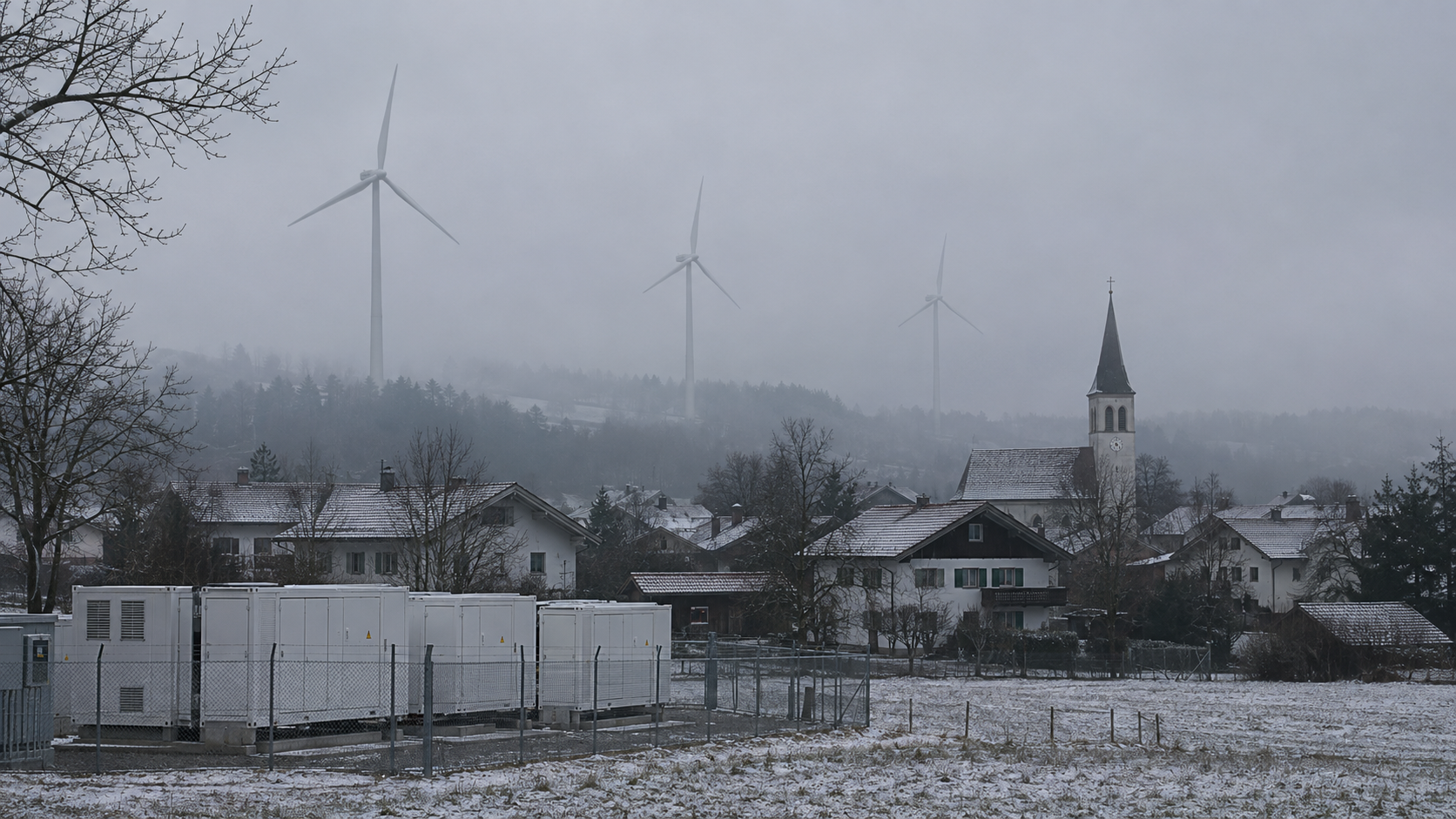
Image: AI-generated illustration
Dunkelflaute exposes the limits of Fuchstal’s energy independence
Fuchstal has invested in energy independence for years. Seven wind turbines, several photovoltaic installations, a biogas plant, and battery storage systems now form part of its local infrastructure. On paper, the municipality already generates more electricity than its residents consume. However, an annual electricity surplus says little about the reliability of the power supply. The blackout test demonstrated this fundamental difference remarkably clearly.
Four wind turbines with a combined rated capacity of twelve megawatts were available for the experiment. By comparison, an assumed electricity demand of one megawatt represents only a fraction of that capacity. On paper, Fuchstal therefore appears to have twelve times the necessary generation capacity. However, the weather is indifferent to installed capacity, political expansion targets, and optimistic computer simulations. Without wind, even twelve megawatts of installed wind power deliver virtually no electricity.
Battery storage systems do not generate electricity
The battery storage system was supposed to compensate for fluctuations in electricity generation. However, batteries are not independent energy sources. They merely store previously generated electricity and release it later, inevitably incurring energy losses. Without sufficient generation during a Dunkelflaute, even the most advanced battery storage system will eventually run out of energy. This is a fundamental principle of electrical engineering.
A storage capacity of approximately 3.3 megawatt-hours can theoretically sustain a demand of one megawatt for 3.3 hours. At two megawatts, that duration falls by half. Moreover, conversion losses and operational reserves further reduce the usable energy. Establishing this fact requires neither a multimillion-euro research project nor an elaborate blackout test. A straightforward energy balance is sufficient.
When cooking lunch becomes a challenge for the power supply
The explanation for the unexpectedly high electricity consumption during the experiment is particularly remarkable. Residents cooked lunch and used their electrical appliances as usual. Consequently, actual electricity demand exceeded the researchers’ expectations. But since when has preparing lunch constituted an exceptional burden on a functioning power supply?
A reliable power supply must accommodate consumers’ actual electricity demand. Instead, during prolonged island operation, residents would increasingly have to adapt their consumption to the available electricity. During a genuine blackout, Fuchstal would therefore have needed to reduce consumption substantially or activate additional power generators. A power supply that struggles with ordinary household consumption cannot yet qualify as crisis-proof.
Technical success is no substitute for security of supply
Nevertheless, the researchers consider the blackout test a technical success. They successfully restored a de-energized local grid using grid-forming inverters. This so-called black start represents a considerable engineering achievement. However, restoring a power grid and maintaining a reliable power supply are fundamentally different challenges.
What good is a technically sophisticated island grid if it runs out of energy shortly afterward? A successful black start does not solve the underlying generation deficit. Nevertheless, Fuchstal is already planning a battery storage system with approximately seven times the existing capacity. At a constant demand of one megawatt, even this larger system could not theoretically sustain the power supply for an entire day without additional generation.
Fuchstal should serve as a warning for Germany’s energy transition
Germany faces the same fundamental challenge on the scale of an entire industrialized economy. Increasingly weather-dependent electricity generation requires additional storage, grid infrastructure, and reliable backup capacity. Each of these components entails substantial costs. Nevertheless, additional wind turbines and short-duration battery storage cannot, by themselves, compensate for prolonged generation shortfalls.
Fuchstal could terminate its blackout test and reconnect to the public grid at any time. During a genuine widespread blackout, however, this fallback option would be unavailable. That is the most important lesson from the experiment. Neither government subsidies nor political targets can eliminate the physical limitations of weather-dependent electricity generation. Ignoring these limitations during the planning process means confronting them later under real-world conditions. Fortunately for Fuchstal, this was only a test.
Author: Klaus Bastian – Blackout News
Sources: Focus (28.11.26) – TH Augsburg (27.11.26) – Kreisbote (27.11.26) – BR24 (26.11.26) – ORF (26.11.26)
Read also:
- Battery storage: The next great hope for storage is cannibalizing itself
- Battery Storage Boom: Germany’s Large-Scale Storage Systems Do Not Solve “Dunkelflaute” Periods
- ‘Dunkelflaute’ causes electricity prices to surge 24-fold – wind power generation plummets by 90 percent
- Power supply at risk – Germany faces a shortfall of up to 35 gigawatts of reliable power plant capacity