
A commentary by our author Klaus Bastian:
Following the sluggish ramp-up of the hydrogen sector, battery storage systems are increasingly moving to the heart of the energy transition. Fraunhofer ISE has now demonstrated that an additional 20 gigawatts of capacity could reduce daily price fluctuations in the electricity market by around 60 percent. Yet these very price differentials represent the primary revenue source for storage systems: they purchase electricity when prices are low and sell it later at higher rates. The more storage systems operate in this manner simultaneously, the more low prices rise and high prices fall. As the margins needed to finance new storage facilities shrink, there is a risk that further expansion will lead to self-cannibalization. At the same time, two-hour storage systems cannot ensure supply during prolonged periods of low wind and solar output. After the economic setbacks faced by many hydrogen projects, the next great hope for energy storage may thus also find itself dependent on state-backed remuneration models.
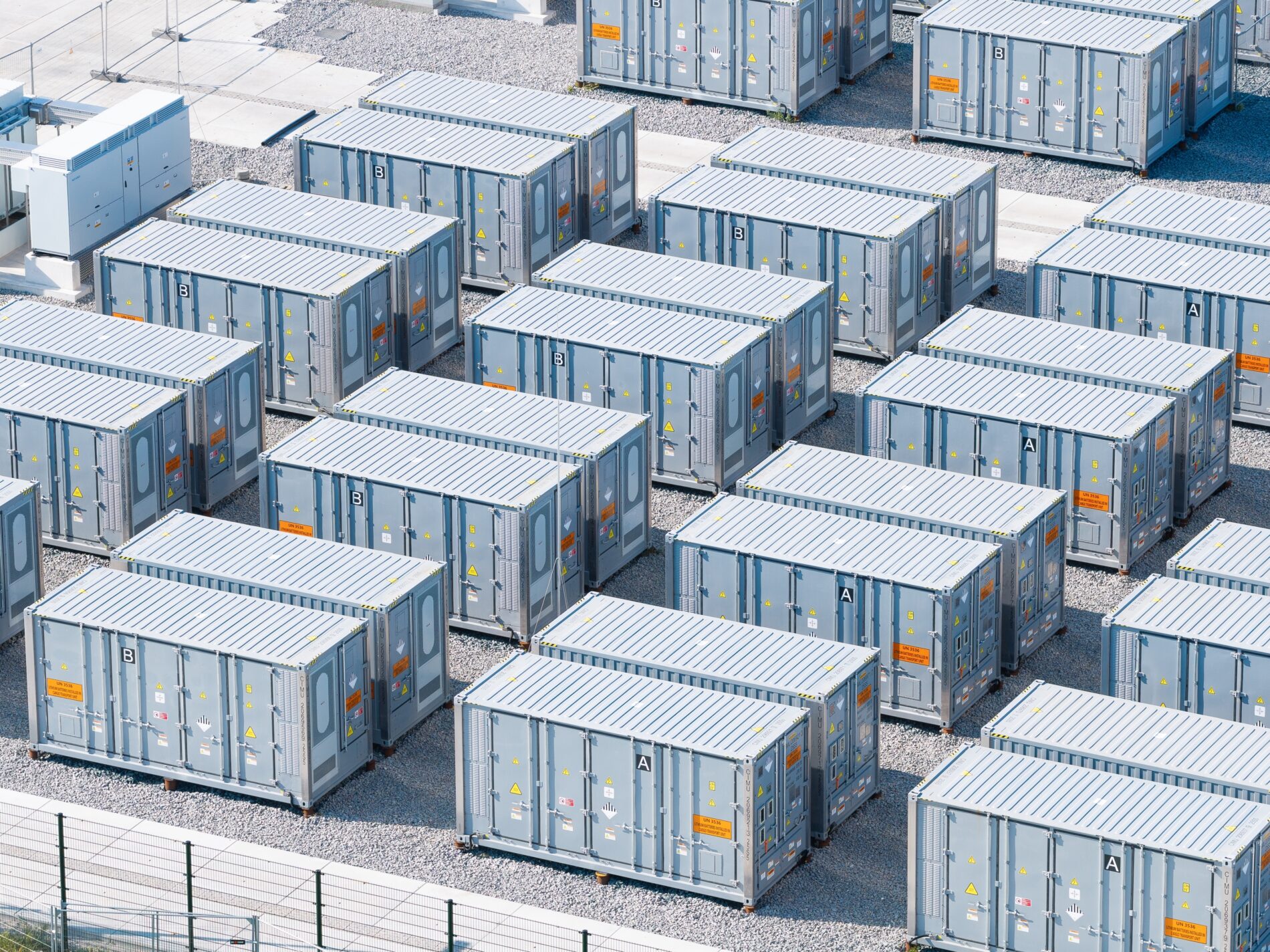
Image: Shutterstock
Hydrogen was supposed to capture surplus wind and solar power
Just a few years ago, green hydrogen was seen as a crucial solution to the problem of fluctuating wind and solar generation. Surplus electricity was intended to power electrolyzers, with the resulting hydrogen stored for the long term. Consequently, the German government raised its target for domestic electrolysis capacity to ten gigawatts by 2030. However, as of early 2026, only around 181 megawatts were operational.
The project pipeline also presents a sobering picture. While projects totaling approximately 1.27 gigawatts had reached the investment decision stage or were under construction, no such decision had been made for more than seven gigawatts of announced projects. Furthermore, the EWI removed around three gigawatts from its database, as these projects had either been cancelled or had shown no progress for an extended period.
High costs have slowed the hydrogen boom
The EWI cites high production costs, customers’ low willingness to pay, and regulatory uncertainty as the primary reasons. Consequently, even substantial government funding pledges do not guarantee implementation. ArcelorMittal halted its hydrogen plans for Bremen and Eisenhüttenstadt, foregoing around €1.3 billion in promised state subsidies.
Disillusionment also set in regarding technology. In 2026, Thyssenkrupp Nucera abandoned plans for the mass production of specific high-temperature electrolysis stacks, incurring charges of approximately €30 million as a result. Meanwhile, the EWI continues to view the economic viability of many electrolysis projects as precarious. While hydrogen remains technically attractive for industry and long-term storage, a self-sustaining mass market has yet to emerge.
Battery storage is set to take over—and destroy its own price spread
Battery storage systems are now expected to absorb a growing share of short-term electricity surpluses. Fraunhofer simulated a scenario involving 20 gigawatts of additional power capacity and 40 gigawatt-hours of energy storage capacity. This caused the average daily price spread to drop from around €130 to €53 per megawatt-hour. At the same time, the market value of solar power rose significantly, while extreme positive and negative market prices became less frequent.
While this can benefit the power system, it creates a conflict of objectives for operators. A recent study in Energy Policy calculates that adding ten gigawatt-hours of capacity results in a 65.6 percent decline in storage revenues. Thus, even moderate capacities lead to significant self-cannibalization. Consequently, the authors are even discussing the possibility of subsidies or a special levy for storage systems. Additional revenues from balancing energy and system services can mitigate the problem, but do not automatically eliminate it.
Wind, solar, and storage are becoming subject to the same market dynamics
This mechanism has long been known in the case of wind and solar installations. High solar output drives down prices at midday—precisely when solar plants are generating the most power. Strong winds have a similar effect on wind power revenues. Consequently, as capacity expands, the market value of additional installations declines unless flexible demand emerges simultaneously.
Battery storage systems initially defer this problem. They buy when prices are low and sell when they are high. While this helps wind and solar, it simultaneously narrows the batteries’ own trading margins. Moreover, a 2026 study indicates that falling battery costs could further diminish the economic viability of hydrogen storage. Thus, one storage solution replaces another without fully resolving the underlying cost issue.
After hydrogen, the threat of another subsidy spiral looms
The trend follows a clear pattern. Wind and solar installations depress their own market values during periods of high generation. Hydrogen was intended to store surplus energy for the long term, but high costs and weak demand have severely hampered the planned scale-up so far. Now, battery storage is expected to absorb a larger share of short-term fluctuations. Yet their business model also comes under pressure as capacity grows, because they reduce the very price differentials from which they derive their revenue.
For electricity consumers, this does not automatically translate into lower prices. Fraunhofer’s own analysis shows that, in the simulation studied, an additional 20 gigawatts of storage capacity barely lowers the average wholesale electricity price. At the same time, billions in investment, grid connections, storage losses, and potentially additional remuneration schemes must be financed. Battery storage can smooth out extreme price spikes and better integrate solar power into the market. However, this does not result in noticeably cheaper electricity for households. Following the dashed hopes for hydrogen, this threatens to bring about the next costly expansion phase of an energy transition whose technical solutions require ever-new investments without resolving the fundamental cost problem for consumers.
Author: Blackout News
Sources: Fraunhofer (01.10.26) – Sciencedirect (03.10.26) – EWI (01.10.26) – Reuters (11.08.26)