
On Thursday, April 16, 2026, three plant closures in Germany and Austria were decided upon or announced: MANN+HUMMEL plans to close its plant in Speyer by the end of 2028, ZF will scale down its Lebring site by the end of 2027, and Hydro will cease production in Lüdenscheid as early as May 31, 2026. This puts around 900 jobs under immediate pressure in just one day. The reasons for these closures are production relocations, declining prospects in existing product areas, and intense cost pressures. However, this development reveals far more than just three individual decisions, as the industrial base continues to shrink and entire regions are losing their economic substance.
Three factory closures send a clear signal
In Speyer, the decision affects a key industrial location. MANN+HUMMEL plans to gradually relocate production and related logistics to other sites. Therefore, the plant on Brunckstrasse is slated to close by the end of 2028. Around 600 jobs are at risk, and the city will lose a major employer.
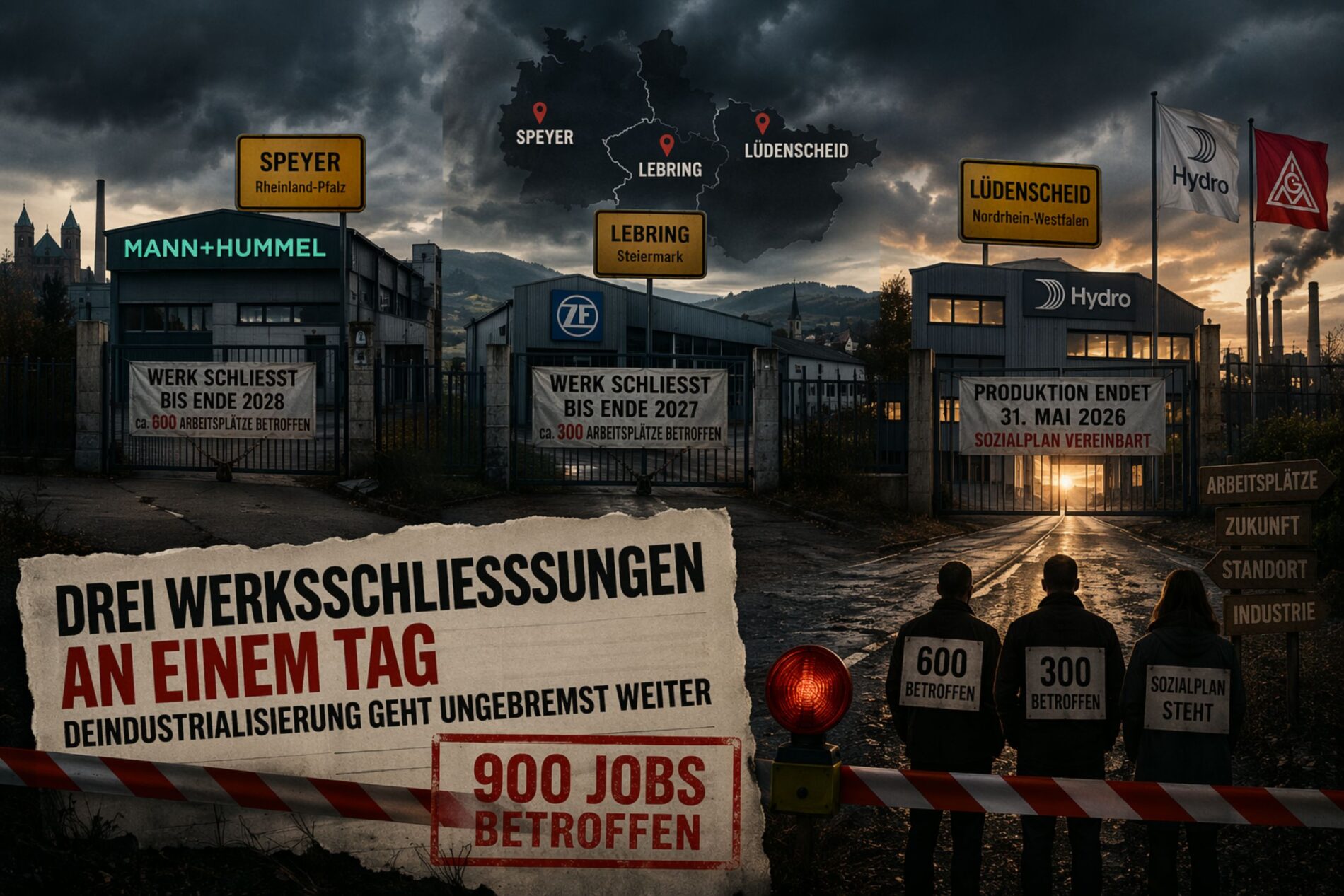
The drastic cuts are also coming to Lebring. ZF announced it will close the ZF Lemförder Axle Systems plant by the end of 2027. Around 300 employees are affected, while the company plans to relocate production to other sites. This marks the disappearance of another key component of the traditional automotive supply industry, even though this sector still sustains many regions.
Plant closures impact entire regions
In Lüdenscheid, the situation is even more rapidly deteriorating. The Hydro plant will close as early as May 31, 2026, and the works council and the IG Metall union have agreed on a social plan. This softens the blow somewhat, but doesn’t change the core message. Another industrial site is disappearing, while the region once again loses purchasing power and added value.
These three plant closures are therefore acting as a magnifying glass for a deeper crisis. Companies are relocating production, consolidating capacities, or abandoning sites altogether. At the same time, suppliers, tradespeople, and service providers are coming under pressure. Where a plant closes, not only the workforce but often the entire surrounding community loses stability.
Deindustrialization continues to accelerate
The sheer number of closures on a single day makes the situation particularly critical. Within just a few hours, three plant closures were announced, affecting a total of around 900 jobs. This is no coincidence, but rather a sign of an accelerated restructuring process. While politicians talk about transformation, companies are creating facts on the ground.
Speyer is losing industrial jobs, Lebring is losing a ZF plant, and Lüdenscheid is losing another employer with the closure of Hydro. Therefore, one diagnosis remains paramount: deindustrialization continues unabated. Three announcements in one day demonstrate how quickly restructuring can turn into real loss. Plant closures are thus becoming an increasingly visible symbol of an industry that is losing both breadth and depth.