
Offshore wind farms affect currents, temperatures, sediments, and seawater stratification worldwide. New studies from 2025 and 2026 examine the North Sea, the Baltic Sea, the US East Coast, and Chinese coastal waters. Rotors extract energy from the air, while foundations slow down currents and generate additional turbulence. Models indicate local changes of more than 20 percent, while satellite data reveal large sediment plumes trailing behind the installations. Consequently, seabeds, nutrient cycles, plankton, and coastal ecosystems could be more significantly affected than many planning processes have previously taken into account.
Offshore wind farms alter currents and temperatures
For the North Sea, German researchers calculated localized reductions in current speeds of more than 20 percent. Additionally, the model showed a shift in the energy of various tidal components. The simulation indicated long-term warming of the water surface by up to 0.2 degrees in wind farm areas. However, foundations can simultaneously mix the water and cause localized cooling of up to 0.5 degrees in summer. Consequently, the results do not describe a uniform warming of the entire sea.
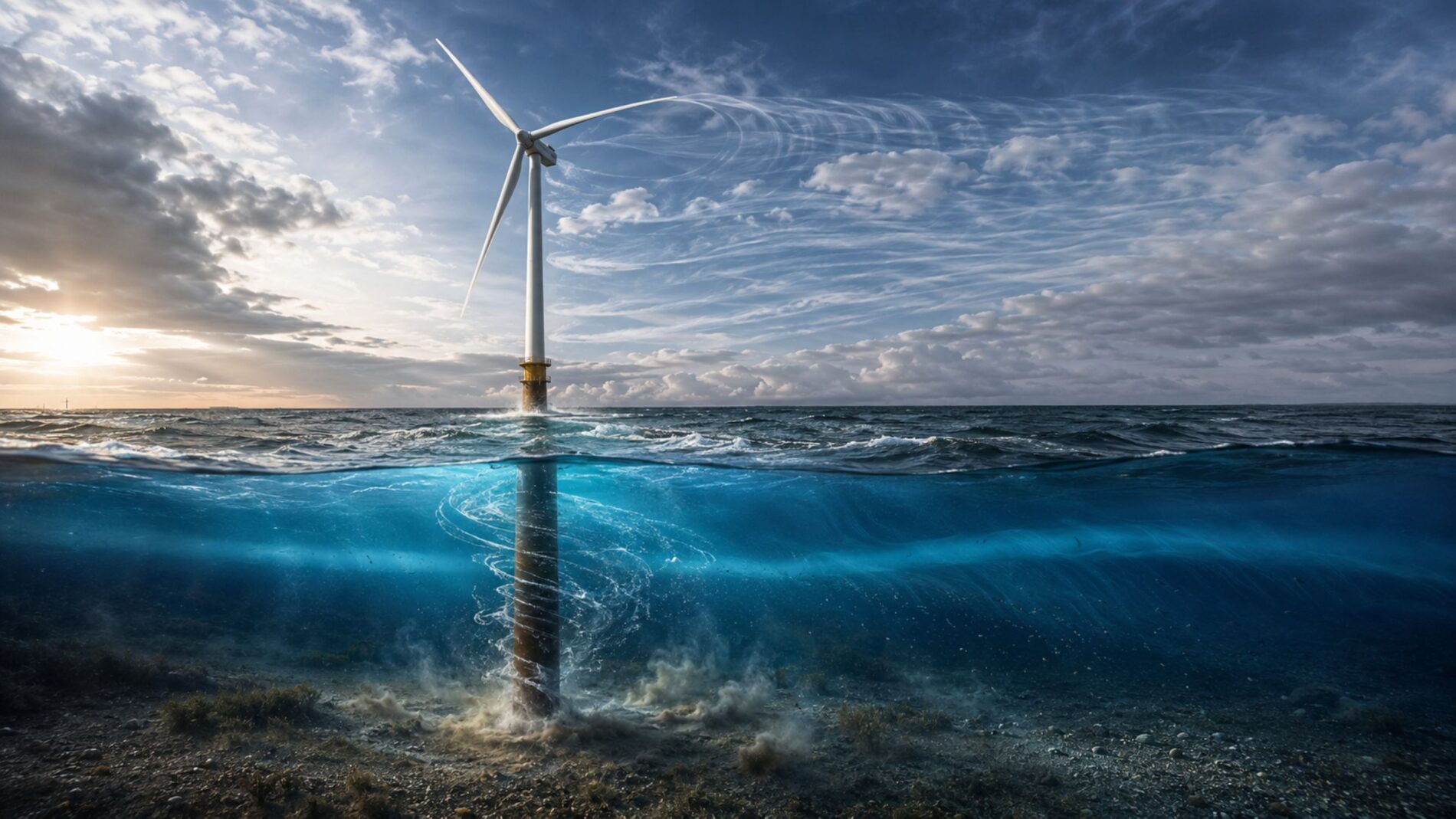
Image: AI-generated
A study focusing on the US East Coast calculated a surface warming of 0.3 to 0.4 degrees associated with large offshore wind farms. At the same time, the mixed upper water layer became shallower, altering heat exchange between the ocean and the atmosphere. However, these figures are derived from coupled model simulations rather than long-term measurements from existing installations. Off the coast of California, reduced coastal upwelling could potentially prolong marine heatwaves, though this effect, too, has so far only been demonstrated through modeling.
Sediment transport extends far beyond foundations
Satellite imagery from the Bohai and Yellow Seas provides particularly concrete observations. In that region, the number of recorded turbines rose from 322 in 2016 to 3,840 in 2024. Researchers identified approximately 5,800 square kilometers of water surface area associated with the visible wakes of the installations. Furthermore, suspended sediment concentrations within individual plumes were more than 20 percent higher. While the images thus reveal actual changes, they primarily capture turbidity near the water’s surface.
A study from June 2026 combined laboratory experiments, models, and data from an existing wind farm. Turbulence generated behind monopile foundations was found to mobilize sand as far as 17 foundation diameters downstream. Consequently, three to eight percent of the seabed within a typical wind farm could be subject to increased stress. Previous assessments had frequently estimated the directly affected area at around one percent; this suggests that seafloor habitats could be impacted over a significantly wider area.
Ecosystem responses vary significantly by region
Offshore wind farms also alter water stratification, thereby affecting nutrient transport. In the North Sea and the Baltic Sea, modeled effects extended up to 60 kilometers beyond the wind farm sites in some areas. Additional turbulence can bring nutrients to the surface, whereas increased stratification inhibits exchange with deeper water layers. Consequently, plankton production may rise or fall depending on the region; no single, universal effect applies to all marine areas.
Models also reveal significant regional differences regarding sediment transport. A study of the North Sea calculated local changes of up to 30 percent and an annual redistribution of 1.5 million tons of silt. Furthermore, approximately 70,000 tons of particulate organic carbon could be displaced. However, there is no evidence of changes to the timing of tides or a comparable reduction in tidal range. Nevertheless, future permitting processes should assess the cumulative impacts of entire wind farm clusters rather than considering individual installations in isolation.
Author: Blackout News
Sources: Nature Communications (03.06.26) – npj Ocean Sustainability (11.05.26) – Communications Earth & Environment (14.03.26) – Marine Pollution Bulletin (25.02.26) – Communications Earth & Environment (13.01.26)