
On July 24, 2026, a Chinese research group published the results of a large-scale fire test involving a flat-mounted rooftop photovoltaic system. A controlled n-heptane fire with a nominal output of 100 kilowatts was used to expose a portion of the PV assembly to intense heat. During the fire, however, the peak heat was concentrated in the narrow cavity beneath the solar modules, where sensors recorded local temperatures of 853.4 degrees. While no people were affected, the test demonstrates the significant thermal stress placed on the roof structure and waterproofing system.
Photovoltaic Fire: Cavity Beneath Modules Becomes a Heat Zone
Inside the cavity, the average peak temperature reached 684.0 degrees, while a single measurement point rose to 853.4 degrees. In contrast, the highest central reading on the upper surface of the modules was 370.7 degrees. Consequently, the thermal stress developing beneath the modules was significantly higher than on their visible upper surface.
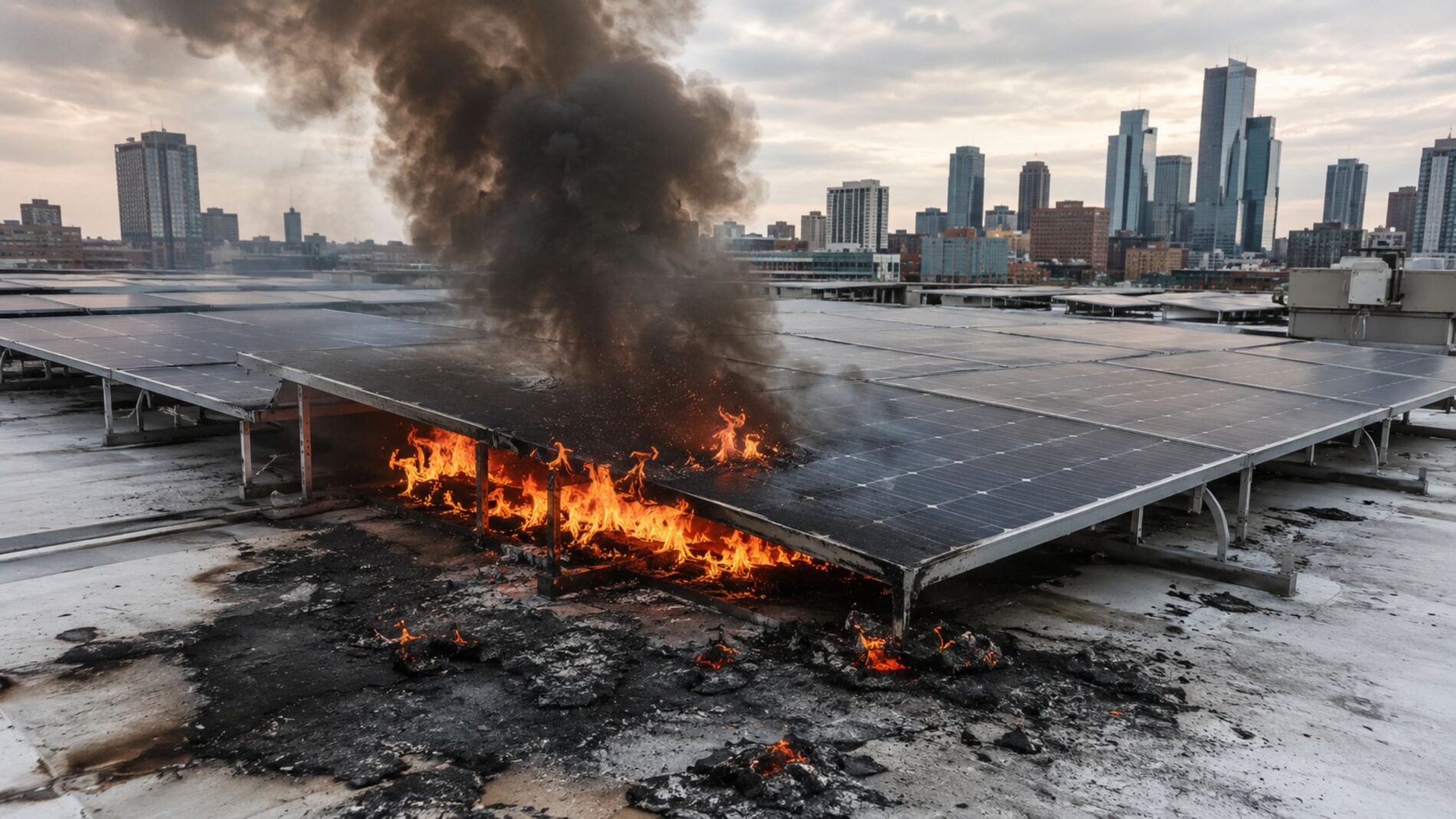
Representative image: AI-generated
The rate of heating also varied significantly. Consequently, the cavity reached critical temperature levels much earlier than the top surface of the system. Temperature monitoring beneath the modules can therefore provide valuable extra warning time in the event of a photovoltaic fire. Furthermore, previous studies indicate that this specific gap between the modules and the roof influences airflow and the spread of flames.
Roof waterproofing adds fuel to the fire
In the test, the roof waterproofing material contributed to the combustion, thereby increasing the thermal load. After 234 seconds, the average temperature beneath the module exceeded 500 degrees Celsius. This phase lasted for approximately another 201 seconds. The photovoltaic fire was thus no longer confined to the initial external ignition source.
The researchers left a one-meter gap between the two module arrays under investigation. Although this spacing reduced direct fire transmission, heat still reached the adjacent array. While sufficient spacing can slow the spread of fire, it does not entirely prevent thermal impact. Therefore, the entire combination of module, spacing, and roofing material must be considered.
Actual rooftop fires reveal electrical faults as a potential ignition source
Another research report from China examined a fire that actually occurred in a rooftop PV system in 2026. The analysis traced the outbreak to a DC arc within a module junction box; according to the researchers, the arc was caused by a poor electrical connection. While such faults can trigger a fire, the roof structure subsequently determines how the fire develops.
However, an international assessment published in July 2026 places the issue in a statistical context. Reported fire rates vary significantly between the UK, Italy, Sweden, and Slovenia. Yet, differing data collection systems make a direct comparison between these countries difficult. Furthermore, triggers include both faults within the PV system itself and external fires. Consequently, ensuring fire safety requires more than just testing the solar module; the assessment must also consider roofing materials, electrical connections, mounting clearances, and early detection systems.
Author: Blackout News
Sources: MPDI (24.07.26) – SienceDirect (Stand: 13.08.26)