
Since March 2025, a facility in Mainz-Mombach—once a flagship project for sustainable sports venues—has stood without a usable electricity connection. The city installed photovoltaic modules with a peak capacity of 60 kilowatts on the roof of the new grandstand. According to plans, these could generate around 55,000 kilowatt-hours of solar power annually. However, the intended consumer—or a cost-effective grid connection—is still missing. The planned multi-purpose building, which was supposed to utilize the electricity, was never constructed following the relegation of TSV Schott Mainz. Retrofitting a grid connection is now estimated to cost around 82,000 euros.
Solar power was intended to round off this prestige project in Mainz
The new grandstand was originally built to meet the requirements of higher-level league play, providing sheltered seating for around 200 spectators. At the same time, the structure was designed to be more than just an ordinary grandstand roof; the integrated photovoltaic system turned the project into a showcase for sustainable sports facilities. Reports even hailed it as a model project that would set an example for the state of Rhineland-Palatinate.
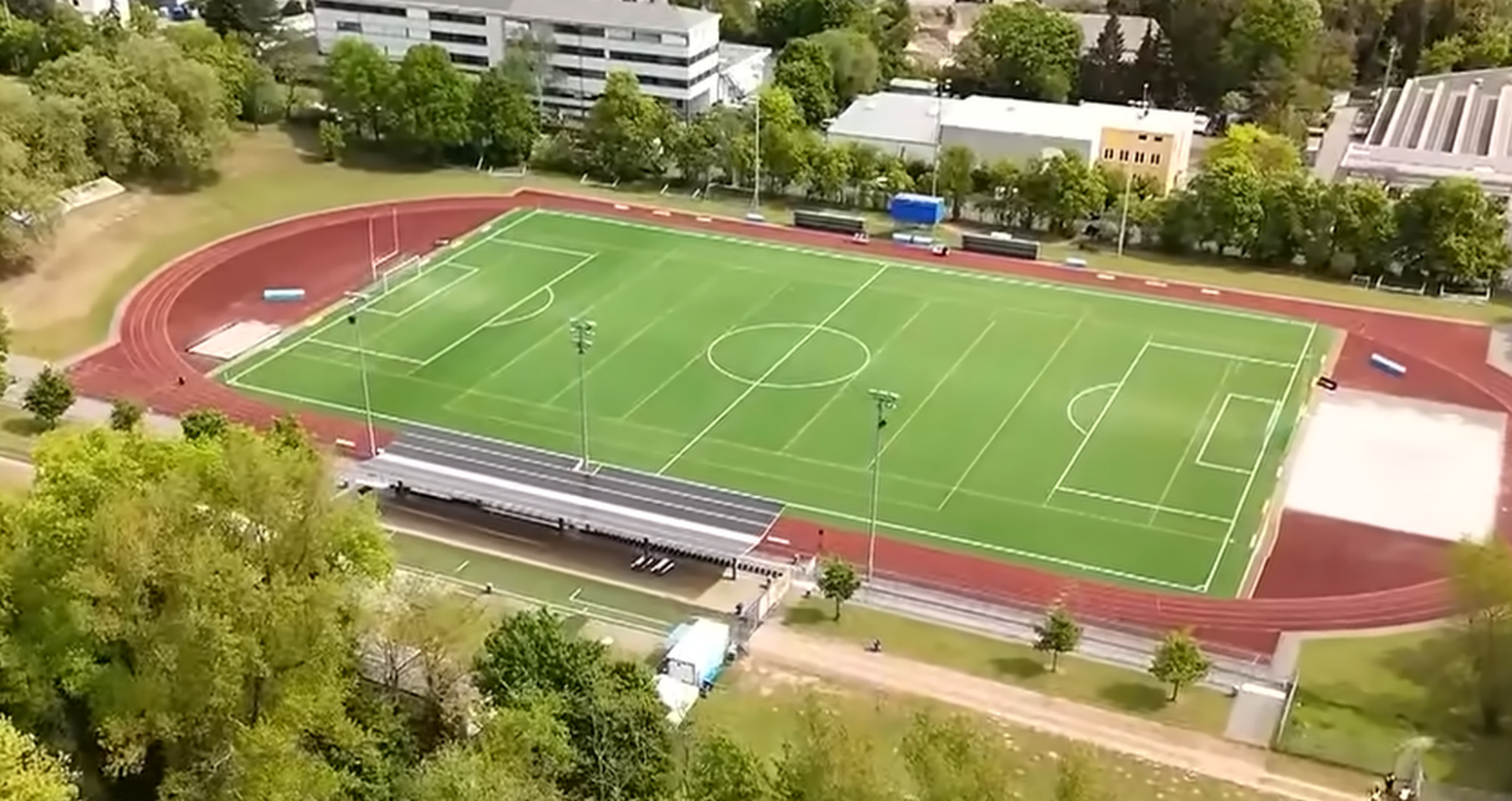
Image: YouTube screenshot
However, the energy concept hinged on a crucial prerequisite: a multi-purpose building was to be constructed behind the grandstand to consume the solar power on-site. Yet, following the team’s relegation, the need for this additional structure vanished. Consequently, the very consumer for whom the power usage had been tailored disappeared. The prestige project was complete, but its energy concept suddenly lacked an end-user.
Solar power remains merely potential without a closed circuit
Photovoltaic modules can generate electrical voltage when exposed to sunlight. However, usable electricity only flows to a consumer or into the grid via a closed electrical path. It is precisely this connection that is missing in Mombach. Therefore, the figure of approximately 55,000 kilowatt-hours represents a theoretical yield potential rather than actual annual output delivered. After all, even ambitious climate policy cannot override the laws of electrical engineering by decree.
A grid connection could be retrofitted, but it would not be economically attractive. According to the city, the connection would cost around 82,000 euros, whereas potential feed-in revenue would amount to no more than about 5,000 euros per year. For this reason, the administration currently deems the connection economically unviable. The sequence of events is remarkable: first the solar installation was built, then its intended consumer disappeared, and finally, the alternative solution proved too costly.
From flagship project to a cautionary tale in municipal planning
The picture regarding published construction costs is not entirely clear, either. When the grandstand was unveiled in March 2025, municipal investment was cited at around 480,000 euros. More recent reports, however, put the figure at approximately 550,000 euros. Yet, the discrepancy of roughly 70,000 euros cannot be definitively accounted for based on publicly available information. Furthermore, an additional 82,000 euros would be required for the grid connection.
Meanwhile, Mainz intends to significantly expand its municipal photovoltaic capacity. In the long term, the city aims for a renewable generation capacity of around 10.4 megawatts. Additionally, at least 1,000 kilowatts-peak of new capacity is to be added annually. However, the existing prestige project in Mombach demonstrates that installed modules alone do not yield usable solar power. That requires consumers, a grid connection, and a planning design that remains functional even after changes are made. At the very least, the grandstand reliably fulfills its traditional function: keeping the rain off the spectators.
Author: Blackout News
Sources: BYC News (08.08.26) – Merkurist (27.07.26) – NDR (26.07.26)