Federal Finance Minister Lars Klingbeil (SPD) has had to have silver coins that were already minted melted down and reminted, because their intrinsic material value exceeded their stated face value. The federal government had produced these commemorative coins with face values of 20 and 25 euros; however, a sharp rise in the price of silver rendered the original cost calculations invalid. Consequently, the Ministry of Finance halted their issuance and ordered the coins to be destroyed. As was revealed in late October 2026, the subsequent reminting process incurred additional costs of 1.357 million euros. The federal government is thus forced to spend nearly 1.4 million euros to rectify a failed financial calculation.
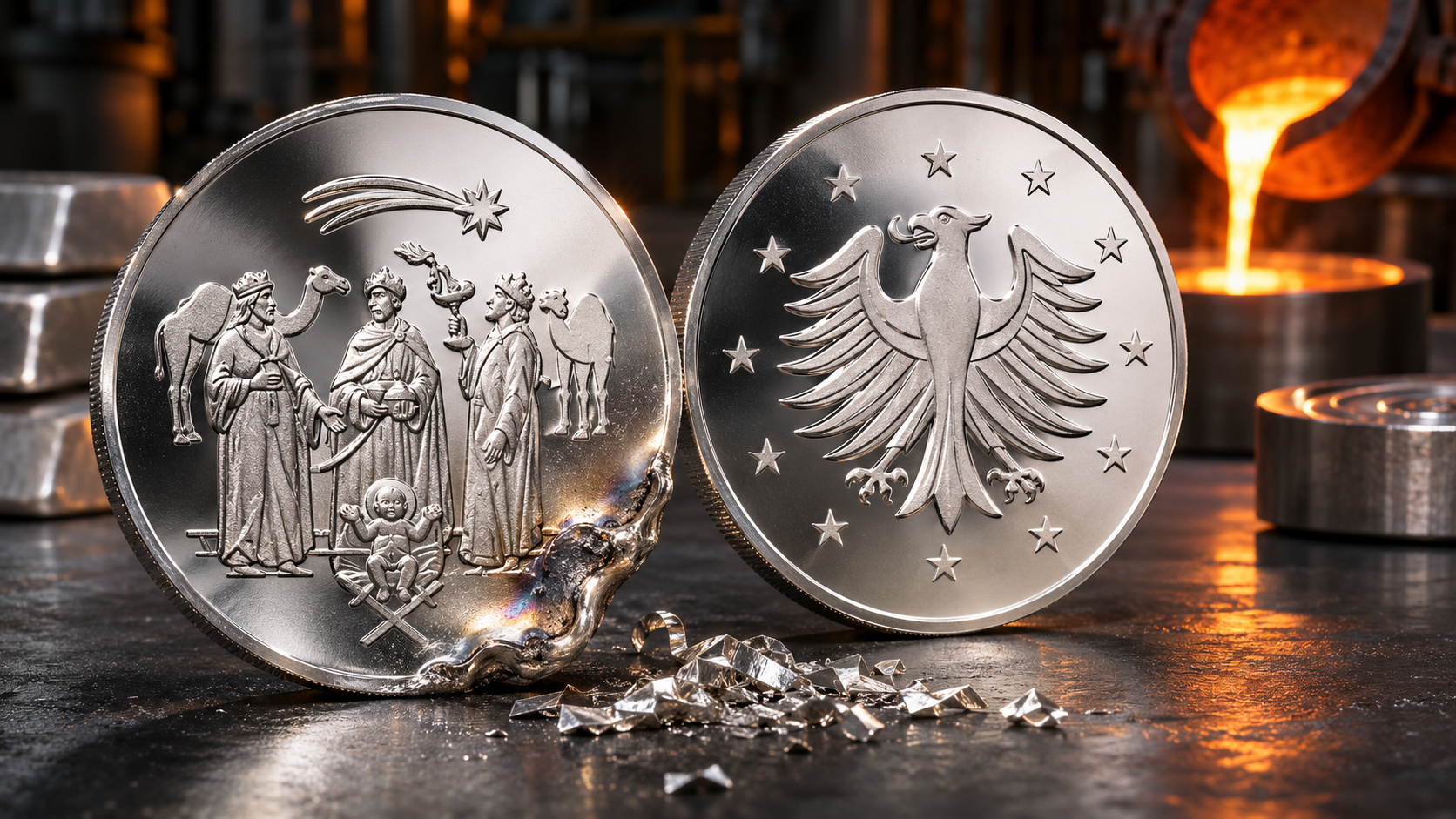
Image: AI-generated
Silver coins contain more silver than their face value justifies
The issue concerns two commemorative coins: one featuring the “Three Wise Men” (Magi) and the other marking the “125th Anniversary of the Wuppertal Suspension Railway.” The coins were originally scheduled for release in 2025, but the price of silver rose sharply during the preparation phase. As a result, the intrinsic value of the silver exceeded the face value printed on the coins. Had they been issued at their face value, the federal government would effectively have been selling the silver for less than its material worth.
Consequently, the Federal Ministry of Finance—headed by Christian Lindner—pulled the emergency brake and halted the planned sale. By that point, however, the coins had already been minted. The mint was forced to render the finished pieces unusable and then melt them down. The “Three Wise Men” Christmas coin alone incurred additional costs of 624,000 euros, while the coin for the Wuppertal Suspension Railway resulted in costs of 733,000 euros. In total, this corrective measure cost the federal government 1,357,000 euros.
Klingbeil increases the face value while simultaneously reducing the silver content
To address the issue, the Ministry of Finance altered two key characteristics of the coins. The previous face value of 20 euros was raised to 35 euros, while the coin originally planned as a 25-euro piece became a 50-euro coin. At the same time, the federal government significantly reduced the silver content. This measure is intended to prevent the material value from exceeding the coin’s stated face value in the future.
The changes are substantial. For the 35-euro coins, the silver content dropped from 92.5 percent to 50 percent, and the weight decreased from 18 grams to 17 grams. Consequently, these silver coins now contain only 8.5 grams of fine silver, down from 16.65 grams. The change is even more pronounced for the 50-euro coin, where the silver content fell from 99.9 percent to 62.5 percent. As a result, the actual fine silver content dropped from nearly 22 grams to approximately 13.1 grams.
Nearly 1.4 million euros in additional costs—yet Klingbeil’s ministry still anticipates a profit
Despite this costly undertaking, the Ministry of Finance expects a significant profit from the coinage—in the high single-digit millions. This is according to a response to a parliamentary inquiry submitted by Green Party budget expert Sebastian Schäfer. The federal government intends to generate this profit partly through the reduced silver content; the combination of a higher face value and lower material usage significantly improves the economic calculus.
However, the prospect of a profit in the millions does not alter the fact that additional production costs were incurred. After all, the coins that had already been minted had to be destroyed, requiring the federal government to have the coins produced all over again. The reason for this is particularly noteworthy: it was not a production error that rendered the coins unusable. Rather, they simply contained too much valuable silver relative to their designated face value.
Sharp criticism even from within the Green Party
Sebastian Schäfer, a budget expert for the Green Party, offered unusually blunt criticism regarding the handling of public funds. In his assessment, taxpayer money was “literally and negligently shredded.” He further stated: “This is simply not how the citizens’ money should be handled.” The criticism strikes directly at the budgetary management of Klingbeil’s finance ministry.
The crucial question, therefore, is why the federal government failed to adjust production in a timely manner to reflect shifts in the price of silver. After all, precious metals are subject to significant price fluctuations. When minting coins with a fixed face value, such developments must be factored into the calculations. Otherwise, the very situation that has now unfolded becomes inevitable: the state is forced to destroy finished coins and then remanufacture them using a smaller amount of raw material.
Christmas coin to be issued as a 50-euro piece instead of 25 euros
The commemorative coin featuring the “Three Wise Men” (Magi) is now set to be released on November 5, 2026, as a 50-euro coin. It was originally planned as a 25-euro issue. However, the new version contains significantly less silver than the pieces initially minted. On the official sales platform, “Münze Deutschland” (the German Mint), the new Christmas coin was already listed as sold out well before its official release date.
For the Federal Ministry of Finance, this episode has proven costly. The material value of the silver coins originally produced exceeded their face value, necessitating that they be melted down and re-minted with different specifications. The bill for this correction amounts to nearly 1.4 million euros. Even if the federal government generates an overall profit from its coinage operations, these additional production costs remain. The case illustrates just how expensive a miscalculation in state-run coin production can be.
Author: Blackout News
Sources: Welt (01.11.26) – t-online (01.11.26) – ntv (31.10.26) – Finanznachrichten (31.10.26)