
Heidelberg is ending a costly hydrogen project and having a hydrogen-powered garbage truck—which cost nearly 1.2 million euros—converted to run on diesel. The federal government had subsidized the purchase with approximately 744,000 euros in taxpayer funds. However, the vehicle was out of service on more than 80 percent of its scheduled operating days. Consequently, the Main and Finance Committee decided on September 30, 2026, to allocate an additional budget of 240,000 euros for the conversion. This brings the total expenditure for the vehicle to an estimated 1.44 million euros. At the same time, the originally subsidized propulsion technology has lost its practical utility, while an old reserve vehicle remains necessary to ensure waste collection services continue.
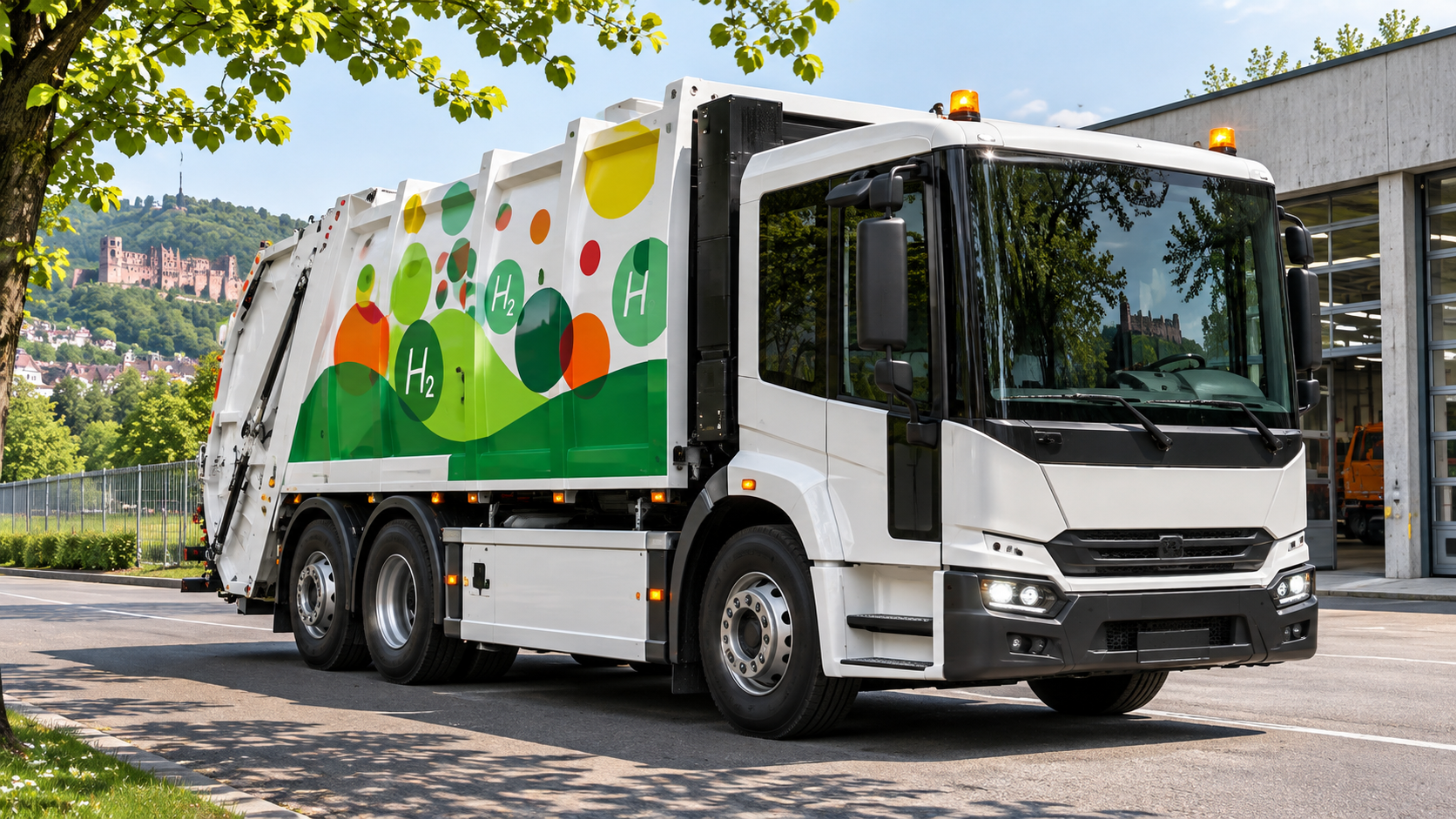
Image: AI-generated
744,000 euros in taxpayer money for a propulsion system that is now being removed
The financial outcome of the project is sobering. Heidelberg paid a total of 1,199,981 euros for the specialized vehicle, which was acquired in 2022. Of this amount, the federal government covered exactly 744,241.50 euros, leaving the city to initially shoulder approximately 456,000 euros. Now, an additional 240,000 euros is required to switch to a diesel engine. This brings the city’s total expenditure to nearly 696,000 euros, while the federal government has already invested more than three-quarters of a million euros.
Particularly significant is the loss of the project’s original objective. The federal grant was intended to facilitate a climate-friendly alternative to conventional diesel. Yet, the very propulsion technology that received the funding must now be replaced because it failed to ensure reliable operation. While the 744,000 euros does not necessarily represent a total financial write-off—as the garbage truck body itself remains in use—the technology transition, financed with public funds, has effectively failed.
Hydrogen-powered garbage truck out of service for 84 percent of operating days recently
Records from the municipal administration reveal just how inefficient the vehicle has become in daily operation. In 2025, the garbage truck was in use for only 41 out of 220 scheduled operating days. It spent 114 days in the workshop and remained out of service for other reasons for an additional 65 days—resulting in a total downtime of over 81 percent.
The situation deteriorated further in 2026. By August 7, the city recorded only 23 days of active service out of 148 scheduled operating days, bringing the failure rate to approximately 84 percent. Technical issues have been mounting ever since the vehicle was first registered in November 2022. Between 2023 and August 2026, the vehicle was out of service for about 64 percent of the time, frequently requiring an older reserve vehicle to step in and handle its assigned tasks.
An additional 240,000 euros instead of a fresh, cost-effective start
Following a technical assessment, the city of Heidelberg no longer sees a realistic way to operate the hydrogen-powered system with consistent reliability. Consequently, the administration plans to acquire a conventional diesel chassis while retaining the existing waste-collection body. This is expected to cost 240,000 euros (gross), whereas a completely new garbage truck would cost approximately 426,200 euros. By reusing the existing body, the city avoids an additional expenditure of roughly 186,000 euros compared to purchasing a brand-new vehicle.
However, this decision extends the financial burden associated with an already exceptionally expensive vehicle. The total cost—covering both the initial acquisition and the planned conversion—amounts to just under 1.44 million euros. In addition, there are unquantified repair and operating costs, as well as the deployment of a reserve vehicle. The existing hydrogen-powered chassis is intended to serve solely as a source of spare parts moving forward. Furthermore, the city anticipates that the conversion process will take approximately one year to complete.
Federal government spent nearly 96 million euros on hydrogen-powered refuse collection vehicles
The case in Heidelberg is particularly noteworthy given the significant federal funding that has been directed toward alternative municipal vehicles nationwide. According to the federal government, it has provided approximately 95.85 million euros in support for hydrogen-powered refuse collection and street-cleaning vehicles since 2020. An additional 43.59 million euros was allocated for battery-electric vehicles. In total, nearly 140 million euros in public funds have been invested in such acquisitions.
Nationwide research accompanying these initiatives also documents significant downtime for a portion of the vehicles. Out of 217 vehicles tracked, 45 reported an outage rate of between 20 and 50 percent, while another twelve vehicles exceeded even that figure. Consequently, 57 of the vehicles studied experienced an outage rate of at least 20 percent. However, as these statistics encompass both battery-electric and hydrogen-powered vehicles, they do not provide a definitive basis for determining which propulsion system is more prone to problems.
Subsidies spent – financial risk remains with the public sector
In response to a parliamentary inquiry, the German federal government stated that it had not been aware of the unusually high downtime experienced by the vehicle in Heidelberg—a project for which it had provided over 744,000 euros in funding. Furthermore, the mandatory usage period tied to the grant was only two years; this term stipulates how long a vehicle must be operated in accordance with the original purpose of the subsidy. It is unclear from the available information whether any attempt was made to reclaim the funds.
For Heidelberg, this has resulted in a costly municipal experiment with a sobering outcome. The public sector initially financed the acquisition of a new propulsion technology and is now forced to pay for its replacement as well. A diesel engine is set to be installed to ensure the level of reliability that the subsidized hydrogen-powered system failed to deliver. This case highlights the financial consequences that arise when state subsidies do not sufficiently ensure that a technology has been practically proven to be both reliable and economically viable. In Heidelberg, the technical promises went unfulfilled, while the costs remain with the municipal and federal authorities.