
In November 2026, Greenpeace dropped approximately 15 tonnes of boulders off the coast of Norfolk in the British North Sea. The environmental organization intended this as a measure to prevent bottom-trawling in a protected area for harbour porpoises. However, it appears that most of these stones are located precisely within the planned site for the Norfolk Vanguard East offshore wind farm. RWE and its partner, KKR, are investing twelve billion pounds in two adjacent wind farms. While Greenpeace explicitly supports the expansion of offshore wind energy, RWE must now assess the locations where the boulders were dropped, as construction work and subsea cables could be affected. This may lead to additional costs and delays, though none have been confirmed at this stage.
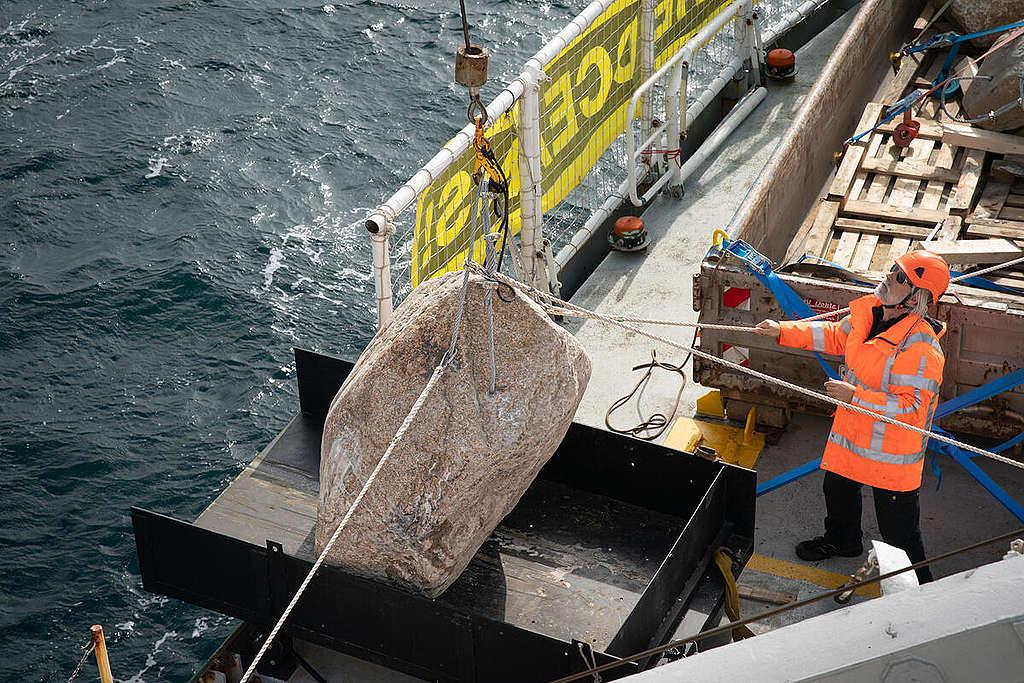
Image: © Andrew McConnell / Greenpeace
Greenpeace inadvertently targets a wind farm project
As part of its campaign, Greenpeace initially placed nine limestone blocks on the seabed. On November 12, a tenth block was added, featuring the face of nature filmmaker David Attenborough. Each of these boulders weighs up to two tons. Trawling nets can become snagged on such obstacles, resulting in damage; consequently, fishing vessels are advised to avoid these areas in the North Sea. The British maritime authority has since published the coordinates of the ten stones for the benefit of vessels navigating the area.
It appears that the activists targeted the planned offshore wind farm unintentionally. According to media reports, while Greenpeace had checked for existing cables, pipelines, and shipwrecks, they failed to account for the site of the future wind farm. A large number of the boulders are located within the “Norfolk Vanguard East” area. The operator had already begun seabed surveys over the summer. Greenpeace and RWE are now exchanging information regarding the locations of the stones—a development that necessitates additional assessments for a project whose construction schedule has long since been finalized.
Norfolk Vanguard: Multi-billion pound investment and a firm timeline
Norfolk Vanguard consists of two offshore wind farms located approximately 50 to 80 kilometers off the British coast. RWE and the financial investor KKR each hold a 50 percent stake in the projects. Together, the 184 planned turbines are expected to reach a capacity of 2.8 gigawatts—an output that, according to the operator, is mathematically equivalent to the annual electricity consumption of around three million British households. For Vanguard West, RWE plans to install the first foundations in the first half of 2027. Vanguard East is set to follow, with both wind farms expected to be fully operational by 2030.
On November 11, RWE and KKR confirmed the financing for the twelve-billion-pound investment. The state-backed National Wealth Fund is contributing a total of one billion pounds in loan commitments, supplemented by extensive bank financing. Revenue from electricity generation will be secured through 20-year, inflation-indexed contracts for difference (CfDs). The established reference price is 91.20 pounds per megawatt-hour (in 2024 prices). This ensures the project’s long-term financial viability well before offshore construction begins.
RWE assesses boulders – Greenpeace considers potential impact minor
The boulders may be located in areas designated for foundation preparation or cable laying. Consequently, RWE must cross-reference their positions with construction plans and existing seabed surveys. Any obstacles within the immediate work zones may need to be removed. While recovery is technically feasible, it could necessitate further investigations and additional work. To date, RWE has not specified any additional costs or a potential delay to the start of construction.
Greenpeace suggests that concerns regarding the potential impact are exaggerated, arguing that offshore construction firms routinely clear naturally occurring boulders from their path. Some of these stones are reportedly significantly heavier than the blocks that have now been submerged. Furthermore, Greenpeace emphasizes that it has long supported offshore wind farms in the North Sea. Nevertheless, a contradiction remains: the organization’s own protest action targets a project designed to generate renewable energy. Moreover, if the stones are recovered before construction begins, the artificial barrier—intended to restrict fishing—will lose its effectiveness.
Marine Protected Area: Protest Impacts Planned Wind Farm
The protest is directed against bottom-trawling in a designated marine protected area in the southern North Sea. Although the area is intended to protect harbor porpoises, fishing vessels are still permitted to drag heavy gear across the seabed there. Greenpeace aims to prevent this activity by placing large stone boulders on the seafloor. However, the UK’s Marine Management Organisation (MMO) has criticized this unauthorized action. According to Greenpeace, the authority threatened legal steps as early as November 5. Nevertheless, the organization deployed its tenth boulder while being monitored by a patrol vessel and an aircraft.
In an ironic twist, an organization that advocates for the expansion of offshore wind farms has created additional obstacles for such a project. While Greenpeace’s goal was to halt bottom-trawling, it appears they did not take the plans for the “Norfolk Vanguard” wind farm into account. Ongoing assessments will determine whether this actually leads to construction delays or additional costs. What is already clear is that RWE will have to deal with the deliberately submerged boulders. And should the operator choose to remove them, the protective barrier installed by Greenpeace could disappear after only a few months.
Author: Blackout News
Sources: The Guardian (14.11.26) – Greenpeace (12.11.26) – RWE (12.11.26) – Marine Management Organisation (12.11.26)