
In 2026, the German government plans to again distribute large sums of money to non-governmental organizations (NGOs). However, it remains difficult to ascertain which recipients will receive the funds. In response to a parliamentary inquiry, the government did not provide a complete overview, citing instead the high administrative costs. Meanwhile, citizens are paying ever-increasing taxes, levies, contributions, and fees. (nius: 22.04.26)
NGO recipients of taxpayer money remain unclear
The central question is: Who receives money from the state, and for what exactly? However, the federal government’s response does not provide a complete list. Furthermore, it refers to scattered data across government agencies, lists, and paper files.
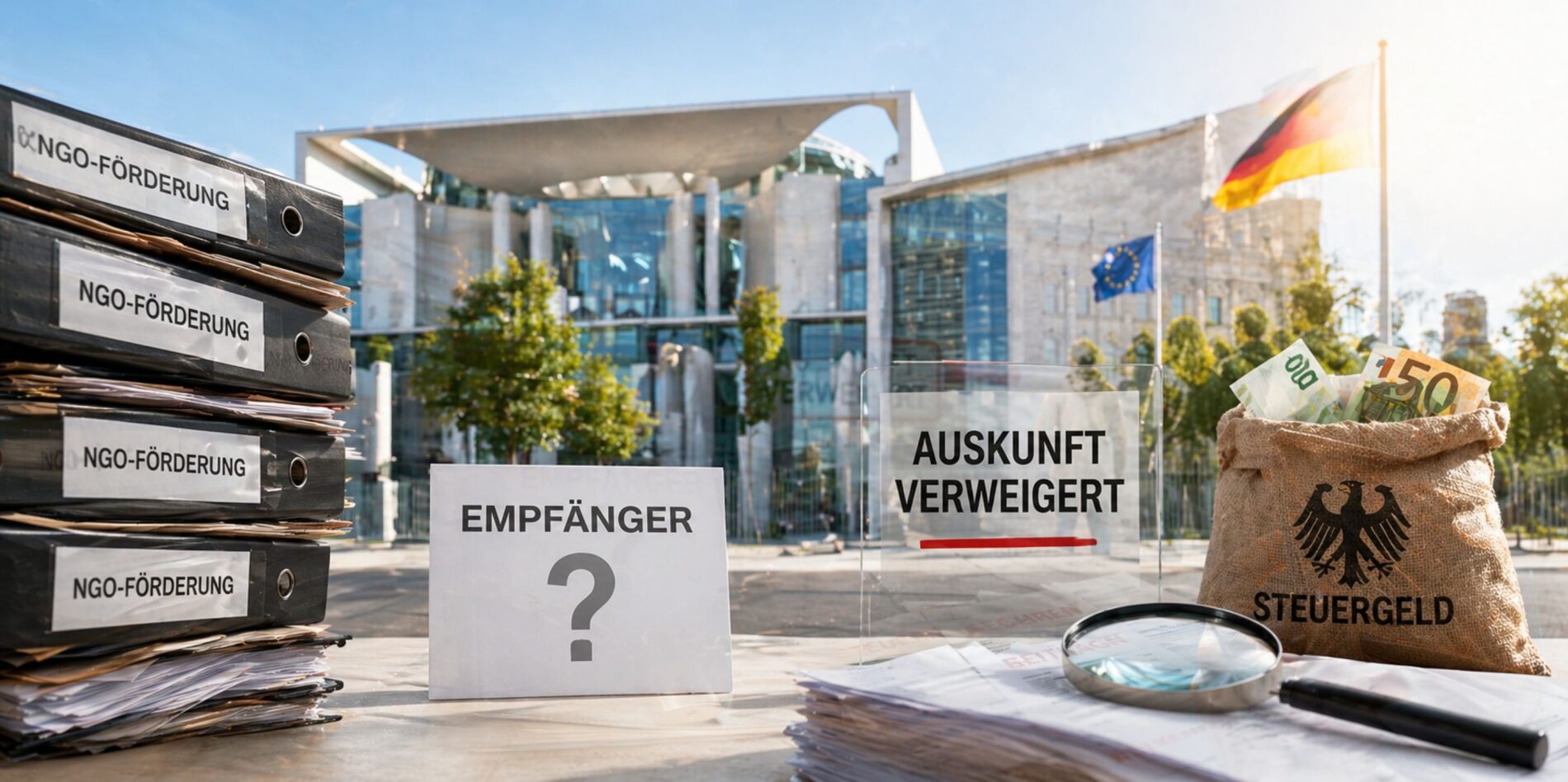
This justification fails to convince many critics. Every subsidy requires files, official notices, and clear documentation. Therefore, the government needs to know which recipient receives which sum for which purpose.
Citizens pay more, transparency remains elusive
The debate comes at a tense time. Energy prices, social security contributions, and municipal fees are straining many households. At the same time, it remains unclear exactly how the government distributes its funds.
The aforementioned figures are particularly explosive. The Ministry for Family Affairs is said to have at least 40,000 individual grants. Furthermore, the government cites approximately 6,600 working hours for a complete review.
Mountains of files are no substitute for oversight
Other ministries also report significant hurdles. The Ministry of the Interior speaks of more than 2,300 working hours. The Ministry of Labor also points to at least 8,000 individual grants.
However, these figures do not eliminate the transparency problem. Rather, they demonstrate that no central overview apparently exists. This is precisely where the political obfuscation of the flow of funds begins.
The State Must Disclose Funding Flows
NGO funding isn’t just about charitable projects. Some organizations also influence political debates. Therefore, it must be transparent which recipients receive public funds.
A public database would be the simplest solution. It would have to list the amount, purpose, duration, and responsible ministry. Furthermore, it would have to be clearly identifiable whether the money is used for project work, campaigns, or political education.
If the state cannot clearly identify the recipients, the lawful use of funds cannot be reliably verified. Without clear allocation, the basis for control, accountability, and parliamentary oversight is lacking. This creates a structural risk of misuse, further eroding trust in government action.