
In July 2026, foreign media are increasingly reporting on Germany’s decline. British and Spanish newspapers, along with international business media, are piecing together a comprehensive picture from the chaos on the railways, crumbling bridges, the Stuttgart 21 project, and the crisis at Volkswagen. They describe an economy with decaying infrastructure and an industrial sector losing its competitiveness, governed by an administration that fails to implement truly effective reforms. Consequently, the criticism no longer focuses on isolated mishaps but rather on Germany’s capacity to act—both economically and at the level of the state.
Foreign media pass judgment on Germany’s decline
On July 6, the British magazine The Spectator published an article titled “Germany is quietly falling apart.” The author points to late trains, closed bridges, and looming job cuts at Volkswagen. He describes the German government’s response as a “shrug sold as reform.” Germany once epitomized technical reliability and industrial strength; now, the question arises as to why Europe’s largest economy is no longer capable of repairing its own bridges on time.
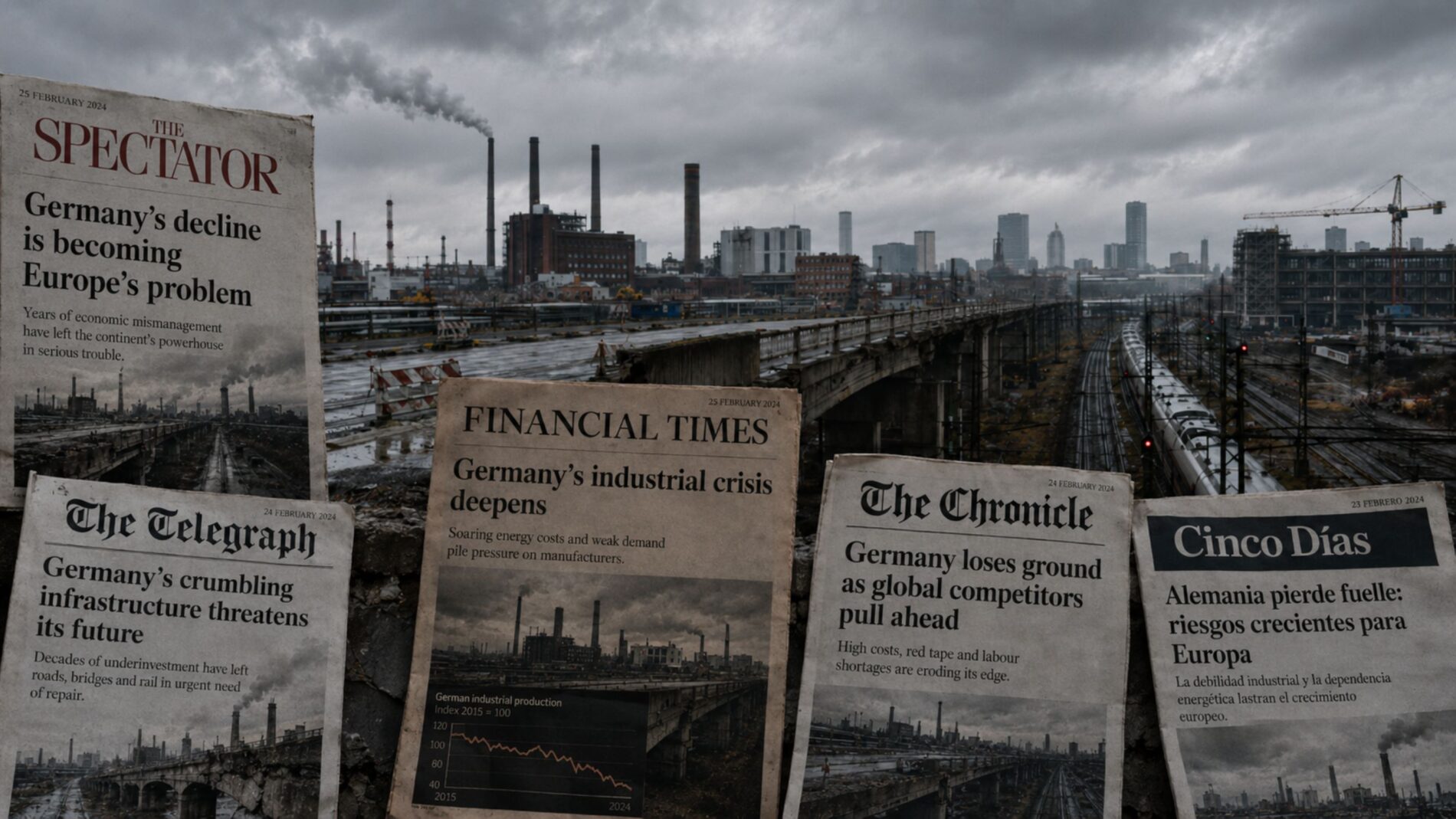
Image: AI-generated
The British newspaper The Telegraph also views Deutsche Bahn as a symbol of the country’s state. Its article from June 28 bears the headline “How German trains became a national disgrace.” After decades of neglect, the rail network has become a source of national humiliation for a country once synonymous with punctuality and engineering excellence. The near-nationwide failure of the railway radio network, frequent delays, and the repeated postponement of the “Stuttgart 21” project reinforce this image.
Business media warn of a “lost decade”
The Financial Times portrays Germany’s decline primarily in economic terms. In an article headlined “German business leaders warn Merz: More needed to avert a lost decade,” it reports on the concerns of German corporate executives. While they welcomed tax relief and labor market reforms, they deemed the measures adopted insufficient to halt high costs, low investment, and the relocation of operations. Boehringer Ingelheim, for instance, reportedly scrapped planned investments totaling around €900 million, while other companies are scaling back projects or considering moving operations abroad.
On July 8, Reuters Breakingviews published a piece titled “Germany finally has an economic plan.” It discusses additional borrowing, increased infrastructure investment, tax relief, and changes to the pension and labor markets. At the same time, Reuters notes that further reforms are required. As early as April, the outlet had warned of long-term sluggish growth in an article headlined “Germany is sleepwalking into permanent stagnation,” citing high energy prices, an aging population, and meager productivity gains as burdens on economic performance.
VW crisis and anxiety about the future worsen Germany’s image abroad
On July 13, the British newspaper The Guardian published an editorial titled “The Volkswagen crisis is another wake-up call for Germany and the EU.” The paper reports on potential job losses of up to 100,000 and the threat of deindustrialization. Chinese manufacturers are gaining market share in electric vehicles and other industrial goods, while US tariffs are hampering exports. Consequently, the crisis at Volkswagen symbolizes the erosion of a German business model that long relied on strong exports, cheap energy, and technological superiority.
The Spanish business newspaper Cinco Días extends this criticism to societal trends. Its article from July 14 bears the headline “No children, no future: Germany’s youth consider emigration.” High housing costs, stagnant real wages, limited opportunities for advancement, and a growing social welfare burden are reportedly undermining young people’s confidence. One in five young Germans has concrete plans to emigrate, while 41 percent could envision taking such a step in the future. In foreign media coverage, the notion of a Germany in decline refers not only to the state of the country’s railways, bridges, and factories; the term increasingly reflects a growing concern that a segment of the population is losing faith in a better future.
Author: Blackout News
Sources: The Spectator (06.07.26) – Financial Times (06.07.26) – Reuters (08.07.26) – Cincos Dias (14.07.26)