
Germany drops three places to 14th rank in Reporters Without Borders’ Press Freedom Index. The organization continues to rate the situation as “satisfactory”; however, hatred, defamation, and politically charged debates are making the work of many journalists more difficult. Reporting on right-wing extremist circles and coverage of the Gaza War remain particularly risky. At the same time, the global ranking reveals a historic deterioration, as—for the first time—more than half of the 180 countries assessed fall into the “difficult” or “very serious” categories. (tagesschau: 03.05.26)
Press Freedom: Germany Loses Ground to Europe’s Top Tier
Germany drops three places to 14th rank in the Reporters Without Borders press freedom index. While the situation is still considered “satisfactory,” hatred, defamation, political polarization, and online pressure are making the daily lives of many journalists increasingly difficult.
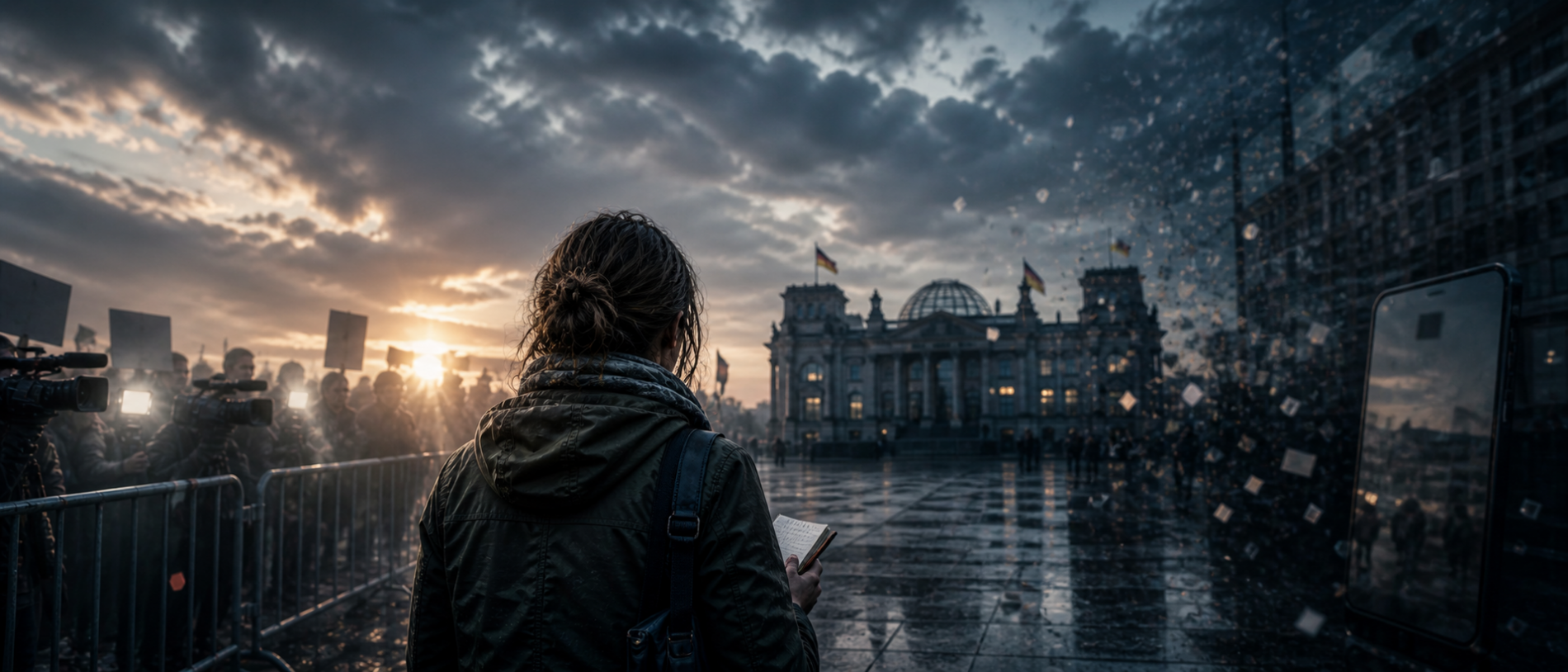
Investigative reporting on right-wing extremist circles and coverage of the war in Gaza remain particularly sensitive areas. Globally, RSF simultaneously reports a historic low point, as—for the first time—more than half of the 180 countries assessed fall into the “difficult” or “very serious” categories.
Press Freedom: Germany Loses Ground to Europe’s Top Tier
Germany now ranks behind Norway, the Netherlands, Estonia, Denmark, Sweden, Finland, Ireland, Switzerland, Luxembourg, Portugal, the Czech Republic, Iceland, and Liechtenstein. While this does not signify a collapse of media freedom, it does represent a clear decline in a European context. Consequently, a ranking of 14th place serves as a warning signal for a country that has long aspired to be counted among the top tier.
Christian Mihr of Reporters Without Borders describes Germany’s decline as a reflection of a “heated climate.” According to reports, many journalists face intense pressure, heated debates, and the fear of being publicly pilloried. At the same time, right-wing radical media circles are gaining reach through polarization and disinformation.
Online Hate and Pressure on the Streets
The risks are not confined to social networks alone. Reporters Without Borders also highlights threats encountered during fieldwork on the streets. For 2025, RSF documented 55 verified attacks against journalists and newsrooms in Germany. While this figure represents a decrease compared to the previous year, the overall level remains a cause for concern.
Reporters are particularly vulnerable when covering demonstrations, political party events, or conducting investigations within right-wing extremist circles. Furthermore, coverage of the Middle East is exacerbating tensions within many newsrooms; disputes regarding Israel, Gaza, antisemitism, and the boundaries of legitimate criticism are leading to personal attacks and online harassment.
Global Situation Hits Historic Low
Globally, the assessment is significantly more dire. According to RSF, only one percent of the world’s population now lives in countries with good press freedom. Christian Mihr commented: “Only one in every 100 people worldwide is able to obtain information through a diverse, healthy media landscape.”
Wars and authoritarian politics are further exacerbating the situation. Israel has dropped to 116th place, while the Palestinian Territories rank 156th. Since October 2023, according to RSF, more than 220 journalists have been killed in Gaza as a result of attacks by the Israeli military. Russia ranks 172nd, while China, North Korea, and Eritrea occupy the bottom spots of the rankings.
Media Policy Must Address Structural Risks
The USA has also slipped, now ranking only 64th. According to RSF, attacks on the media there took on a systematic character under President Donald Trump. At the same time, budget cuts to US-funded international broadcasters—such as Voice of America and Radio Free Europe—are undermining reliable sources of information in authoritarian states.
Germany remains significantly better positioned by international standards; however, the data reveals an erosion of protections within its own borders. Consequently, formal guarantees alone are insufficient. Media policymakers, law enforcement, the judiciary, and digital platforms must provide more effective protection for journalists, while newsrooms must defend their independence against defamation and economic pressure.