
In May 2026, Germany is experiencing a distinct shift in its labor market. The unemployment rate stands at 6.4 percent, and more than three million people are actively seeking work. Many companies are responding to a weak economy, high costs, industry-specific challenges, and automation by implementing hiring freezes. Entry-level professionals, university graduates, and job seekers in office administration, IT, general administration, and marketing roles are particularly affected. However, the shortage of skilled workers persists in the healthcare, skilled trades, logistics, and social services sectors. This creates a labor market that is becoming increasingly tight for many applicants, even as businesses in sectors facing labor shortages continue to recruit staff. (focus: 24.05.26)
Hiring Freeze Hits New Applicants Hardest
However, many companies are not openly cutting staff on a large scale. Instead, they leave positions unfilled when employees leave. Furthermore, they are less likely to extend fixed-term contracts and are making use of partial retirement schemes or severance packages. As a result, the situation remains more stable for many current employees, while job seekers feel the impact immediately.
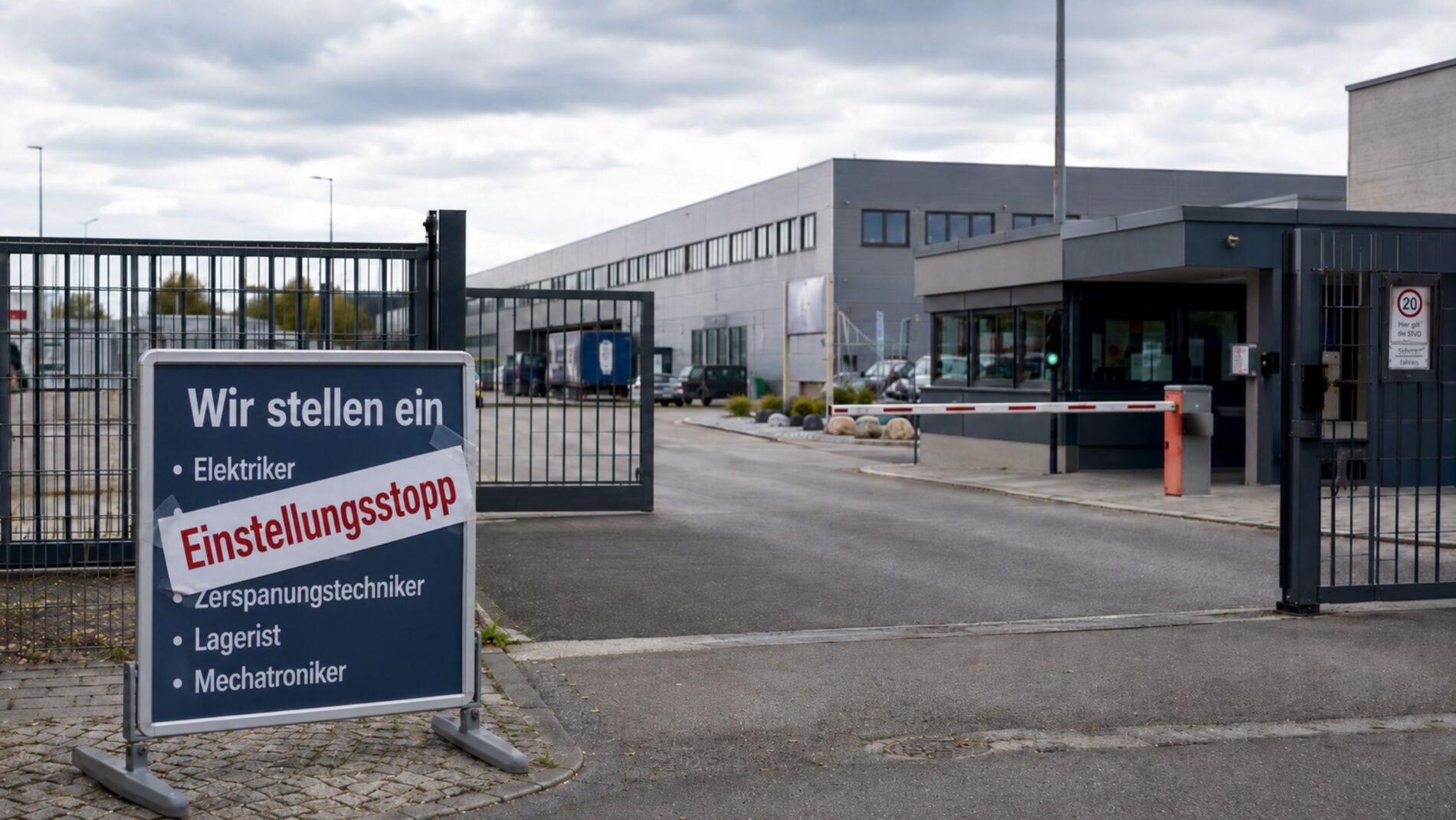
The hiring freeze is having a particularly significant impact on entry into the workforce. In the past, young applicants were often able to choose from multiple job offers. Today, even highly qualified candidates face longer waits for job acceptances. Furthermore, companies are scrutinizing more closely whether a new position is truly necessary.
Entry-Level Job Seekers Lose Their Former Advantage
The number of job postings for entry-level positions fell by 42 percent in 2025. Junior-level roles in sales, human resources, administration, marketing, and IT were hit particularly hard. At the same time, software and automation are taking over simple, routine tasks more rapidly than before.
Consequently, competition is intensifying for university graduates. While many possess academic degrees, they often lack practical professional experience. Companies are therefore seeking candidates who can be productive immediately. This makes it more difficult to gain entry into precisely those fields that were long considered secure career paths.
Industry Sheds Jobs While the Public Sector Grows
The industrial sector is experiencing the most severe decline in employment. Automakers, mechanical engineering firms, and chemical companies are grappling with high energy prices, weak export figures, and fierce competition from China. Moreover, the rise of electric mobility is transforming entire production chains—and, by extension, many workforce planning strategies.
Concurrently, job growth is shifting increasingly toward the public sector. While this offers opportunities for individual applicants, it does not automatically replace well-paid industrial jobs. This is because industrial employment supports a vast network of suppliers, service providers, and regional incomes. When these jobs vanish, the surrounding community loses its economic stability as well.
Skilled Worker Shortage Persists in High-Demand Professions
Consequently, the shortage of skilled workers is not coming to an end. The healthcare, medical, construction, skilled trades, logistics, and social sectors continue to seek personnel. In these areas, demographic trends exert a stronger influence than the sluggish economy. Moreover, demand in many of these fields is rising on a permanent basis.
The core problem, however, lies in the mismatch. Germany does not suffer from a general shortage of workers across the board; rather, the specific qualifications needed are lacking in the specific locations where they are required. Hiring freezes in many office-based and industrial roles further exacerbate this imbalance.
Fewer Job Vacancies Increase Pressure on Applicants
The number of job vacancies also reflects this trend. In the third quarter of 2025, the IAB recorded approximately 1.03 million open positions—246,100 fewer than a year earlier. While the figure did rise to 1.26 million in the fourth quarter, it nevertheless remained below the previous year’s level.
For job seekers, this translates into longer job search periods and more rigorous selection processes. Companies are demanding greater experience, specialization, and industry-specific knowledge. At the same time, financial pressure is mounting on unemployment insurance schemes, the Bürgergeld (citizen’s income) system, and local municipalities. Consequently, the labor market requires faster retraining opportunities, more effective job placement services, and new investments in productive employment sectors.