
A commentary by our author Klaus Bastian:
After more than a quarter of a century of state-subsidized energy transition, there is a wide gap between political promises and economic reality. The vision included affordable electricity, energy independence, the emergence of new industries, and growing prosperity. Instead, consumers are paying high electricity prices, while multi-billion-euro subsidy programs and the addition of new gas-fired power plants continue to generate further costs. Industry is losing its competitiveness, forests are being cleared for wind turbines, and key future technologies are increasingly coming from China. While German CO2 emissions have fallen, they continue to rise on a global scale.
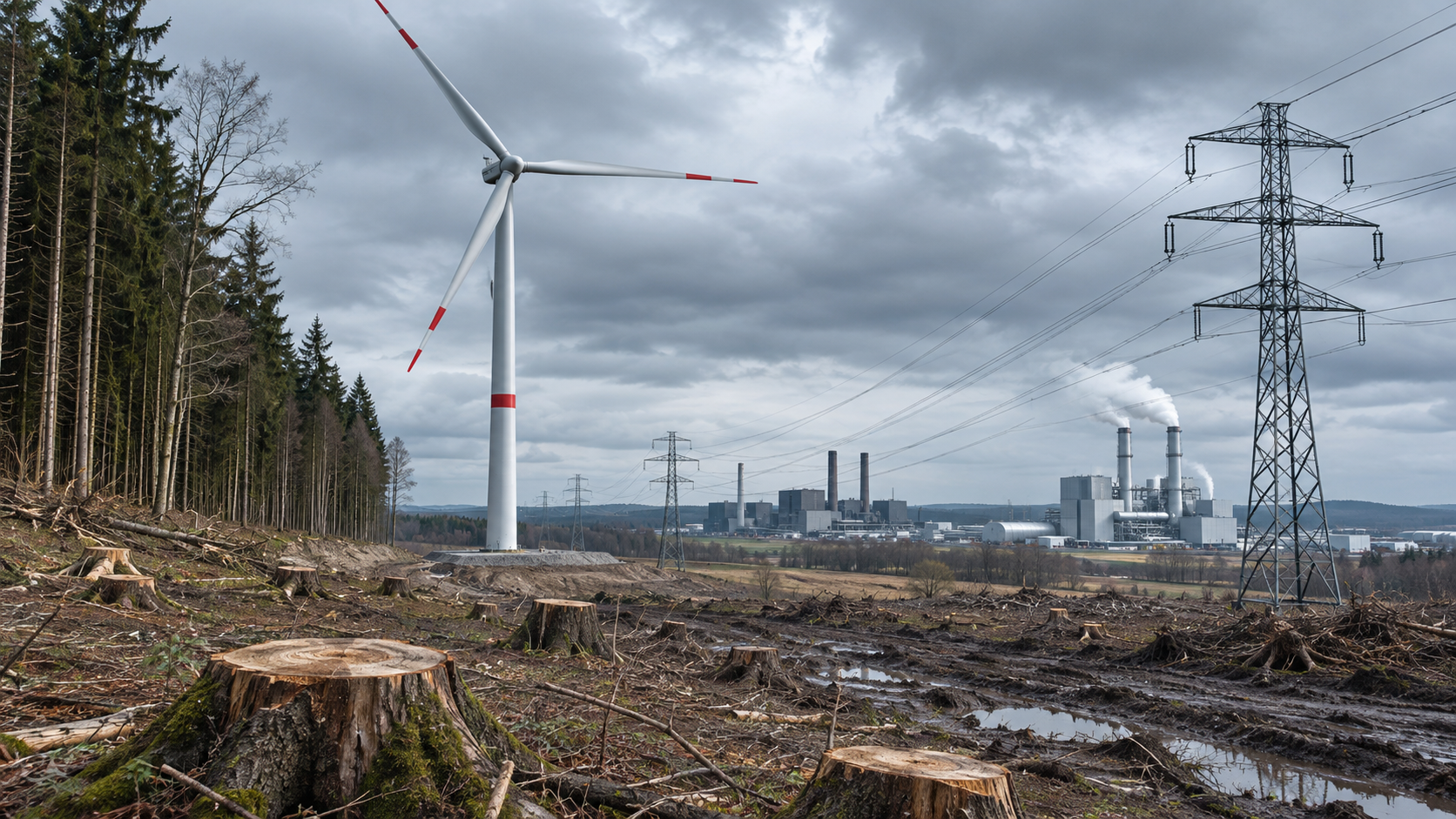
Image: AI-generated
Promised cheaper electricity – yet the entire system has become more expensive
The energy transition (Energiewende) began with the anti-nuclear movement of the 1970s. Starting in 1991, Germany began subsidizing renewable electricity, followed by the introduction of an “eco-tax” in 1999. Under the Renewable Energy Sources Act (EEG) of 2000, solar installations initially received feed-in tariffs of around 50 cents per kilowatt-hour. The long-term vision was for wind and solar to provide cheap electricity. Yet, after decades of subsidies, households are now paying—in nominal terms—more than twice as much as they did in the late 1990s.
In October 2026, modeled tariffs for new customers reached 40.87 cents per kilowatt-hour. Meanwhile, transmission system operators anticipate an additional funding requirement of 17.524 billion euros for the EEG in 2027. Furthermore, the offshore wind industry—of all sectors—is once again calling for state-guaranteed electricity revenues. Following a tender in 2025 that drew no bids, the industry association is pushing for long-term price hedges in the form of “contracts for difference.” The intent is for the state to once again cushion the economic risks faced by wind farm operators, while any potential excess profits would be siphoned off. As the saying goes, the sun and the wind do not send an invoice—but the grid operators and the Ministry of Finance certainly do.
Energy independence promised – now we need two power generation systems
Germany aimed to become independent of fossil fuel suppliers. In reality, the country continues to import large quantities of natural gas, crude oil, and fuels. This is because wind turbines and solar installations cannot provide a reliable supply of electricity during periods of low wind and little sunshine—a phenomenon known in German as a “Dunkelflaute” (dark doldrums). Consequently, the energy transition requires an additional infrastructure consisting of dispatchable power plants, energy storage systems, and power grids.
In early November, eleven new power plant projects were granted subsidies for approximately 5,160 megawatts of firm capacity. The total cost for these capacity payments is estimated at twelve billion euros over 15 years. Further tenders are expected to follow, while the procurement of gas and the operation of these plants will incur additional costs. Moreover, the fuel supply remains dependent on imports and geopolitical developments. In this sense, the new “energy independence” continues to arrive, in part, via pipelines and LNG tankers.
Climate protection promised – forests cleared and new mountains of waste created
The ecological balance sheet also contains notable contradictions. By the end of 2025, 2,635 wind turbines had already been erected on German forest land. Trees must be cleared to make way for foundations, access roads, and assembly areas, while heavy machinery compacts the soil. Ironically, this impairs natural CO₂ sinks—the very things meant to aid climate protection. Compensatory tree planting does little to change the fact that established forest ecosystems take decades to recover.
At the same time, wind turbines, solar installations, power lines, and storage systems consume vast quantities of raw materials. For various construction materials, they require significantly more resources per unit of electricity generated than nuclear power plants do. Furthermore, a growing waste disposal problem is emerging: the German federal government expects more than 400,000 tons of fiber-composite waste from turbine rotor blades by 2040. Economically viable, high-quality recycling has not yet been established on a comprehensive scale for these volumes. However, a complete environmental assessment must also take these consequences into account.
A “Green Economic Miracle” Promised—but Industrial Exodus Is Growing
The economic situation is particularly grim. According to the Association of German Chambers of Commerce and Industry (DIHK), around 40 percent of industrial companies are considering scaling back or relocating their business activities—with some already taking such steps. Meanwhile, production in energy-intensive sectors fell by 3.5 percent in the third quarter of 2026. High energy prices, CO₂ costs, and bureaucracy are eroding international competitiveness. Consequently, this industrial exodus threatens jobs, tax revenues, and the very foundation of Germany’s prosperity.
The promised “green economic miracle” has indeed materialized—but in China. From January to May 2026, 86.1 percent of Germany’s solar module imports came from Chinese production. Chinese manufacturers also hold strong market positions in batteries and electric vehicles, and they are increasingly competitive in the heat pump sector. While Germany provides the sales markets, a significant portion of the value creation takes place elsewhere. The transformation is being paid for here, while key industrial profits are generated abroad.
Promises of CO₂ reduction – global emissions reach record highs
German greenhouse gas emissions have fallen by nearly half since 1990. However, part of this decline is due to structural economic changes and a reduction in industrial production. Consequently, the relocation of production capacity can simply shift emissions to other countries. The actual scale of this effect depends on the specific production locations; a carbon footprint analysis that focuses solely on factory chimneys within Germany fails to fully account for such shifts.
Globally, greenhouse gas emissions reached a new peak in 2025, totaling 54.1 billion tonnes of CO₂ equivalents—an increase of 0.7 percent. Meanwhile, despite decades of the Energiewende (energy transition), Germany’s electricity generation remains among the most carbon-intensive in Europe. In 2025, the German electricity mix produced approximately 330 grams of CO₂ equivalents per kilowatt-hour, compared to just 41 grams in France and 35 grams in Sweden. This means Germany’s electricity generation was roughly eight times as carbon-intensive as France’s and more than nine times as intensive as Sweden’s—though Poland’s figure was significantly higher, at 589 grams. While France and Sweden rely on a mix of nuclear power and renewables, Germany shut down its final nuclear power plants in 2023 and continues to depend on substantial amounts of coal-fired electricity. Ironically, the very country that sought to become an international model through its energy transition continues to generate electricity with a significantly higher carbon intensity than many of its European neighbors.
After 25 years of the Energiewende – promises versus reality
The goal was to provide affordable electricity, yet prices have risen drastically. Energy independence was promised; instead, Germany now relies on imported gas and an expensive reserve infrastructure. New industries were supposed to generate prosperity, yet companies are currently shifting their investments abroad. Even the progress made in ecological terms comes at the cost of further encroachment upon nature and the depletion of raw material cycles. The only clear gains have been in the expansion of renewable energy and the reduction of national emissions.
Measured against the original economic promises, the outcome after a quarter of a century is devastating. Enormous sums have been poured into this transformation, yet it has failed to deliver affordable energy or an internationally competitive industrial sector. In fact, the state is now even forced to subsidize a portion of industrial electricity costs. Germany set out to show the world how climate protection, security of supply, and growing prosperity could be reconciled. In this regard, Germany has indeed become a model for other nations—though one that serves as a cautionary tale.
Author: Klaus Bastian – Blackout News
Sources: Destatis (06.11.26) – Bundesnetzagentur (05.11.26) – Tagesschau (03.11-26) – DIHK (30.10.26) – Netztransparenz (28.10.26)