
In Berlin, BEW Berliner Energie und Wärme, 50Hertz, and Stromnetz Berlin have commenced construction of a massive new immersion heater for district heating at the Heizkraftwerk Mitte power plant; scheduled for completion by the end of 2028, the unit is designed to convert surplus wind and solar electricity into heat. The start of construction was announced on May 11, 2026. The facility is projected to reach an output of 120 megawatts, thereby ranking among the largest Power-to-Heat projects in Europe. This initiative is driven by growing electricity surpluses, grid bottlenecks, and high redispatch costs in northeastern Germany—a region where Berlin still relies heavily on fossil fuels for its district heating generation. However, the central weakness of the project lies in its temporal profile: solar surpluses occur primarily during the summer, precisely when demand for heat is at its lowest. Consequently, while the facility can help alleviate grid-related issues, it resolves neither the challenge of meeting winter demand nor the underlying dependence on guaranteed heat generation capacity. (fr: 11.05.26)
Summer Electricity Meets Low Heat Demand
Technically, the new facility operates like a large immersion heater. Three electrode boilers are designed to each deliver 40 megawatts of thermal output. Furthermore, they can ramp up quickly when needed.
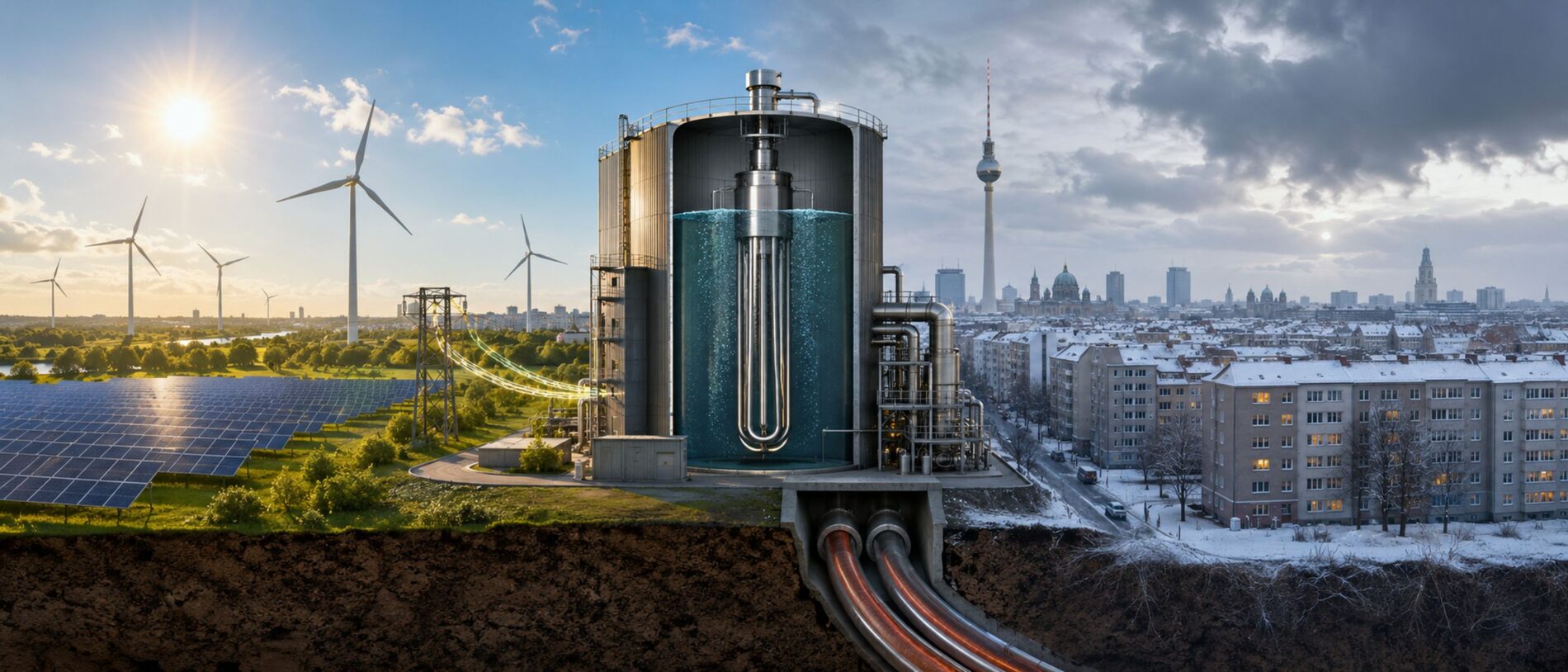
This is particularly helpful during short-term grid bottlenecks. At the same time, its utility remains heavily dependent on the timing of electricity surpluses. Large quantities of solar power are generated on long summer days—precisely when district heating is rarely needed for space heating.
Immersion Heaters Are Only Useful During Simultaneous Power Surpluses
In the summer, the district heating network primarily requires energy for hot water. Consequently, calculated supply figures appear particularly high during this season; however, they reveal very little about the actual contribution to heating requirements in the winter.
In the winter, heat demand rises significantly. Concurrently, solar power systems generate considerably less electricity than they do in the summer. Therefore, an immersion heater is only beneficial during those specific hours when wind power generation is high and a grid bottleneck exists simultaneously. However, such instances are likely limited to just a few hours.
Immersion Heaters Cannot Solve the Seasonal Problem
Heat storage systems can smooth out load peaks and bridge short timeframes. However, their utility is generally limited to periods of a few hours or, at most, a few days. They are scarcely sufficient to achieve an economically viable balance between summer electricity generation and winter heating demand.
Consequently, the immersion heater does not solve the fundamental seasonal problem: the fact that electricity generation from solar systems and the demand for heating heat occur at different times. Particularly during periods of “dark lulls”—when both solar and wind power are scarce—Berlin therefore requires facilities capable of supplying energy independently of the sun and wind.
Natural Gas Remains Relevant Despite New Technology
Berlin aims to make its district heating system climate-neutral by 2045 at the latest. Currently, however, natural gas power plants supply a large portion of this heat. Furthermore, coal-fired plants remain in operation, though they are scheduled to be phased out by 2030 at the latest.
The new “Power-to-Heat” facility can displace fossil-fuel-based heat generation only if a sufficient supply of affordable green electricity is available. This availability remains subject to fluctuations driven by weather conditions and market dynamics. Consequently, this technology serves better as a supplement to—rather than a foundational pillar of—the heat supply system.
Grid Stability Management Shifted to the Heating System
Investment costs for the project amount to up to 75 million euros. 50Hertz is shouldering the majority of the financing. Additionally, via a “redispatch” agreement, the transmission system operator gains access to the facility’s control systems.
This highlights the project’s true purpose: the electric heating unit serves not only to advance the transition to sustainable heating but also to manage grid bottlenecks. Thus, the project effectively shifts costs and operational complexity from the electricity grid into the district heating system.
Benefits Remain Limited to Specific Scenarios
Nevertheless, the facility can still yield benefits for Berlin. It capitalizes on electricity supply peaks, reduces the need for curtailment, and can temporarily lower CO2 emissions. Moreover, it introduces an additional source of flexible load into the city’s overburdened power grid.
However, the limitations remain evident. Surplus electricity does not automatically become available precisely when Berlin requires heat. Consequently, the project remains primarily a grid stabilization tool—one that happens to yield thermal energy—rather than a reliable solution for addressing the seasonal vulnerabilities inherent in the energy transition.