
The demolition of the failed Thermoselect waste-to-energy plant at the Karlsruhe Rhine port has been underway since July 2026. Once a flagship project, it resulted in losses of approximately 400 million euros and has been idle since 2004. Technical malfunctions, a failure to consistently meet exhaust emission standards, and economic difficulties led to its collapse. Now, the energy company EnBW is having the industrial ruin removed. By May 2027, more than 55,000 tons of concrete and steel are set to be cleared away. Subsequently, the site is intended to accommodate a potential new gas-fired power plant project.
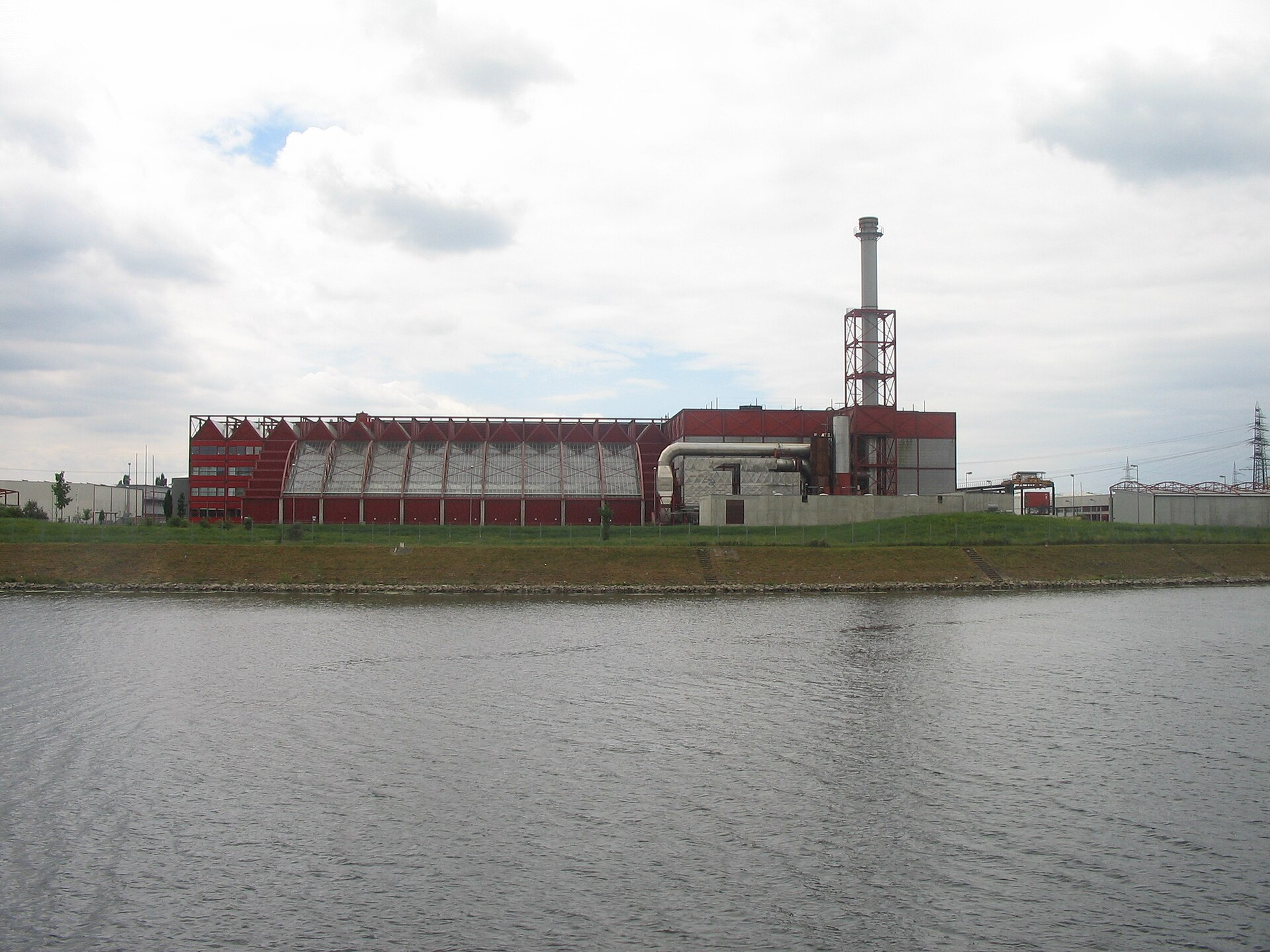
Image: Kucharek, CC BY-SA 3.0, via Wikimedia Commons

Losses in the Millions After Only Five Years of Operation
The story of the facility began with high economic and political expectations. In the late 1990s, Karlsruhe was intended to become a pioneer in a new type of waste recovery. The process promised an exceptionally eco-friendly method for treating household and commercial waste, while also generating valuable energy and recyclable materials. In reality, however, the project turned into one of the most costly failed investments for the regional energy utility.
Construction alone cost approximately 144 million euros. The facility was designed to process more than 200,000 tons of waste annually, with the aim of creating a long-term, profitable business. Yet, delays arose as early as the construction phase. Following its commissioning in 1999, the facility was plagued by mounting technical difficulties. Ultimately, EnBW terminated the project in 2004, by which time losses had accumulated to around 400 million euros.
Thermoselect failed due to technical and economic problems
The process was based on the thermal treatment of waste at high temperatures, intended to produce—among other things—a combustible gas from the refuse. This gas was then meant to generate electricity and heat. Furthermore, the plan included utilizing mineral residues as granules, for instance in road construction. The technology thus promised a more comprehensive use of waste than conventional incineration methods.
In practice, however, the facility failed to meet these expectations. Problems included leaking water basins and the explosion of a pump. Additionally, local residents reported that vehicles in the vicinity of the Rhine harbor were becoming soiled. It proved impossible to consistently maintain the targeted exhaust emission levels, and the plant never achieved stable operation at full capacity. Compounding these issues was a decline in the volume of waste, which further undermined the project’s economic foundation.
Warnings from experts were largely ignored
Even before construction began, experts from the Karlsruhe waste management authority had expressed significant doubts about the technology. Nevertheless, numerous politicians and decision-makers supported the ambitious project. A demonstration plant on Italy’s Lake Maggiore was intended to prove the process’s viability; entrepreneurs and local government officials traveled there to see the technology’s potential for themselves. Ultimately, however, the operation of a small-scale pilot plant could not be successfully scaled up to an industrial level.
Looking back, former Karlsruhe city councilor and environmental activist Harry Block criticizes how the warnings issued at the time were handled. According to his account, political expectations were given more weight than technical objections. The case therefore highlights a fundamental issue with large-scale technology investments: a successful demonstration does not necessarily prove that a process can be operated economically on a long-term, industrial basis. Especially with new industrial processes, technical difficulties can significantly alter the costs originally projected.
Demolition to Cost Millions More
More than two decades after its closure, the Thermoselect facility is finally being removed from Karlsruhe’s Rhine harbor. Since the end of July, heavy machinery has been dismantling the building and its technical equipment. The removal of the large high-temperature reactors is proving to be a particularly complex task. In total, more than 50,000 tons of concrete and 5,000 to 6,000 tons of steel must be cleared away. The foundations are also set to be completely removed.
EnBW expects the demolition costs to reach a figure in the low single-digit millions—an additional expense on top of the losses already incurred. This sum, however, relates exclusively to the current dismantling process and does not reflect the project’s overall financial balance sheet. According to the company, the work is proceeding according to plan, with the site expected to be completely cleared by May 2027.
Site cleared for a new power plant project
The former waste-to-energy plant is located between two harbor basins, in the immediate vicinity of the Rhine port steam power plant. Following the demolition, EnBW intends to use the site for storage and logistics—a move linked to the planned further development of the power plant site. The company is currently evaluating the construction of a new combined-cycle gas turbine (CCGT) plant with an electrical capacity of approximately 850 megawatts. Additionally, the plant could provide around 220 megawatts of district heating.
The project, designated RDK 9, is intended to run on natural gas initially, with the capability to transition to hydrogen later. However, its realization depends on obtaining the necessary permits and meeting specific economic criteria. In particular, EnBW would need to be a successful bidder in the nationwide tender process for new power generation capacity. Consequently, a final investment decision has yet to be made. On October 15, the company provided an update on the current status of its planning. Meanwhile, the environmental organization BUND Karlsruhe is organizing opposition to the proposed gas-fired power plant, criticizing its reliance on fossil fuels.
A costly lesson in political expectations versus technical reality
The dismantling marks the end of an industrial project that was once hailed as a technological breakthrough and a lucrative waste-disposal venture. Instead of operating as a long-term waste-to-energy facility, the plant functioned only for a few years during a trial phase. Afterward, this complex industrial installation sat unused for over two decades. The economic losses had already been incurred long before the current demolition began.
This case illustrates just how expensive immature, large-scale technologies can become when political expectations diverge from industrial reality. It underscores the critical importance of robust practical testing, transparent economic analysis, and independent technical assessments—especially for projects intended to establish long-term energy and waste-management infrastructure. In Karlsruhe, the promise of the future that once existed comes to an end with the demolition. The economic consequences cannot be undone by this.
Author: Blackout News
Sources: SWR (27.10.26) – Bund (24.10.26)