
In Pirna, Saxony, the newly constructed Gottleuba Valley Bridge requires repairs due to significant defects, even before it can be opened to traffic. Construction flaws discovered in the spring of 2026 have prevented the planned opening of the southern bypass, which was scheduled for the end of October 2026. The issue stems from faulty concrete work on structurally critical connections between the bridge piers and the superstructure. Although assessments indicate no immediate threat to the bridge’s structural stability, extensive remedial work is necessary. The 3.8-kilometer-long bypass now carries a price tag of 288.4 million euros. As a result, the long-awaited relief from traffic congestion for the town—home to approximately 40,000 residents—is being delayed once again. The federal government is now aiming for completion in 2027.
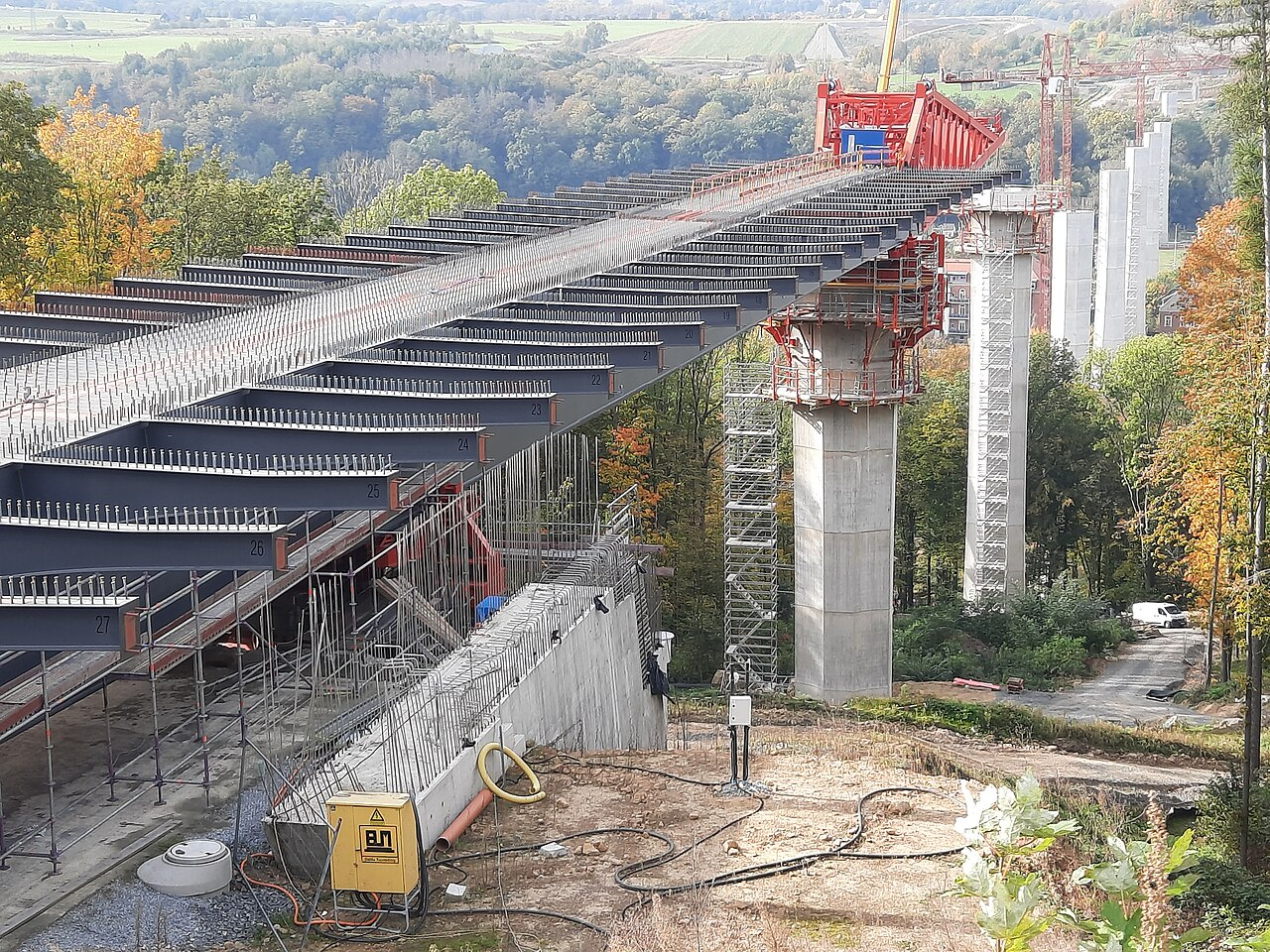
Image: Bybbisch94, Christian Gebhardt, CC BY-SA 4.0, via Wikimedia Commons

Gottleuba Valley Bridge Exhibits Serious Concrete Defects
The Gottleuba Valley Bridge spans the valley for a length of 916 meters and reaches a height of approximately 70 meters. Its design places specific demands on the connection between the bridge piers and the superstructure. For five of the eight piers, there is a rigid connection between these two structural components. It is precisely at these structurally complex transition points that significant defects have emerged—specifically affecting four reinforced concrete haunches, which transfer substantial forces from the superstructure into the piers.
During the concrete pouring process, the construction consortium failed to completely remove the formwork material, resulting in the formation of voids within the affected components. According to the project management company DEGES, the construction firm discovered the error as early as April 2026. Subsequent inspections using ultrasound and radar technology confirmed the damage. While structural analyses indicate that the bridge’s overall stability is not in immediate jeopardy, the voids must still be professionally filled to ensure the structure can perform its intended function without limitation.
Remedial work delays opening to traffic until at least 2027
The construction firm requires a special type of concrete for the remedial work, the use of which necessitates separate authorization from the federal government. Furthermore, DEGES—the project management company—must review and approve the proposed remediation plan. According to current reports, work cannot begin before 2027 at the earliest. A definitive date for opening the road to traffic has yet to be set. Additionally, adverse weather conditions could further delay the construction process.
The federal government attributes the damage to an execution error by the consortium contracted for the project, which consists of the German construction company BeMo Tunnelling and the Czech firm Metrostav. Consequently, the contractor must bear the direct costs of the remedial work; however, the total amount remains unknown. According to DEGES, these repairs are not expected to increase the total approved budget. It is not yet possible to determine whether the extended construction period will result in additional financial burdens.
Costs for the bypass have nearly tripled since construction began
Even before the construction defects were discovered, the infrastructure project had experienced an extraordinary rise in costs. During the initial planning phase in 1999, the estimated cost was approximately 36 million euros. By the time construction began in 2017, that figure had reached 96.6 million euros. The latest cost estimate, from 2025, now stands at 288.4 million euros—translating to roughly 75.9 million euros per kilometer of the new federal highway. As a result, the Pirna southern bypass is considered the most expensive bypass in Germany.
Contract amendments alone now total nearly 135 million euros. The Federal Government attributes this development to factors including construction execution issues, additional work requirements, and rising construction costs. Furthermore, there were earlier delays involving the 315-meter-long Kohlberg Tunnel; difficult geological conditions there initially prevented the project from being completed by the planned 2022 deadline. Later, modifications to the construction design for the Gottleuba Valley Bridge necessitated a further postponement to 2026. Now, a concreting error has made it impossible to meet even that date.
Pirna Continues to Await Relief from Through-Traffic
Construction on the new B 172n federal highway has been underway since August 2017. The bypass is intended, in particular, to divert through-traffic away from Pirna’s town center and improve the connection to the A 17 motorway. Although a western section opened in December 2022, the hoped-for relief from traffic has yet to materialize, as the project remains incomplete. Consequently, the town must continue to contend with the significant burden of regional and long-distance traffic.
The sequence of construction challenges encountered thus far is particularly notable. Geological obstacles initially hindered tunnel excavation, followed by delays caused by structural adjustments to a bridge. Now, construction firms are required to repair concrete components that had already been completed—even before the road has opened to public traffic. At the same time, it remains unclear what additional costs this latest delay will incur. For Pirna, this means another year without the full bypass that has been in the planning stages for decades. What was originally a road project with a projected cost of 36 million euros has since grown into an investment of nearly 290 million euros.
Author: Blackout Bews
Sources: Berliner Kurier (26.10.26) – Deutscher Bundestag (21.10.26) – Freie Presse (26.10.26)