
Sila Atlantik is a German project company established specifically to create a power link between Morocco and Germany. The company is planning two subsea cables, each approximately 4,800 kilometers long, designed to transport renewable energy generated in Moroccan solar and wind farms to the German North Sea coast. The total infrastructure is expected to cost around 30 billion dollars. However, Berlin and Rabat are at odds over guarantees, the project structure, and the bidirectional supply of electricity. Furthermore, Morocco has not yet made a binding commitment regarding the necessary land. Consequently, the financing, investment decision, and start of construction remain unresolved.
Two undersea cables are set to meet five percent of electricity demand
Sila Atlantik plans a transmission capacity of two times 1.8 gigawatts. To achieve this, wind and solar farms with a combined capacity of up to 15 gigawatts are to be built in Morocco. The concept also includes large-scale battery storage systems designed to enable electricity supply for more than 20 hours a day. The developer projects an annual output of up to 26 terawatt-hours, which would correspond to around five percent of Germany’s electricity consumption.
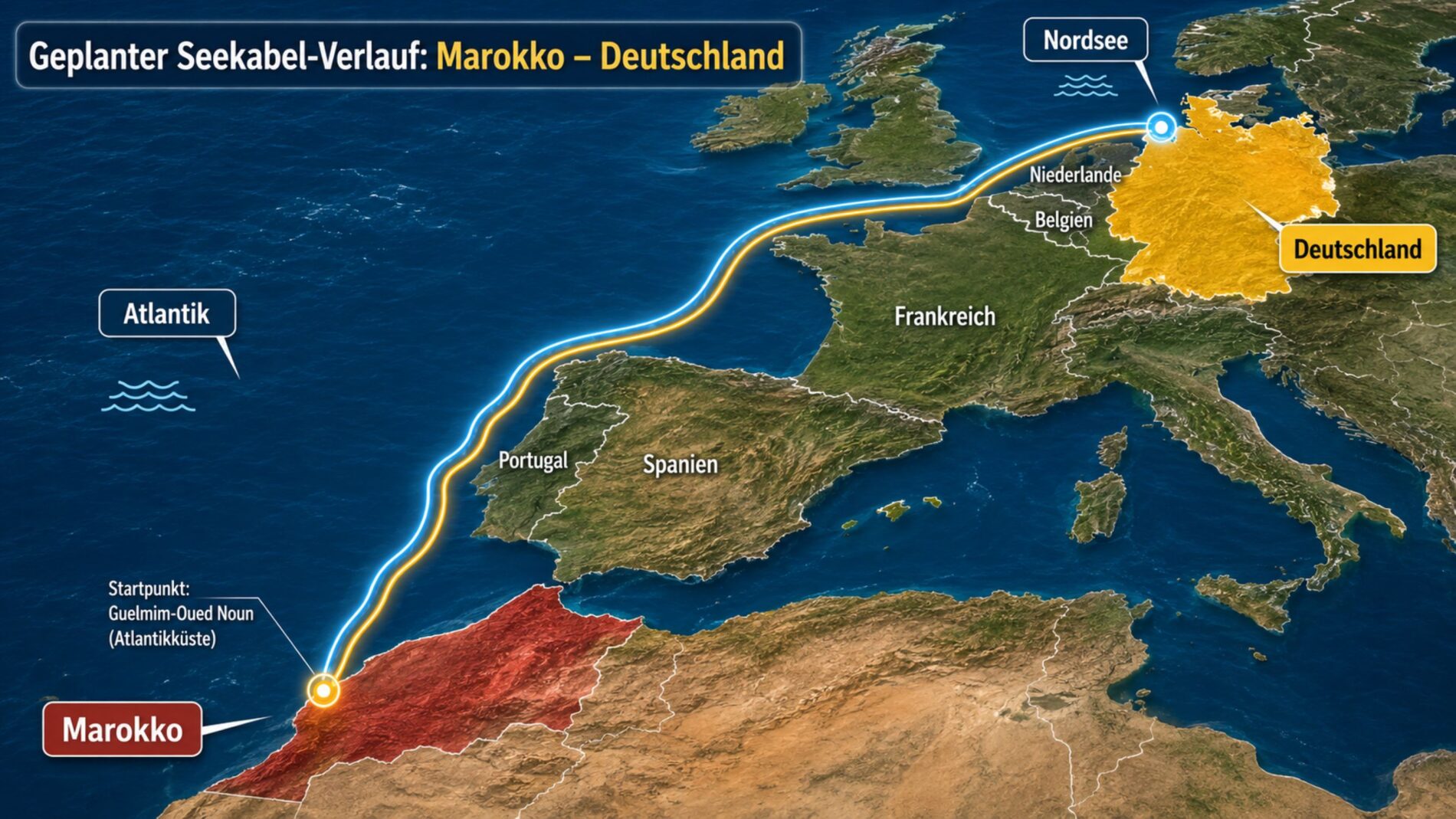
Image: AI-generated.
The cables are intended to run along the Atlantic coast of several European nations before connecting to the German transmission grid. Potential connection points lie within the grid areas operated by TenneT and Amprion. Deutsche Bahn has also expressed interest in electricity from Morocco. However, the project is not yet part of the binding expansion plans of German grid operators; the developer must first provide technical, regulatory, and economic evidence.
Morocco seeks state guarantees and bidirectional transmission
Morocco is calling for an intergovernmental agreement with Berlin’s formal approval. Rabat aims to secure long-term political and financial assurances through this measure. Additionally, the cable is intended to transport electricity in both directions, allowing Morocco to source power from Europe when needed. While technically feasible, this configuration would be more costly. Consequently, securing private financing is likely to remain difficult without state guarantees.
The Xlinks project serves as a cautionary tale. The British developer had planned a solar and wind farm in Morocco with a capacity of 10.5 gigawatts. Four subsea cables, each approximately 3,800 kilometers long, were intended to transport the electricity to Great Britain, potentially meeting up to eight percent of the UK’s electricity demand. However, in June 2025, London rejected a state-guaranteed power purchase agreement. The government favored domestic energy projects that posed lower supply and security risks. In response, Xlinks withdrew its UK permit application on July 1, 2025, effectively causing the planned Morocco-UK link to fail in its original form.
Desert power initiatives have already faltered on several major projects
Desertec pursued a similar vision. Founded in 2009, the industrial consortium aimed to generate solar and wind power in North Africa and the Middle East, with a portion of the energy to be transmitted to Europe via new long-distance power lines. However, high costs, political uncertainty, and a lack of viable business models drove away many investors. Almost all industrial partners abandoned the original initiative in 2014, causing the large-scale export concept to collapse. Meanwhile, in Australia, Sun Cable was planning the Australia-Asia PowerLink. The plan involved a massive solar farm supplying electricity to Singapore via an undersea cable spanning approximately 4,300 kilometers. The project company entered administration in 2023 following a dispute among investors. Although a new owner later relaunched the venture, a final investment decision is still pending.
After Desertec, Xlinks, and the collapse of the original Sun Cable company, Germany—of all places—is now expected to pull it off. While Berlin has not yet issued a state guarantee for the project, it welcomes the idea of its feasibility being examined. Germany’s expertise in major projects is currently best exemplified by the Stuttgart central station. Construction began in 2010 and was originally scheduled for completion in 2019; Deutsche Bahn now cites December 2031 as the new launch date. Costs are projected to reach around 14.5 billion euros. Consequently, an underground station with eight tracks is expected to take more than two decades to complete. By comparison, a 4,800-kilometer power cable running through the territorial waters of multiple nations seems almost like a manageable warm-up exercise. Perhaps the greatest advantage is that, in the case of Sila Atlantik, no German opening date has yet been postponed.
Author: Blackout News
Sources: Euronews (23.07.26) – MarketScreener /22.07.26) – Marocco- UK Power Projekt (01.07.25) – Reuters (22.10.24)