
A major fire at a cold storage facility in Boyle Heights illustrates the difficulty of managing destroyed photovoltaic modules in the event of damage. The roof of the approximately 500,000-square-foot building was covered with solar panels. The fire broke out on June 17 and lasted for several days, prompting authorities to issue warnings regarding smoke, fine particulate matter, and potential hazardous substances. Depending on the module design, these substances can include cadmium, lead, antimony, arsenic, selenium, tellurium, indium, gallium, and fluorinated plastics. Emergency responders also tested for toxic metals, ammonia, and hydrogen fluoride. The incident highlights why damaged modules—whether from fire, hail, or storms—must be quickly secured and disposed of separately. This issue of disposal is becoming increasingly critical amidst the solar boom, as a growing number of systems age, sustain damage, or are taken out of service in the coming decades.
Hazardous substances make damaged PV modules tricky to handle
PV modules consist primarily of glass, aluminum, and plastics. In principle, these components can be effectively recycled. However, smaller fractions—such as heavy metals, semiconductor layers, films, adhesives, and electrical contacts—pose challenges.
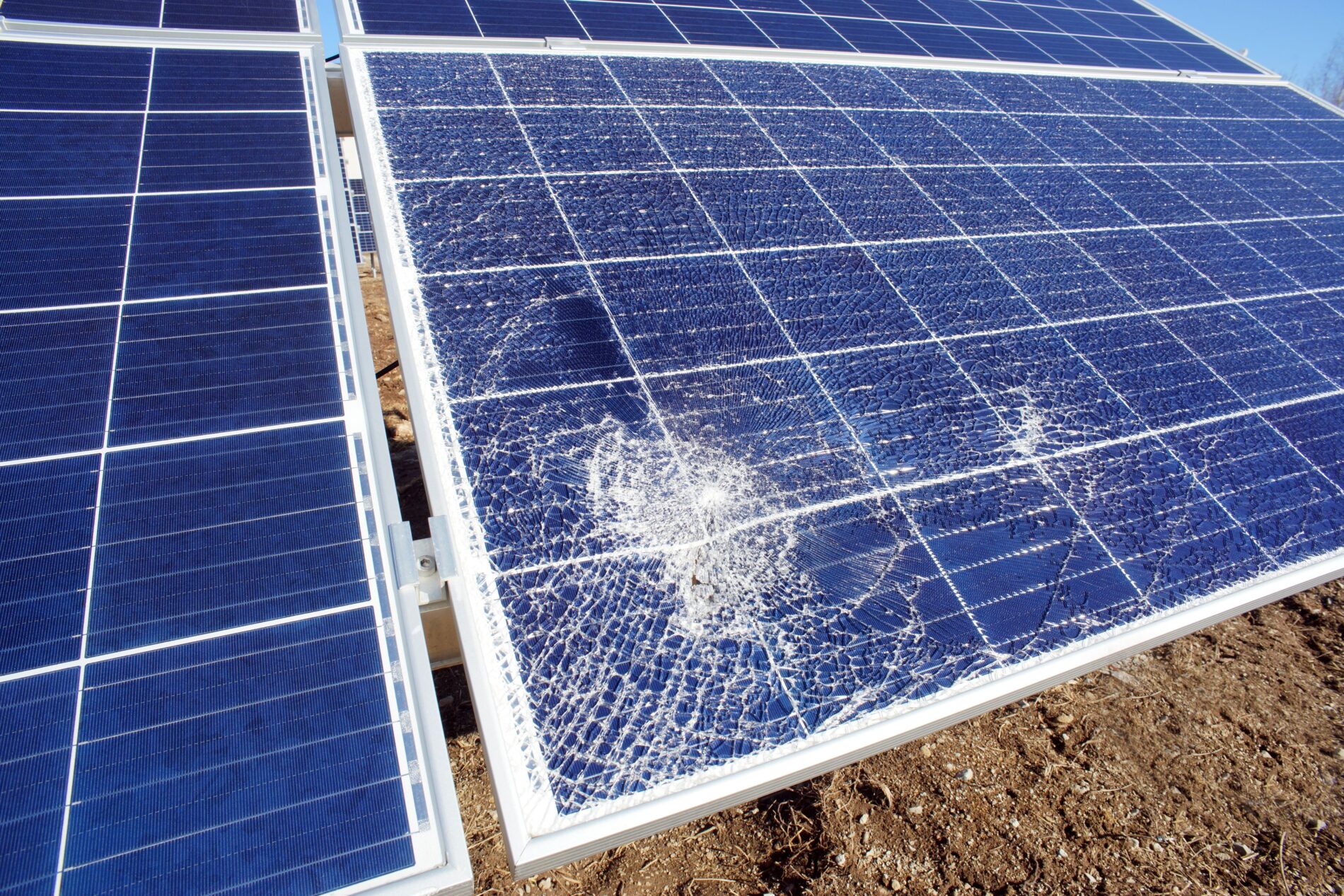
Image: Shutterstock
Fires present an additional risk. Fluorinated plastics can generate problematic decomposition products when exposed to heat. Consequently, the Los Angeles Fire Department also tests for hydrogen fluoride, which can be released during fires involving solar modules or lithium-ion batteries.
However, major damage does not necessarily have to be caused by fire. Hail can destroy modules across vast areas. A specialist study cites a 178-megawatt solar park in Pecos County, Texas, where more than 400,000 PV modules were damaged by hail in 2019.
Cadmium is largely banned—but an exception applies to PV modules
Cadmium is no ordinary material. This heavy metal poses toxicological risks because it can accumulate in the body; kidneys and bones are particularly sensitive to long-term exposure.
As a general rule, cadmium is no longer permitted in many industrial products, barring specific exceptions. For electrical and electronic equipment, the permissible cadmium content is limited to just 0.01 percent by weight per homogeneous material. In practice, this means designers must use cadmium-free components.
However, a special exemption granted by lawmakers applies to photovoltaic modules. Cadmium telluride thin-film modules are permitted to contain the hazardous substance cadmium as a semiconductor material, even though the substance is effectively banned in many other industrial products. This exception does nothing to alter the toxicity of the heavy metal.
Quantities per unit area
Cadmium is not an issue for every solar module. The market is dominated by crystalline silicon modules; these are more likely to contain lead in solder joints, contacts, and electrical connections.
In the case of cadmium telluride modules, however, the Bavarian State Research Center for Agriculture cites figures of 18 to 26 kilograms of cadmium per hectare of module surface area. For 1,000 hectares of such installations, the calculated cadmium content within the modules would range from 18 to 26 tonnes. While this quantity does not leak out automatically, it must be safely captured during decommissioning.
Lead also remains a significant factor. The LfL cites figures of approximately 19 to 25 kilograms of lead per hectare of module surface area for silicon modules. Consequently, it is insufficient to treat old modules merely as glass and aluminum waste.
Recycling rate masks critical material fractions
Germany reports a recycling rate of 92.4 percent for end-of-life photovoltaic modules. However, this figure is driven primarily by glass and aluminum. Both materials account for the bulk of a module’s mass and are technically relatively easy to recycle.
In contrast, the problematic substances are found in thin layers, contacts, and films. Materials such as cadmium, lead, antimony, arsenic, selenium, tellurium, indium, gallium, and fluorinated plastics require different processing methods than crushed glass. Consequently, a high mass-based recycling rate reveals little about the safe handling of hazardous substances.
An emerging economic issue compounds the situation. An analysis dated June 24, 2026, warns that declining silver content is making new modules less attractive to recyclers. As a result, the value of the materials will play a diminishing role in subsidizing the cost of safe disposal in the future.
The solar boom drives the growth of the waste stream
By the end of 2025, Germany had reached an installed solar capacity of approximately 117 gigawatts. This figure is projected to rise to 215 gigawatts by 2030. This implies a significant increase in future decommissioning volumes, even though only a small fraction of end-of-life modules are currently being returned.
Therefore, defective modules must not be left sitting on roofs, in fields, or at depots for extended periods. Following events such as hail, fire, or storms, operators are required to secure the modules, collect them separately, and ensure professional disposal. They must also document whether the affected units are silicon-based, thin-film, or cadmium-containing modules.
A clear policy contradiction remains. Cadmium is effectively banned in many industrial applications due to its toxicity and environmental harm. Yet, it remains permitted in certain solar modules because photovoltaic systems are subject to different regulations. The solar boom therefore requires not only new installations but also rigorous logistics for handling hazardous materials.
Author: Blackout News
Sources: Los Angeles Times (02.07.26) – PV-Magazine (24.06.26) – Bundesinstitut für Risikobewertung (08.06.26) – Bundesnetzagentur (08.01.26) – Bayerische Landesanstalt für Landwirtschaft (Stand: 07.07.26) – Umweltbundesamt (26.03.24) – Universität Stuttgart (18.11.2014)