
A commentary by our author Klaus Bastian:
Chemnitz is opting for large-scale wood combustion for its district heating supply, thereby creating an enormous additional demand for raw materials. The foundation stone for a new wood-fired combined heat and power plant was laid on October 19, 2026. From the end of 2027, the facility is expected to cover approximately ten percent of the city’s district heating requirements. This will necessitate 100,000 tonnes of wood annually. Over the agreed 20-year contract period, this adds up to a total requirement of two million tonnes—mathematically equivalent to the wood mass of roughly one million mature trees, assuming two tonnes of fresh wood per tree. Around 90 percent of the fuel is intended to be sourced from within a 250-kilometer radius. However, this massive demand comes on top of the region’s existing wood consumption. Whether such quantities can be supplied on a long-term basis—without felling additional trees or placing further strain on the forests—has not yet been sufficiently substantiated.
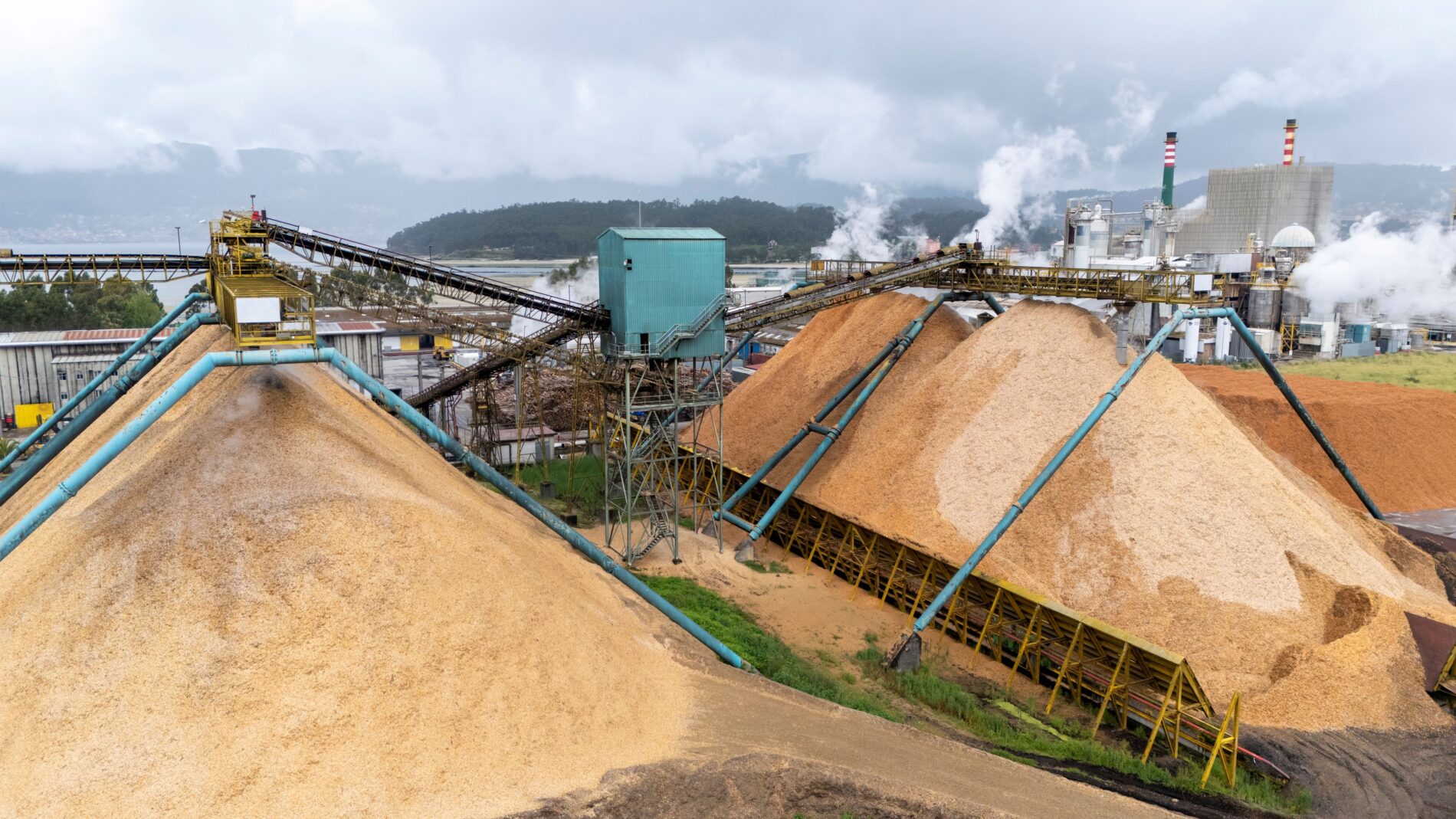
Representative image: Shutterstock
Wood-fired power plant adds two million tonnes of wood to existing consumption levels
The new demand for fuel does not arise in a previously untapped landscape of raw materials. The timber industry, existing biomass power plants, and private consumers already require significant quantities. Consequently, the wood-fired power plant in Chemnitz creates an additional annual demand of 100,000 tonnes, 90,000 tonnes of which are intended to be sourced from the immediate region. Over two decades, this amounts to approximately 1.8 million tonnes of regional wood. The crucial question remains: where will these additional quantities consistently come from?
The operator, HoSt, identifies forest residues, landscape maintenance debris, and trimmings from roadside trees as the intended fuel sources. These terms suggest the use of waste materials that are already available; however, the supply of such materials is limited, and some are already being utilized. Furthermore, forest residues typically only become available during regular logging operations. Therefore, additional demand may exacerbate existing conflicts over resource use. A mere pledge to source materials regionally is no substitute for a transparent and verifiable account of the quantities involved.
Wood-fired power plant consumes in hours what takes decades to regrow
A tree often requires several decades to accumulate a significant amount of wood. In a power plant, however, this material is burned in a very short time. While wood does grow back continuously in the forest, not all of this new growth is available as fuel; a substantial portion serves ecological functions or is already earmarked for other uses. Therefore, the availability of additional wood—beyond what is already being utilized—is the critical factor, rather than the mere fact that trees regrow.
The state of Germany’s forests makes this issue particularly urgent. According to the fourth National Forest Inventory, annual wood growth has declined by 16 percent compared to the previous survey. Drought, forest damage, and the loss of productive spruce stands have all contributed to this decline. At the same time, between 2017 and 2022, German forests lost significant amounts of stored carbon. A sustained, additional demand for wood-based energy could exacerbate this trend if it necessitates higher rates of timber harvesting.
How long will wood residues within a 250-kilometer radius last?
Long-term security of supply is especially questionable. The power plant is intended to burn wood continuously for 20 years. Yet, the annual volume of forest residues depends on timber harvesting levels, the condition of the forest, and other forms of utilization. Similarly, trimmings from roadside trees and landscape maintenance debris are not available in unlimited quantities. One cannot simply assume that sufficient volumes will remain available for two decades based solely on the procurement radius.
This is the fundamental weakness of the supply concept. The project partners should disclose exactly what quantities of wood are truly available as additional resources within the designated area—after accounting for existing uses and the residues that must remain in the forest for ecological reasons. Furthermore, the calculation would need to account for how forest damage and the demand for timber might evolve in the future. Without this information, it is impossible to assess how long existing resources will actually last.
Will healthy forest stands eventually end up being used as fuel, too?
According to the operator, there are no plans to specifically target high-quality sawlogs for use as fuel. While this may sound reassuring at first, it does not resolve the fundamental issue of quantity. A growing demand for energy wood could alter the economic incentives for additional timber extraction. If prices and market opportunities rise, more material—previously left in the forest—might be harvested. Whether this will eventually lead to the additional felling of healthy trees remains an open question.
Moreover, there is the ecological significance of what might be considered “worthless” wood debris. Dead trees, branches, and crown material provide nutrients and promote the formation of humus. At the same time, they serve as a habitat for numerous animal species. Removing these components on a larger scale disrupts the natural nutrient cycle. In doing so, forests may lose the very resources they require for regeneration. Consequently, the fact that wood is unsuitable for construction does not automatically mean it is available in a sustainable manner.
Forests are meant to store CO₂ – yet Chemnitz is opting for wood combustion
Another contradiction concerns the role of forests in climate protection. Trees absorb CO₂ from the atmosphere and store the carbon over long periods. When wood is burned for energy, this storage is immediately brought to an end. New trees, by contrast, require many years to build up comparable carbon stocks. This becomes particularly problematic when the additional demand reduces existing timber reserves or their future growth.
At the same time, a vast quantity of biomass is required to supply only a relatively small portion of Chemnitz’s district heating—the power plant is intended to cover just about ten percent of the total heat demand. Yet, this creates long-term obligations regarding fuel procurement. Other heating technologies—such as large-scale heat pumps, the use of industrial waste heat, or geothermal energy—do not require a similarly continuous supply of wood. While the local feasibility of these alternatives must be assessed, such a comparison is an essential component of any sound, transparent investment decision.
An energy transition at the expense of forests would be a contradiction
The operators point to affordable district heating prices, facilitated by the additional generation of electricity—a process supported by remuneration under the Renewable Energy Sources Act. However, state-subsidized electricity production does not create additional wood resources, nor does it guarantee low fuel prices throughout the entire duration of the contract. Should wood residues become scarcer, rising procurement costs could fundamentally alter the economic calculations.
The timing of this investment is therefore particularly critical. Germany needs resilient forests—forests that can store carbon and recover from the damage sustained in recent years. Yet, at the same time, a new demand for two million tons of wood is being created in Chemnitz. It has not yet been proven that the quantities available for this purpose consist exclusively of material that was previously unused and whose extraction would have no ecological impact. The fact that the material originates from within a 250-kilometer radius is not sufficient evidence of this.
A sustainable heat supply must be measured against the actual availability of its resources. Chemnitz, by contrast, is establishing long-term consumption requirements without providing a publicly verifiable account of the additional raw material base needed to meet them. The primary risk lies not in the simple act of burning wood, but in the potential for increased timber extraction. If the available wood residues prove insufficient, the economic incentive to tap into further timber stocks will grow. For this very reason, the sustainable availability of resources should be definitively proven before construction begins, rather than once operations are already underway.
Author: Klaus Bastian – Blackout News
Sources: MDR (19.10.26) – Tag24 (19.10.26) – Parentsfofuture (19.10.26) – Holz-Zentralblatt (02.10.26)