
A commentary by our author Klaus Bastian:
In the summer of 2026, political initiatives are gaining momentum that could reshape the relationship between the state and critical media. The federal government intends to restrict access to government records under the Freedom of Information Act, while new oversight models for digital media are simultaneously being discussed. Added to this are plans to exert greater regulatory influence over the visibility of journalistic content on platforms. Furthermore, the creation of a new agency to monitor the digital information landscape is under consideration. This gives rise to a striking paradox: media outlets could find themselves with fewer opportunities to scrutinize government actions using original documents, while state-established institutions gain greater influence over the media. The central question, therefore, is not merely whether specific measures are permissible, but rather who will decide in the future which media outlets are deemed reliable, professional, or socially desirable.
Press Freedom Requires Distance from Political Power to Define Terms
The proposal put forward by legal scholar Frauke Brosius-Gersdorf is particularly far-reaching. The jurist—nominated for a seat on the Federal Constitutional Court starting in 2025—advocates for oversight of social networks, and explicitly “new media” as well, that remains “at arm’s length from the state and government.” Under her proposed model, state media authorities could take direct action and impose sanctions in cases involving violations of personal rights. While protecting personal rights is a legitimate aim, this structural arrangement alters the nature of the oversight mechanism: it would introduce an institution capable of independently reviewing and sanctioning publications, effectively interposing itself between the affected party and the media outlet.
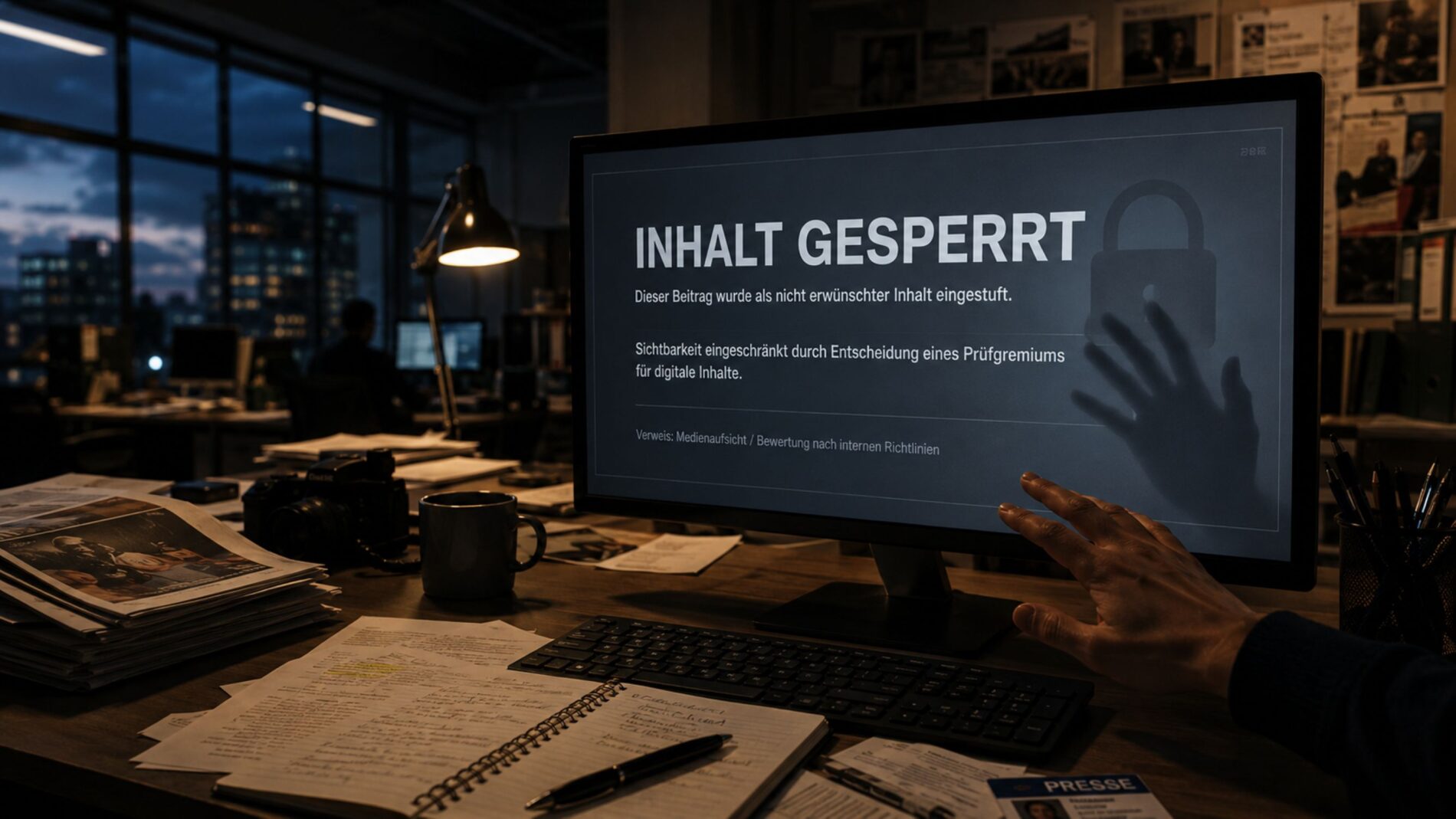
Image: AI-generated
Citing “independence from the state” addresses only part of the problem. While media authorities are not subject to direct government directives, their governing bodies do not emerge in a vacuum, free from political and societal power structures. Parliaments appoint members, civic organizations send representatives, and statutory regulations define their powers. Consequently, the crucial question remains unanswered: Who can guarantee, in the long term, that the composition of such institutions will not be shaped by political majorities, prevailing societal ideals, or shifting moral standards? A democratic order must not make freedom of the press contingent upon oversight bodies happening to remain balanced in their composition.
Defining quality means distributing editorial power
The implications become even more far-reaching when authorities move beyond merely monitoring legal compliance to influencing media visibility. The Bavarian Regulatory Authority for New Media (BLM) advocates for making “professionally researched” journalistic content easier to find via recommendation algorithms. Similar considerations play a role in the State Media Treaty. This shifts the state’s influence from traditional legal oversight to the question of which content actually reaches users. Ultimately, whoever decides on preferential discoverability is also distributing audience reach within the digital media market.
This is precisely where the real problem lies. Terms such as “professional,” “reliable,” “relevant to democracy,” or “high-quality” may sound innocuous at first, but they are not categories that can be measured scientifically. Who determines whether a sharply worded critique of the government constitutes quality journalism or merely problematic sensationalism? Who decides which moral boundaries apply when a piece of content is neither illegal nor a violation of freedom of expression? And what happens to media outlets whose political stances fall outside the societal consensus? The Basic Law protects far more than just polite, balanced, or mainstream opinions.
From Media Oversight to De Facto Censorship
Freedom of the press is not limited merely to instances where an official wields a red pen prior to publication. Ex-post control mechanisms can also impact media output. A media outlet may formally continue to publish yet lose reach due to reduced discoverability, burdensome administrative procedures, or the risk of sanctions. At the same time, supervisory bodies are increasingly automating technical tools to systematically identify potential violations within vast datasets. This significantly narrows the gap between sporadic legal oversight and constant surveillance.
In parallel, the federal government is planning restrictions on the Freedom of Information Act. This could limit journalists’ access to information precisely where state decisions take shape—in files, memos, and internal deliberations. Meanwhile, the institutional capacity to monitor, classify, and—where appropriate—sanction media outlets is growing. This divergent trend alters the democratic balance of oversight. The state may become less transparent to journalists, while journalists become increasingly transparent to state-established oversight bodies.
The State Must Not Become the Arbiter of Permissible Journalism
Criminal content, defamation, and proven violations of personal rights must, of course, be prosecuted. Courts, clear legal standards, and due process procedures already exist for this purpose. The danger arises when additional institutional categories emerge that distinguish not merely between legal and illegal, but between desirable and undesirable, reliable and questionable, or democratically valuable and allegedly problematic. At this point, regulation abandons the solid ground of objective legal violations and veers into political judgment.
This is precisely why the accumulation of such initiatives is more problematic than any single measure. Freedom of the press does not depend on the goodwill of a given oversight body, but rather on clear limits placed on its power. A democratic state must not decide which lawful opinion possesses sufficient quality to merit a wide audience. Nor should it create structures that could later be used by other political majorities against media outlets they dislike. For censorship does not necessarily begin with an outright ban; it can also start when institutions determine which voices remain visible and which are gradually pushed out of the public sphere.
Author: Klaus Bastian – Blackout News
Sources: IT-Journal (10.08.26) – Tagesschau (23.07.26) – Bayerische Landeszentrale für neue Medien (16.07.26) – Deutscher Bundestag (10.07.26) – Landesregierung Rheinland-Pfalz (25.06.26)