
In Germany, the expansion of wind farms near residential areas has been exacerbating the conflict surrounding the energy transition for years, because new installations generate noise, alter the landscape, and cause a significant drop in property value for many homes. A study by the RWI Leibniz Institute for Economic Research, based on 2.7 million real estate listings, shows that houses within a one-kilometer radius of new wind turbines lose an average of seven percent of their value. For homeowners, this can mean losses of tens of thousands of euros, while project developers, landlords, and individual stakeholders profit. At the same time, the conflict intensifies because many locations only appear economically viable with high premiums, and residents often bear the financial burden alone. (welt: 06.03.26)
Depreciation directly impacts homeowners’ assets
For many homeowners, their house is their most valuable asset. A significant drop in market value not only affects a potential sale but also their entire personal financial planning. This effect is particularly pronounced in rural areas, where a substantial portion of one’s wealth is often tied up in their home.
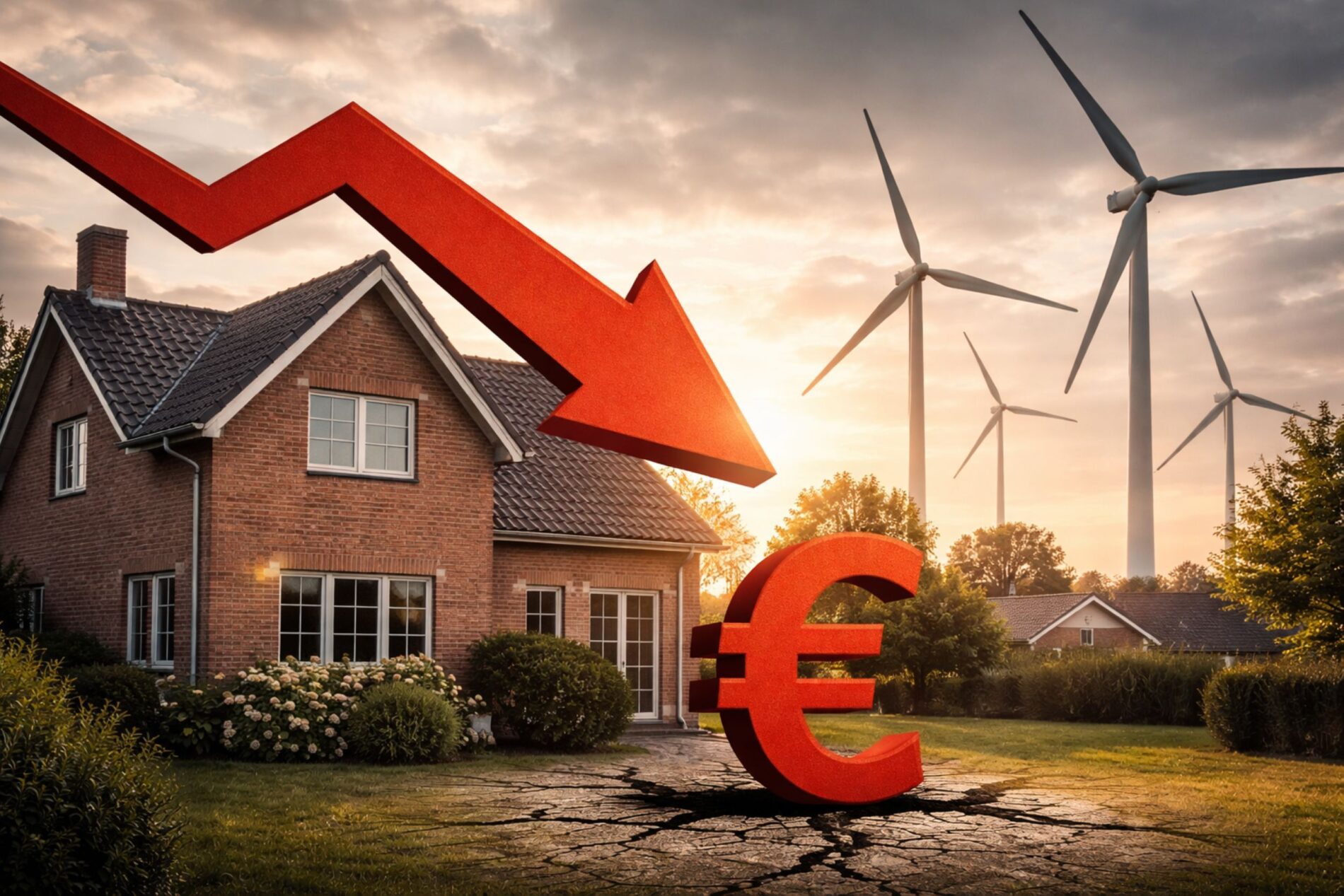
The RWI data makes the problem tangible. Listings on Immoscout24 from 2007 to 2015 were analyzed. The result was clear: near new wind turbines, the asking prices for comparable houses were on average a good seven percent lower. This loss in value is therefore not just a feeling among affected residents, but a measurable economic loss.
Many citizens’ initiatives against wind farms arise precisely for this reason. Residents are not only protesting against altered views or noise, but also against real losses to their property. While lessors receive regular income, neighbors are left to bear the disadvantages. Furthermore, the attractiveness of entire residential areas often declines when large wind turbines dominate the surroundings.
Citizen participation does not solve the real estate problem
To mitigate resistance, operators and municipalities are increasingly relying on citizen participation. Citizens can participate in wind farms through cooperatives, and these models also advertise returns and climate benefits. For affected homeowners without a stake in the project, however, this changes little, as their property doesn’t regain any lost market value.
Even for investors, these projects are by no means as safe as they are often portrayed. Technical problems such as gearbox damage can cause high costs, and insurance policies don’t cover every risk. Even more serious is the fact that insufficient electricity yields due to misjudged wind conditions are not compensated. Especially at less-than-ideal locations, this can quickly become a financial problem for the entire project.
Such miscalculations affected around half of the commercial wind farms built in the 2000s. Planners sometimes worked with indices instead of long-term, on-site measurements, which is why the yield forecasts were overly optimistic. This affected not only large operators but also many community wind farms. Even small deviations have a significant impact, because electricity yield is cubed with wind speed.
High subsidies, little benefit for many affected residents
From an economic perspective, the problem is exacerbated by the subsidization of less windy locations. Wind farms in low-wind regions receive 55 percent higher subsidies to make them profitable. However, these additional costs are borne by all taxpayers, while only a few directly benefit. For local residents, this means that in addition to the financial damage to their homes, they also feel the political and financial consequences twice over.
Furthermore, such projects have a special political status. Wind power projects are legally considered projects of “overriding public interest,” which makes local resistance even more difficult. For many homeowners, however, another point is paramount: the depreciation of their property is concrete, immediate, and often permanent. Therefore, anyone discussing wind farms must not only talk about electricity generation but must also focus on the financial losses suffered by homeowners.