
Wind turbine scrap will become a key waste management issue in the energy transition in the coming years. Since 2020, 2,351 onshore wind turbines have been decommissioned. An additional 415 were decommissioned in November of last year. An industrial recycling process for fiberglass-reinforced plastic (FRP) and carbon fiber-reinforced plastic (CFRP) rotor blades is still lacking. Furthermore, the German government states that it has no information on the number of rotor blades replaced. Data on treatment, disposal, or reuse is also reportedly unavailable. (nordkurier: 17.01.26)
Wind turbine scrap: Rotor blades considered problematic material without an industry standard
A statement from the industry aptly describes the situation: “To date, no industrial solution exists” for the disposal of rotors. However, a mass market requires precisely that: scalable systems, established standards, and predictable costs. Without such structures, the problem is merely shifted instead of solved. The wind turbine scrap then ends up in temporary storage facilities, makeshift solutions, or expensive special processes.
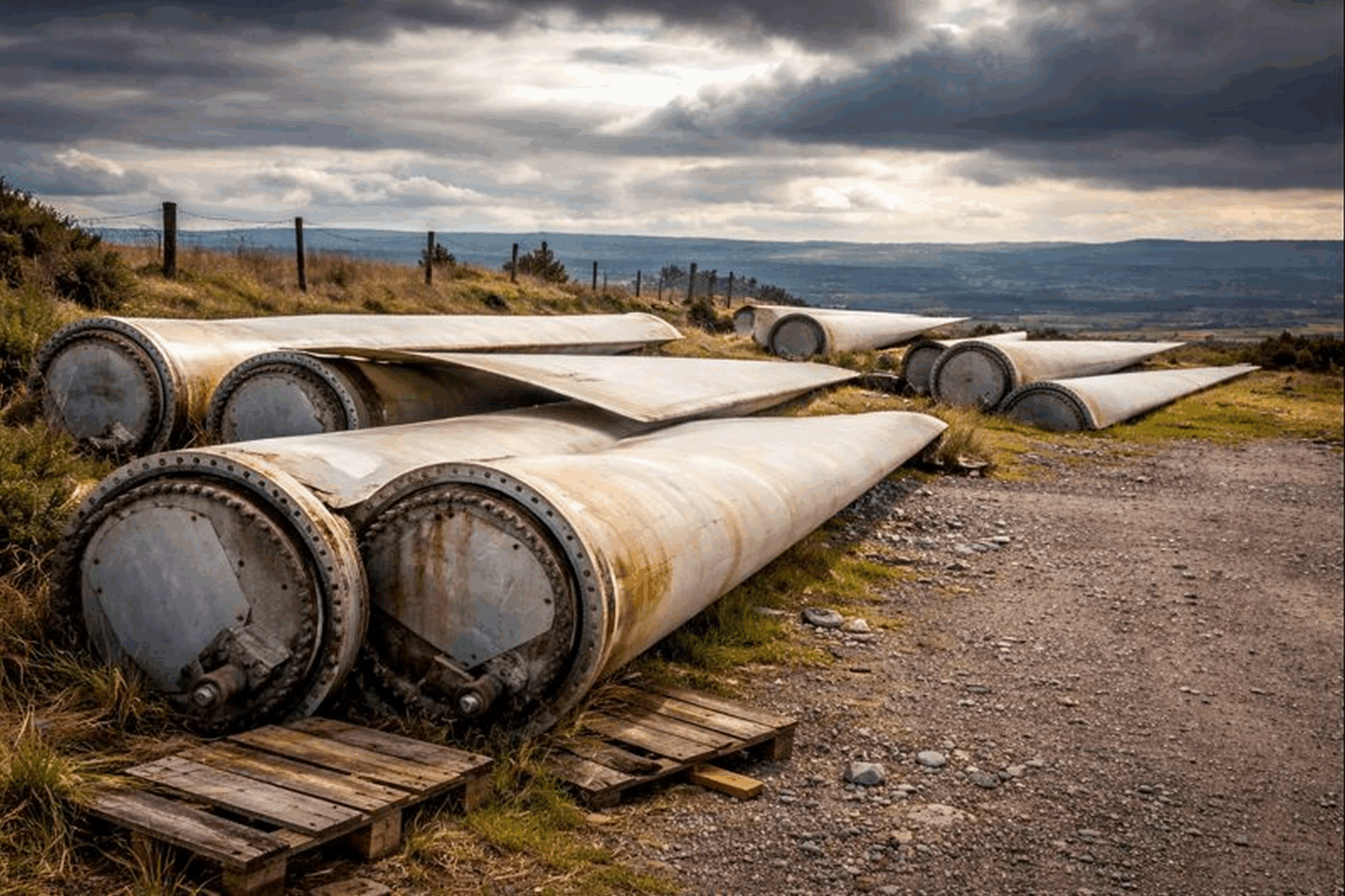
Wind turbine scrap is developing into a key waste management issue for the energy transition in the coming years. Since 2020, 2,351 onshore wind turbines have been decommissioned, and 415 more were dismantled in November of last year. At the same time, a large-scale industrial recycling process for fiberglass and carbon fiber rotor blades is still lacking, while the German government, according to its own statements, has no information on the number of replaced rotor blades or on their treatment, disposal, or reuse.
Decommissioning figures are rising, but the fate of the blades remains a blind spot
Decommissioning figures are already increasing. Since 2020, 2,351 onshore wind turbines have been decommissioned, and 415 more were dismantled in November of last year. At the same time, the government answers key questions about rotor blade currents not with measurements, but with references. This leaves it unclear whether large-scale recycling pathways will emerge or whether disposal will effectively become mere removal.
Enrico Komning, AfD member of the Bundestag from Mecklenburg-Western Pomerania, is addressing precisely this gap. He asks: “Does the federal government now possess data on the treatment, disposal, or reuse of old rotor blades and the fiber composites they contain for the years 2024 and 2025?” He also states: “It has been known for years that carbon and glass fiber reinforced plastics are hardly recyclable.” And he adds: “The majority is therefore incinerated.” This raises the crucial question of how Germany will deal with wind turbine scrap in a few years when the volume becomes critically high.
Does the federal government now possess data on the treatment, disposal, or reuse of old rotor blades and the fiber composites they contain for the years 2024 and 2025?
UBA forecasts show massive quantities, but recycling remains theoretical
The German government refers to a 2022 study by the Federal Environment Agency (UBA) regarding waste volumes. According to the study, a cumulative 326,000 to 430,000 tons of waste from glass fiber reinforced plastics (GFRP) from pure rotor blades will be generated by 2040. The UBA also cites 77,000 to 212,000 tons of fiber-reinforced plastics from rotor blade types containing GFRP and CFRP components. However, this range is of limited help if an industrial recycling process is lacking and the blades do not find a stable recycling loop in practice.
At the same time, the mountain of material beyond composites is growing. The UBA also anticipates 835,000 tons of steel and 5.5 million tons of concrete. Nevertheless, it is precisely this most difficult component that will determine acceptance and costs, because rotor blades do not simply disappear into standard recycling processes like metals. Therefore, the public focus on wind turbine scrap is primarily on the blades, as recycling often fails in this area.
Disposal Costs Rise as Long as Standards Are Lacking
Costs are also driving the debate. Greenpeace estimates disposal costs at between €160,000 and €305,000 per wind turbine, depending on the turbine’s size. If operators simultaneously plan more decommissioning, the need for predictable prices and guaranteed disposal routes increases. Without industrial-scale solutions, bottlenecks threaten because disposal and recycling will then compete for the same scarce capacities.
Therefore, the next phase of wind power will be decided not only by new turbines but also by dismantling and waste management. Anyone initiating decommissioning today needs clear documentation of where rotor blades go and how the disposal process is carried out. As long as the government fails to provide an overview of this, wind turbine debris remains a risk for municipalities, operators, and waste disposal companies.