
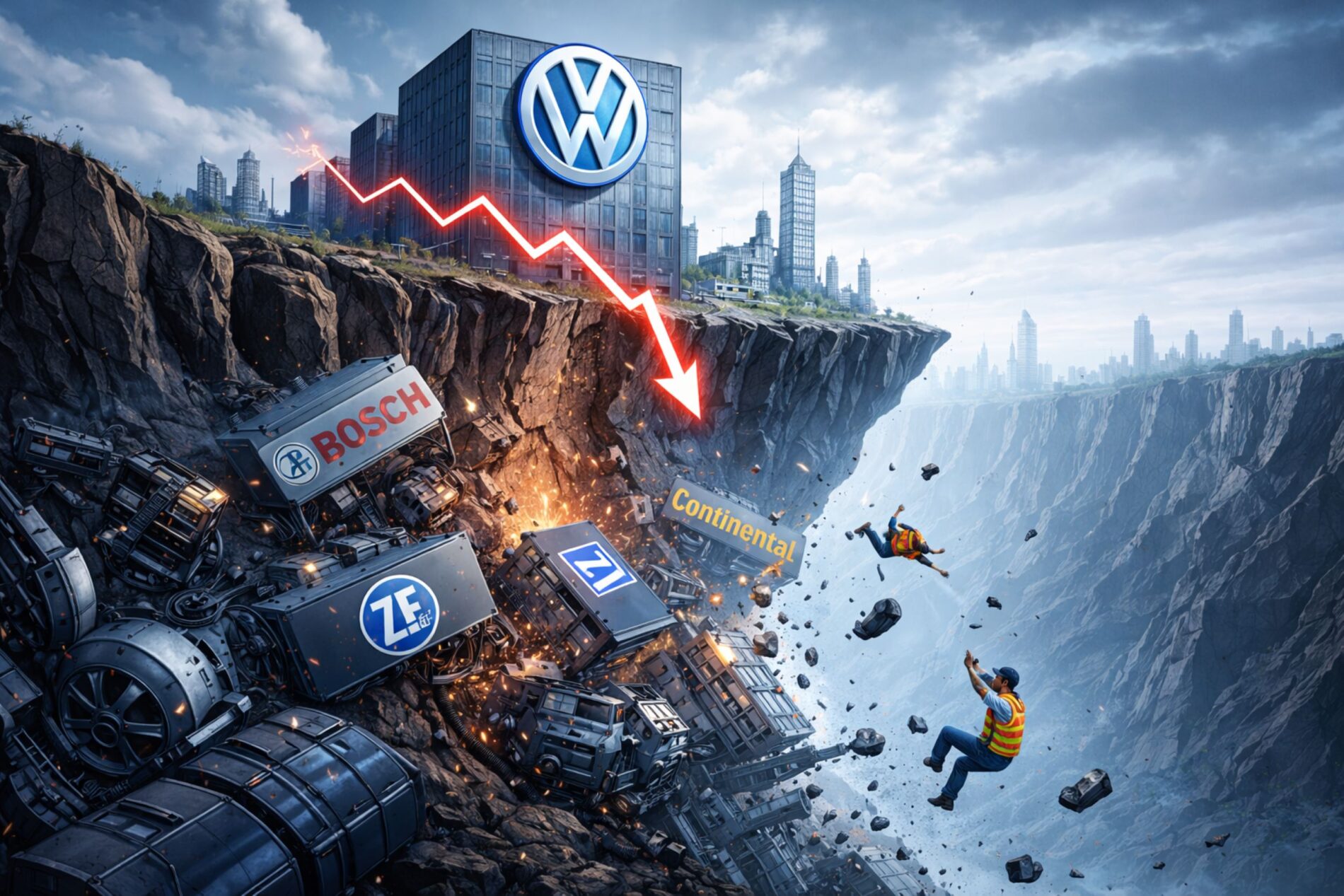
The Volkswagen crisis is exacerbating the situation for the German automotive industry, hitting suppliers particularly hard. The massive drop in Volkswagen’s profits is acting as an accelerator in an already fragile environment, as high production costs, the stalled transition to electric vehicles, new US tariffs under President Donald Trump, and growing competitive pressure from China are putting additional strain on companies. Since 2018, the sector has lost around 120,000 jobs, more than 50,000 of them within a single year. Medium-sized companies, especially those focused on Europe and components for combustion engines, are particularly vulnerable. The consequences range from restructuring and plant closures to bankruptcies, supply chain disruptions, and further job losses in regions such as Saxony and southern Germany. (berliner-zeitung: 13.03.26)
VW Crisis Hits Suppliers Harder Than Manufacturers
While the automakers themselves are under pressure, the main burden is being borne by the suppliers. They are struggling with declining order volumes, high restructuring costs, and aggressive pricing policies from the manufacturers. Large corporations like Bosch and ZF Friedrichshafen have already initiated cost-cutting programs and job reductions. Volkswagen is also taking a hard line. The company plans to eliminate around 50,000 jobs in Germany by 2030.
Another major blow came at the end of 2025 in Dresden. At that time, VW ceased car production at the Transparent Factory. Such a step had never been taken before in the company’s 88-year history at this location. The signal extends far beyond Saxony because it reveals the depth of the industrial crisis. The VW crisis is therefore not limited to the balance sheet of a single manufacturer.
Studies and experts anticipate further bankruptcies
A study by the management consultancy Oliver Wyman warns of a potential “domino effect.” This refers to a scenario in which not only individual companies fail, but entire supply chains become unstable. Specialized suppliers, in particular, are difficult to replace in the short term. If one link fails, downstream production also grinds to a halt. This increases the economic pressure on the entire industry.
The director of the Institute for Automotive Economics, Stefan Reindl, expects further cutbacks in the coming months. He says: “In the coming months, we will likely see further restructurings, plant closures, and also bankruptcies.” Stefan Bratzel of the Center of Automotive Management also considers the development alarming. Some German suppliers will “not survive” the crisis. His warning is aimed primarily at companies whose business still relies heavily on conventional powertrains. These companies often lack the capital, time, and planning certainty needed for the necessary transformation.
Import pressure from China exacerbates the VW crisis
In addition to the domestic problems, pressure from China is growing. Certain vehicle components from the People’s Republic are rapidly entering the German market. These include transmissions, electronics, and forged parts. In some segments, import volumes have increased by more than 180 percent within a year. This is noticeably shifting the competitive landscape. German suppliers are consequently losing additional pricing and margin flexibility.
Wulf Schlachter, founder of the charging infrastructure company DXBe Management, describes the situation as “tense to critical, especially for medium-sized and smaller suppliers that have focused on the manufacturers’ business in Europe.” Companies heavily reliant on the combustion engine are particularly at risk. He warns: “More bankruptcies, plant closures, and job cuts are unfortunately more likely than ever.” He doesn’t expect a sudden wave. Rather, he anticipates a gradual structural decline that will erode the industry month by month.
Entire industrial regions are under pressure
When suppliers fail, the consequences are not limited to individual plants. Missing parts can slow down or halt production at VW and other manufacturers. New suppliers often require extensive qualification, which costs time and money. At the same time, dependence on a few large global suppliers is growing, increasing the vulnerability of the entire industry.
Regions with dense supplier networks are particularly threatened. Schlachter speaks of “noticeable job losses in typical supplier regions such as southern Germany or Saxony.” He also sees the manufacturers as contributing to the problem. For years, they have exerted massive price pressure and passed risks on to their suppliers. Added to this are rapid platform shifts from combustion engines to electric vehicles and the discontinuation of entire assemblies. “For many suppliers, their core business is collapsing faster than they can invest,” says Schlachter. In his view, policymakers also bear responsibility because they demand restructuring but have failed to create viable framework conditions for many medium-sized businesses.