
In Vienna, the Ministry of the Interior has ended the TRON project, which had been testing electric vehicles as police patrol cars since 2023. Negative practical experiences during operations were the deciding factor, leading Interior Minister Gerhard Karner to prematurely halt the trial. The test was conducted in real-world situations and across several federal states, but limitations repeatedly became apparent in practice regarding charging breaks, equipment, and continuous availability. A critical factor proved to be the lack of a reserve fleet for long shifts, as vehicles could not be easily recharged. The consequences are immediate: for the time being, there will be no regular switchover, and combustion engine vehicles will remain the backbone of daily operations. (kurier: 24.02.26)
Real-world operational challenges overturn the concept in patrol service
TRON was intended to determine whether electric vehicles could handle traditional patrol duties, and the Ministry of the Interior focused on a rapid fleet modernization. The test included models such as the VW ID.3 and VW ID.4, with a total of 22 vehicles leased. The trial took place not only in Vienna, but also in Lower Austria, Tyrol, and Styria; however, its practical application remained limited.
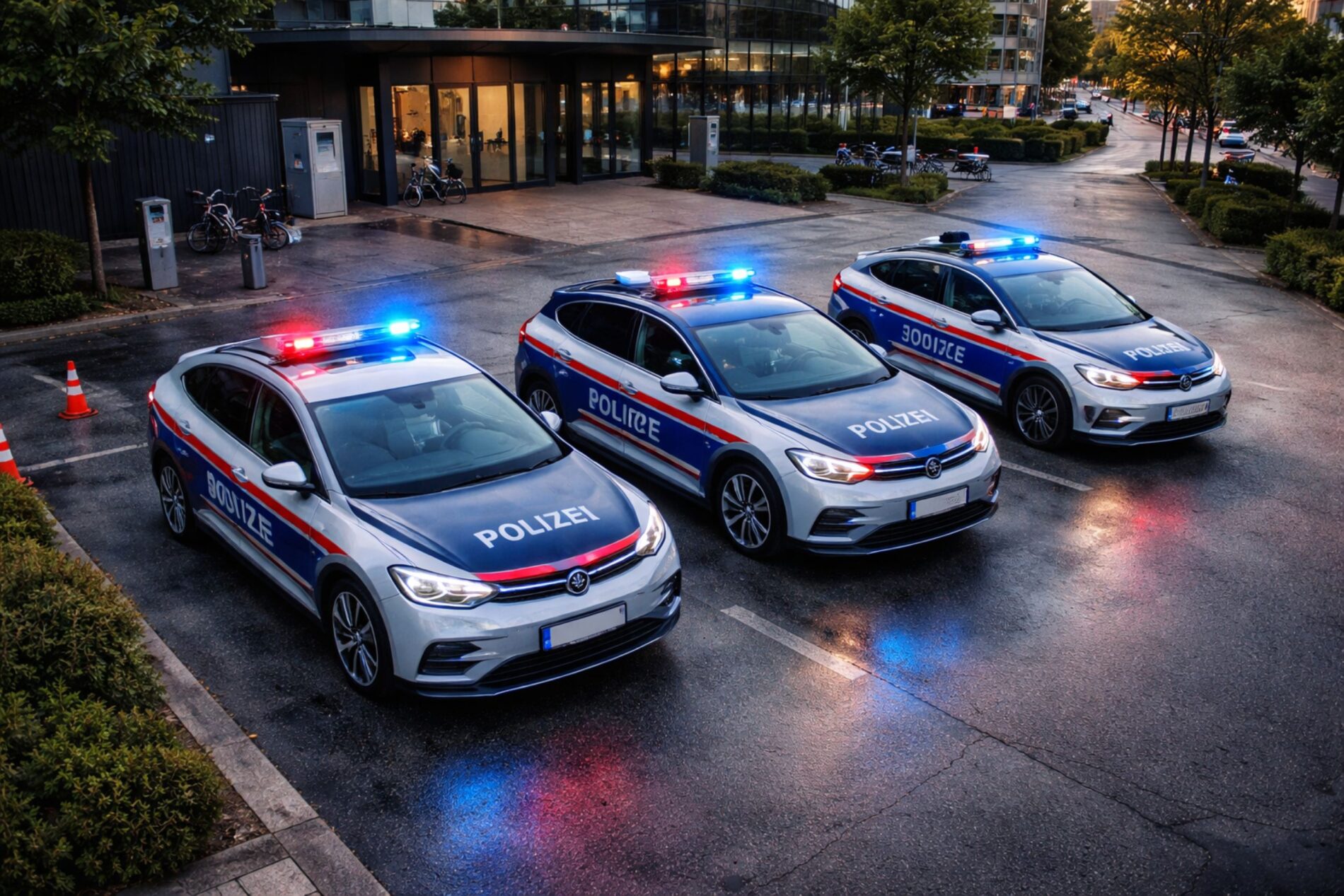
Availability was crucial, as police vehicles must be able to start immediately. Charging breaks often didn’t fit into the duty roster, so teams frequently had to swap vehicles. This tied up additional resources, while conventional vehicles still had to be kept on standby.
Charging breaks became an operational problem in practice
The charging infrastructure proved to be a bottleneck because patrol work rarely offers predictable downtime. When a vehicle needs to be plugged in, it’s unavailable at the station, creating gaps in coverage. In practice, this often meant switching to another car, effectively requiring two vehicles to be stationed.
Equipment also played a role, as radio equipment, protective gear, and additional weight reduced range and usability. In some vehicles, space was also limited, as all the equipment couldn’t be accommodated. Furthermore, the user interface of modern cockpits presented a challenge, as touchscreens can be more difficult to operate than traditional switches in stressful driving situations.
The police union is pushing for operational criteria for police cars used in patrol duty
Criticism from within the police force arose early on, focusing less on ideology and more on suitability in real-world situations. According to this view, electric vehicles are better suited for administrative and courier services because charging breaks are easier to plan. However, they lack the necessary reserve power for dynamic situations, which is why a combustion engine vehicle remained essential for backup.
Additional discussions arose regarding performance, with some models having limited top speeds. While this is sufficient for routine patrols, pursuits and rapid deployments require different reserves. Furthermore, practical limitations arose in tight inner-city areas, as size and weight affect maneuverability.
No final end, but a clear interim assessment
The Ministry is not ruling out further testing, but is first waiting for technological advancements in batteries and charging capacity. Until such systems can guarantee continuous operational readiness in everyday patrol duties, the status quo will remain. TRON will therefore be temporarily discontinued until the technology improves sufficiently to be used in police vehicles.
For Vienna, the bottom line is simple: operational readiness trumps experimentation, which is why the fleet’s propulsion system will remain conventional. Whether a second attempt succeeds depends on charging infrastructure, range under load, and robust usability under stress.