
The German government has presented key points in Berlin for a new building modernization law, intended to replace the existing heating law (Building Energy Act) introduced by Robert Habeck. This initiative stems from the political restart following the collapse of the coalition government in 2024 and the controversy surrounding the de facto mandate for heat pumps. In the future, homeowners will again be free to choose the technology when replacing their heating systems; however, the coalition is linking new oil and gas heating systems from 2029 onward to a risk clause: fuels must then contain at least 10 percent biofuel. The consequences are predictable: energy suppliers will be required to provide these mixtures, while heating costs are likely to rise, and new dependencies on scarce biofuels are also a threat. (nzz: 24.02.26)
Heating Law – What the Coalition is Specifically Planning
The German government is prioritizing freedom of choice when replacing heating systems, while simultaneously shifting the responsibility to the supply chain. From 2029, fossil fuels for newly installed heating systems will only be permitted as a mixture containing 10 percent biofuel, such as biomethane, hydrogen, or synthetic fuels. Suppliers will be required to offer these mixtures, creating procurement pressure that will be reflected in prices. The quota is to increase in three stages by 2040, with the coalition determining the exact extent of these increases during the legislative process.
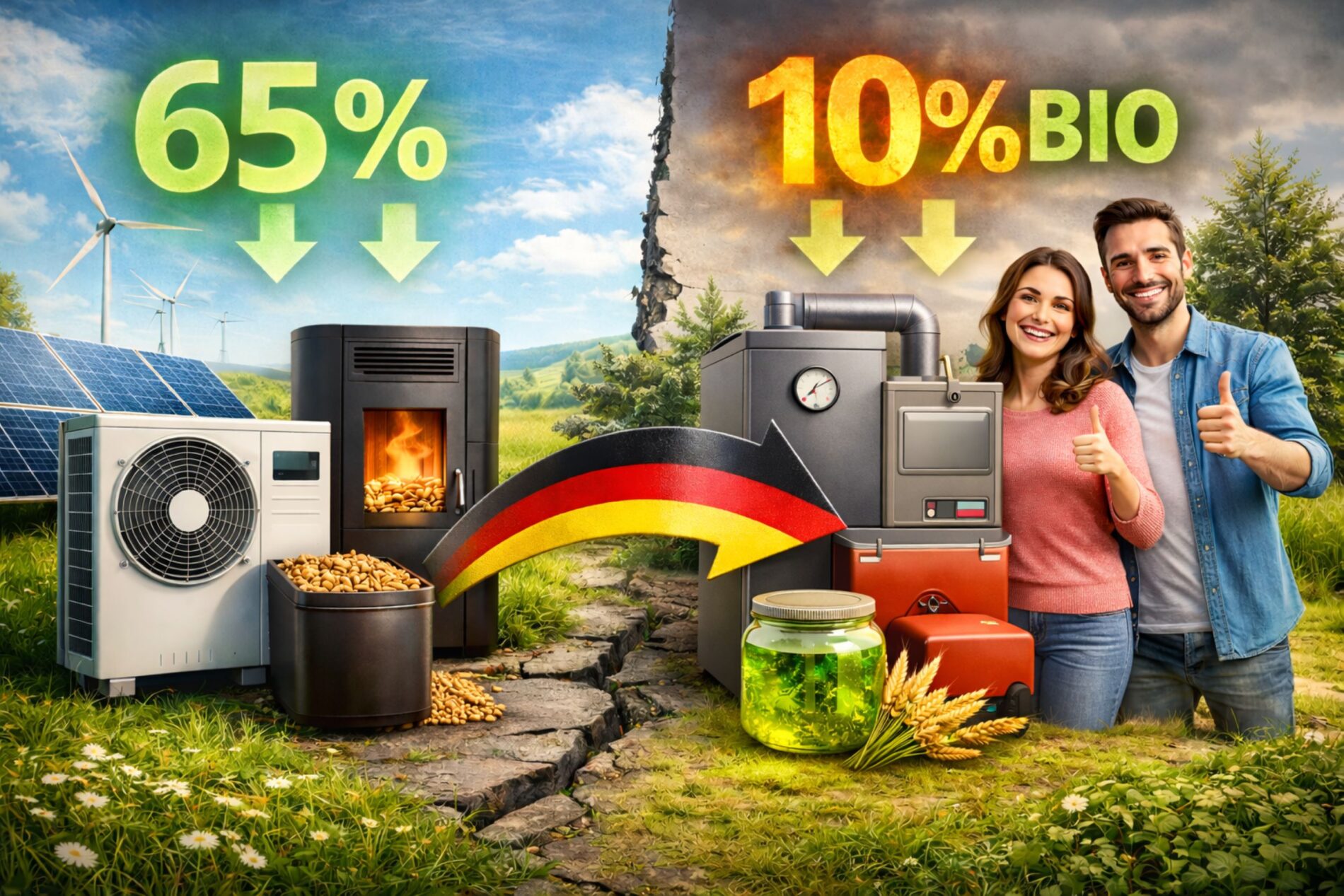
For consumers, the choice of heating system remains formally open, but price could effectively limit the selection. The coalition intends to continue the existing subsidies for heat pumps at least until 2029. However, experts anticipate higher fuel costs due to the addition of a 10% biofuel component. In an internal document, the parties calculate additional monthly costs of €16 for gas and €23 for oil for the average consumption of a single-family home. This particularly affects households that still rely on fossil fuel systems after 2029, while a later switch could trigger additional investments.
Why the issue remained so politically explosive
The conflict was sparked by Robert Habeck’s 65 percent target for renewable energy in heating system installations. In practice, this target was primarily met by heat pumps and pellet heating systems, which would have largely displaced new oil and gas heating systems. Many homeowners feared high costs, and the efficiency of heat pumps in unrenovated older buildings remains controversial. In opposition, the CDU denounced this as a technology ban, and the heating law became a symbol of a policy that permeated the daily lives of many households.
Ultimately, a watered-down version came into effect in 2024, but without resolving the fundamental conflict. The 65 percent quota initially applied primarily to new buildings, while the replacement of older systems was less strictly regulated. At the same time, the government introduced subsidies of up to 70 percent of the installation costs for climate-friendly heating systems. This very mix of regulations, subsidy logic, and cost concerns shaped the debate and now provides the new coalition with the justification for its change of course.
Climate Target and Heat Planning – Municipalities as Pace-Setters
The German government remains committed to its goal of achieving climate neutrality by 2045, which is why the building sector remains a crucial element of climate policy. A significant portion of energy consumption is attributable to buildings, and without CO₂ reductions in this sector, the overall target will become unattainable. At the same time, the practical implementation hinges on municipal heat planning, as it is intended to provide households with a basis for choosing between connecting to a heating network, such as district heating, or implementing their own individual solutions.
Cities with more than 100,000 inhabitants must complete their heat planning by June, while smaller municipalities have until mid-2028. For towns with fewer than 15,000 inhabitants, the coalition intends to standardize the requirements to reduce administrative costs, but without fundamentally abandoning the instrument.
10 Percent Biofuel Share – Technically Feasible, Politically Risky
Mixing fossil fuels with biofuels is technically possible, but availability will determine its success. Biomethane currently accounts for just under 1 percent of total gas consumption in Germany, meaning suppliers would have to procure large additional quantities quickly. Jens Spahn speaks of “enormous potential” and also points to Ukraine as a possible source, while the Ministry of Economic Affairs is expected to present an implementation plan by summer.
Politically, the coalition frames the move as the end of the debate on bans, while the opposition warns of new dependencies. Spahn declared that this puts an end to the “restrictive policies” of Habeck’s era. Minister of Economic Affairs Katherina Reiche said: “We are relying on reason, freedom, and speed instead of bans. This will resolve the investment backlog and get the modernization of our buildings moving again.” The Greens are firing back sharply: Katharina Dröge calls the 65 percent target the core of climate protection and warns: “If the CDU and SPD abandon this, they will increase Germany’s dependence on fossil gas, and then Germany will not be able to achieve its climate goals.” Local gas suppliers also caution that a tight supply could drive prices up significantly, which is why the cost issue remains the crucial point of this new heating law.
Roadmap – Draft by Easter, Implementation before July
The federal government intends to translate the key points into a draft law by Easter, after which the Bundestag will debate it. The new regulations are to come into force before next July, which is why the coalition is pushing for speed. The decisive factor will be whether the biofuel quota is affordable and feasible, while the funding framework is intended to signal stability until at least 2029.