
The Netherlands’ nuclear plans are now taking concrete form, as the government has established a new state-owned company specifically for their implementation. NEO NL will initially plan, build, and later operate two nuclear power plants. The Hague is planning for four reactors in the long term. This move is driven by a shift in energy policy towards increased nuclear power. The first two plants are expected to cost between 20 and 30 billion euros. A location has not yet been determined, and the first reactors could be connected to the grid no earlier than the second half of the 2030s. (rp-online: 09.03.26)
State-owned company to implement nuclear program
NEO NL started last year as part of the Ministry for Climate and Green Growth, but is now operating independently. The Ministry remains the sole owner, so the state retains full control. Around 100 employees already work for the state-owned company. The team is expected to grow gradually.
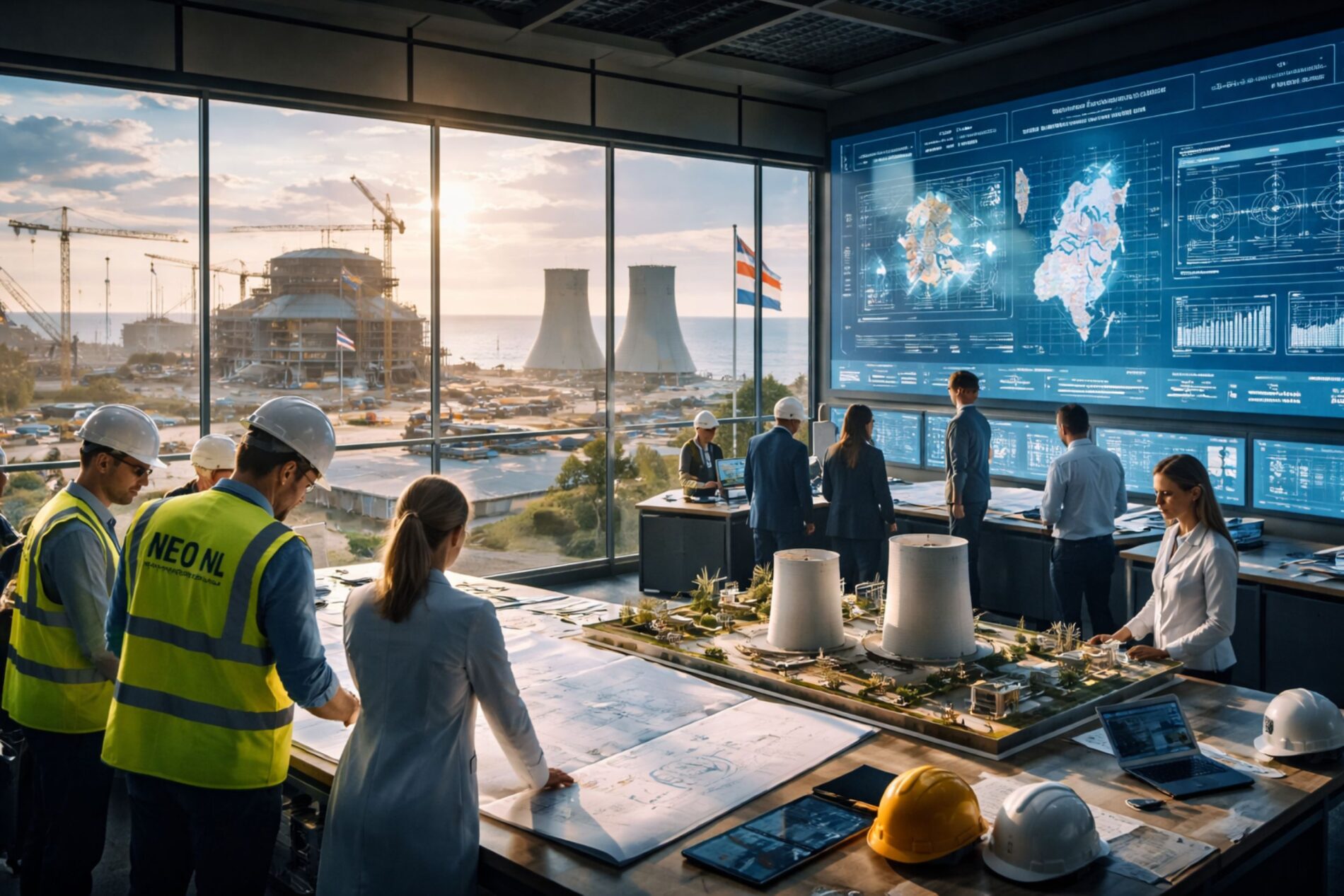
With this structure, the Dutch nuclear plans are moving beyond the mere announcement phase. Experts are already preparing the next steps, transforming political decisions into a concrete, large-scale project. The first two reactors are to be built at a shared site. However, the exact location is still undecided. For 2026, policymakers have only announced a preliminary site selection.
Government Focuses on Expansion with Up to Four Reactors
The new government in The Hague is clearly committed to nuclear energy. The coalition agreement states that the Netherlands intends to build at least four nuclear power plants. This plan goes significantly beyond the initial two plants. In addition to conventional large reactors, smaller modular reactors, known as SMRs, are also being considered.
Former Climate Minister Sophie Hermans justified this course of action with the need for security of supply. She stated: “Nuclear power plants in the Netherlands contribute to a stable and sustainable energy supply, making us less dependent on foreign countries.” This reduced dependence is a key motivation behind the strategy, as energy imports carry more political and economic weight. While SMRs are projected to produce only around 300 megawatts, compared to more than 1,000 megawatts for large nuclear power plants, this technology currently exists only in experimental form. Nevertheless, the new state-owned company marks a turning point, as The Hague has now firmly established the nuclear program both organizationally and in terms of personnel.